
 Worksheets
Astronomy Part 1 Test Review
Total questions: 77
Worksheet time: 2hrs 4mins
What is the Big Bang Theory primarily a theory of?
The end of the universe
How the universe evolved
The creation of black holes
Which of the following is evidence for the Big Bang Theory?
the planets orbit the sun
the universe is expanding
Earth's surface is 71% water
the universe is shrinking
Complete the sentence: Objects are red-shifted when they are moving ____________, causing the wavelengths of light to ______________.
towards us, decrease
away from us, increase
away from us, decrease
towards us, increase
Which piece of evidence supports this claim: The universe is expanding
cosmic microwave background
the abundance of elements in the universe
red-shift from distant galaxies
According to spectra what two elements make up most of the universe?
Hydrogen and Helium
Nitrogen and Oxygen
Lithium and Potassium
Silver and Gold

Cosmic Background Radiation is...
the remaining energy from the big bang.
incredibly hot.
visible to the human eye.
only located in certain places in the universe.
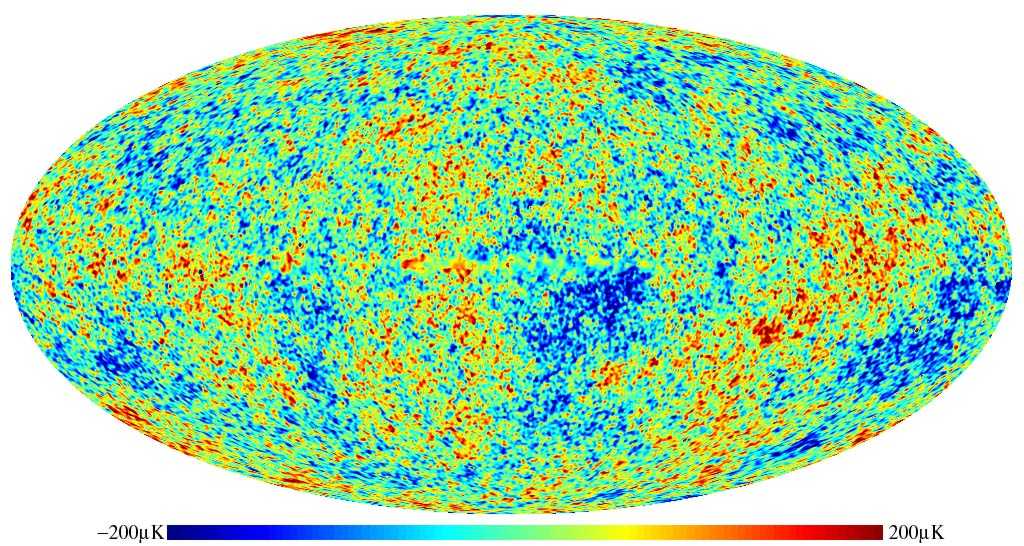
The Cosmic Background Radiation
What is a galaxy?
Like a solar system, but made of dust
A cluster of thousands of stars all floating together in space
A cellphone made by the Nokia company
A grouping of hundreds of millions of stars held together by gravity


Which color of visible light has the shortest wavelength?
green
yellow
violet
red
As the sun ages it will be composed of
more oxygen and less carbon
less oxygen and more carbon
more hydrogen and less helium
more helium and less hydrogen

The timeline below represents time from the present to 20 billion years ago. Letters A, B, C, and D represent specific times.
Which letter on the timeline best represents the time when scientists estimate that the Big Bang occurred?
A
B
C
D

Compared to the spectral lines observed in the laboratory, the spectral lines observed in the light from the distant star have shifted toward the
red end of the spectrum, which indicates that the star is moving away from Earth
red end of the spectrum, which indicates that the star is moving toward Earth
blue end of the spectrum which indicates that the star is moving away from Earth
blue end of the spectrum which indicates that the star is moving toward Earth
Compared to the sun a white dwarf star is
hotter and larger
hotter and smaller
cooler and smaller
cooler and larger
The dependent varaible of an H-R diagram relates to the
the size of the star
the brightness of the star compared to our sun
the color of the star
the temperature of the star
Which star has a surface temperature most similar to the surface temperature of Alpha Centauri B?
Altair
Betelgeuse
Procyon B
Pollux
The Sun is inferred to spend the greatest amount of time in its life cycle
contracting from a gas cloud (nebula)
changing from a giant star to a white dwarf star
moving away from the main sequence and becoming a giant star
as a main sequence star
Which sequence of stars is listed in order of increasing luminosity?
Barnards Star, Alpha Centauri A, Rigel, Spica
Spica, Rigel, Deneb, Betelgeuse
Procyon B, Sun, Sirius, Betelgeuse
Wolf 359, Deneb, Canopus, Antares
Energy is produced in the cores of main sequence stars when
cosmic background radiation is absorbed
lighter elements undergo fusion into heavier elements
heavier elements undergo fusion into lighter elements
cosmic background radiation is released
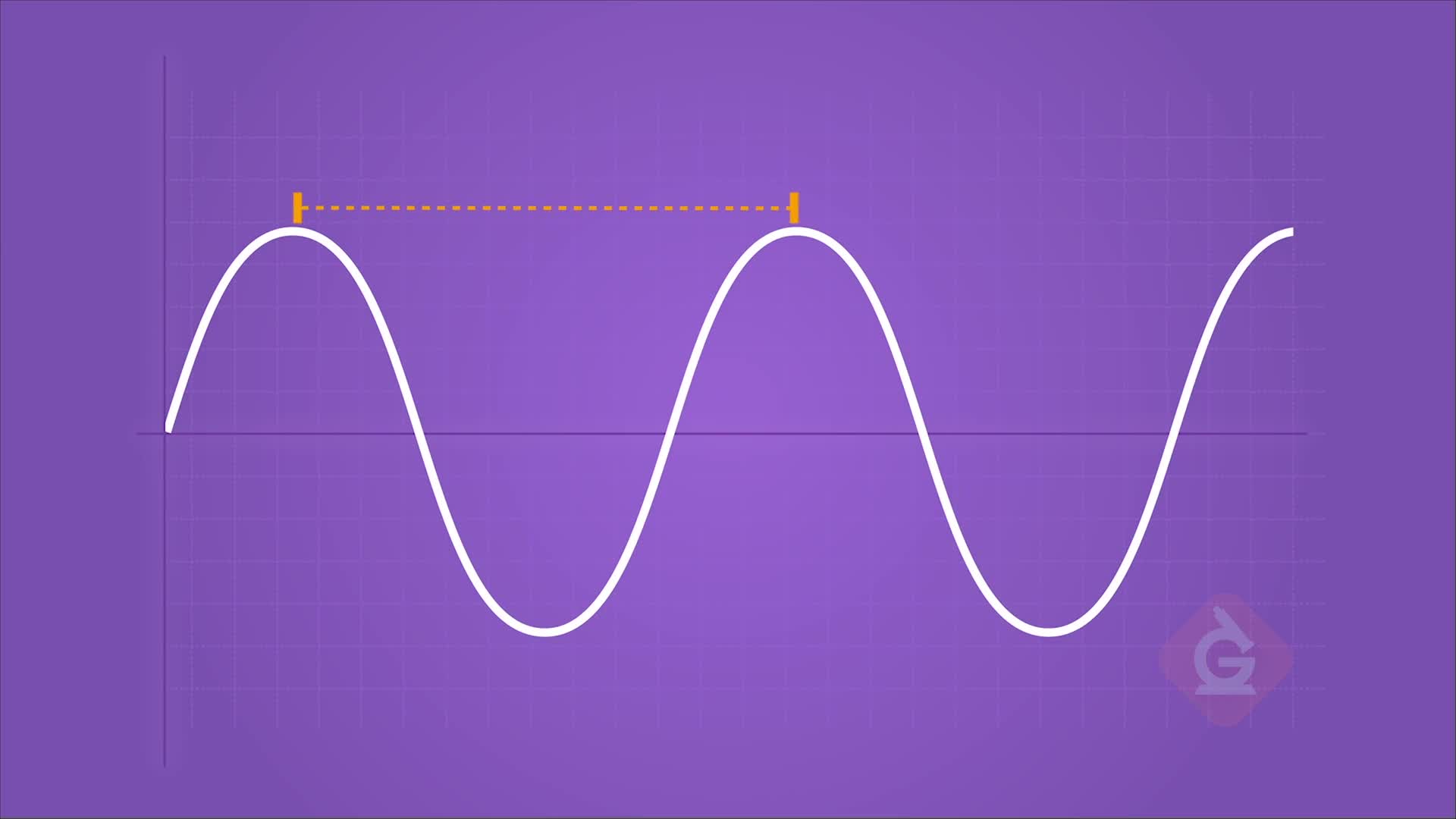
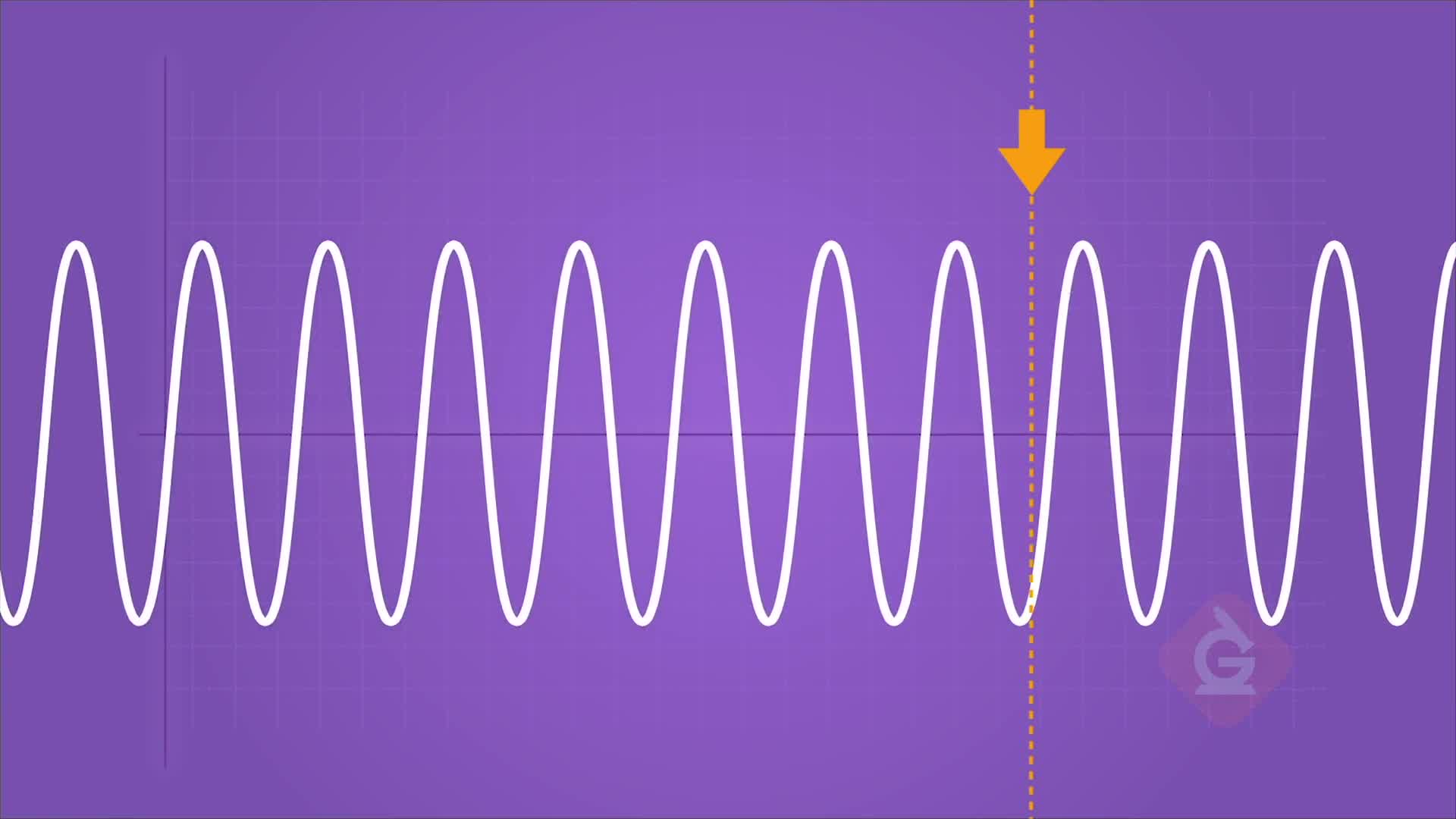

Which color has the highest frequency?
Blue
Green
Yellow
Red

What is the Doppler Effect?
A change in frequency due to the relative motion of a wave source and an observer
When a wave overlaps with another wave
When a wave bounces off of another object
When a wave bends due to traveling through a different medium


What element can be found on a star that is emitting this spectrum (type your answer with all lower case letters)
(a)
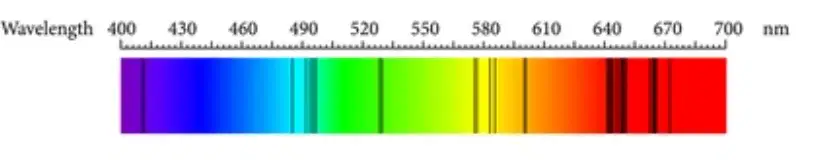
What element can be found on a star that is emitting this spectrum (type your answer with all lower case letters)
(a)
O stars are ____ in color.
Red-Yellow
Green-Yellow
Blue-White
Brown
What is the Spectral Type of the Sun?
A
M
Binary
G
If a yellow spectral line in a star is Doppler shifted toward the orange part of the spectrum. The source is ____
Moving towards you.
Moving northward relative to you.
Moving away from you.
Moving only in the plane of the sky.

How many protons are in Gold
79
197
118
276

How many electrons are in Potassium
19
39
20
58

How many neutrons are in Tungsten
110
74
183
258

What is the label A?
protons
neutrons
electrons
nucleus
A subatomic particle that has a negative charge is called --
a proton
a neutron
an electron
the nucleus
Light elements such as hydrogen and helium are formed through the process of __________ nucleosynthesis.
big bang
stellar
fusion
supernova
A reaction in which two or more nuclei combine to form heavier nuclei.
combustion
nuclear fission
nuclear fusion
nuclear synthesis
Elements bigger than Iron are formed through _______.
big bang nucleosynthesis
nuclear fusion
stellar nucleosynthesis
supernova nucleosynthesis
If visible light is recorded to have a wavelength of 6.0 x 10 ², what color would this be
Blue
Green
Yellow
Orange
This type of star forms when a massive star collapses.
Black Hole
Protostar
Neutron Star
Pulsar
An explosion in which some of the outer layers of a very massive star are blown away
Nebula
Main Sequence
Protostar
Supernova
Low mass stars such as our SUN get swollen and expand into __________ after using up the hydrogen in their core.
red giants
supergiants
white dwarfs
protostars

Our sun is currently in what star stage?
Protostar
Nebula
Main Sequence
Red Giant
Which fusion of elements does Iron come from?
carbon fusion
neon fusion
magnesium fusion
silicon fusion
In main sequence star, Hydrogen fuses and converted to Helium. What element is produced from Helium gas at its core?
carbon
iron
neon
silicon
The largest element that any star can create is _______.
Iron
Helium
Hydrogen
Uranium
Main Sequence
Supergiants
Giants
What is the relationship between luminosity and a star's radius?
brighter stars have a bigger radius
dimmer stars have a bigger radius
Shorter wavelengths of electromagnetic radiation have ______ energy than longer wavelengths.
less
more
How do scientists know that stars are moving?
The Doppler Effect
Emission Lines
Radio Waves
The Electromagnetic Spectrum
What unit is frequency reported in?
meters/second
meters
Hertz
seconds/meter
What happens to wavelength as energy is increased?
Nothing
Decreases
Increases


What causes a protostar to collapse?
Solar Radiation
Gravity
Nova explosins
Conservation of momentum
What is the classification of stars on the HR Diagram
ABCDEFG
OBAFGKM
MKGFABO

For main sequence stars, the _________ the luminosity, the ___________ the temperature.
greater, lower
greater, higher
lower, higher
What is the spectral class our Sun is in?
O
M
G
F
A
What stage is at the beginning of each star?
average star
stellar nebula
planetary nebula
supernova
Most stars fall into which group on the HR diagram?

