
 Worksheets
POE Unit 1 Review 24-25
Total questions: 28
Worksheet time: 19mins
Which is a first class lever?


Which is a third class lever?


The fixed point around which a lever rotates.
Pivot
Fulcrum
Base
Floor
A circular toothed object used to transfer rotary motion and torque through interlocking teeth.
Pulley
Lever
Gear
Sensor
Ratio of distance traveled by the applied effort and resistance force within a system.
Ideal Mechanical Advantage
Actual Mechanical Advantage
A gear positioned between the driver and the driven gear used to change rotational direction.
Idler Gear
Transfer Gear
Pulley
Sprocket
What is the definition of torque?
A force that produces or tends to produce rotation or torsion.
A type of lever that is a wheel with a groove in its rim, which is used to change the direction or multiply a force exerted by a rope or cable.
Impeding effect exerted by one material object on another.
An inclined plane wrapped around a cylinder, forming the path and pitch.
What is the definition of wheel and axle?
Two different sized circular objects that are attached together and turn as one.
A type of lever that is a wheel with a groove in its rim, which is used to change the direction or multiply a force exerted by a rope or cable.
Impeding effect exerted by one material object on another.
An inclined plane wrapped around a cylinder, forming the path and pitch.
This step is usually the hardest. This is where one solution must be chosen using the needs, constraints and research from previous steps.
Plan
Test and Evaluate
Improve
Imagine
This step includes talking to experts and seeing what solutions already exist.
Imagine
Research
Test and Evaluate
Improve
In this step you will decide is your solution works or doesn't work, and what could be improved.
Plan
Test and Evaluate
Research
Imagine
This step makes your idea real by building a prototype.
Ask
Imagine
Test and Evaluate
Create
Choose which of the following is the step featured in the example:
After creating his RC prototype, Keegan begins racing his design in order to see its flaws.
Research
Imagine
Create
Test and Evlaute
A prototype is a model that
functions like the final solution would
is made of the same materials as the final product
is made after the final product is made
can only be made once
When finding the solution to an engineering problem, there is/are usually
only one possible correct solution
a very limited number of possible correct solutions
many possible correct solutions
a right and wrong answer
Which word best describes a criteria?
requirements
limitations
opportunity
issues
In order to develop ideas for a basketball shoe, a design team visits three different shoe stores. What part of the design process is this?
testing and evaluation
research and generate ideas
select an approach

A drawing of a machine part is shown below. Which of the following drawings shows the top view of the part?


Stating the goals and objectives of the problem is an example of what step?
Identifying the problem
Selecting an approach
Brainstorming ideas
Generating ideas

What does "iterative" mean?
The process happens only once
The process is difficult
The process repeats itself
The process is slow

Which step of the design process would you brainstorm ideas on possible solutions or products?
Evaluate Solutions
Generate Concepts
Present Solution
Define the Problem
What is the mechanical advantage of a lever with an effort (input) arm of 5 meters and a load (output) arm of 1 meter? MA=Fo/Fi
1
5
0.2
10

What is the mechanical advantage of an inclined plane with a length of 10 meters and a height of 2 meters?
2
5
10
20
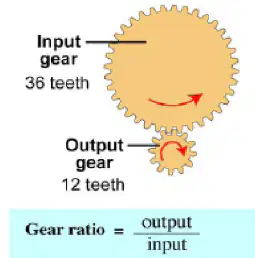
View the picture: The Input Gear turns 10 times, how many times does the Output Gear turn?
0.3
3
15
30
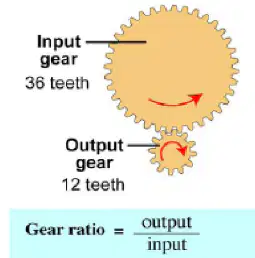
If an Input gear with 36 teeth drives an Output gear with 12 teeth, what is the gear ratio?
3:1
1:1.5
1:3
36:12
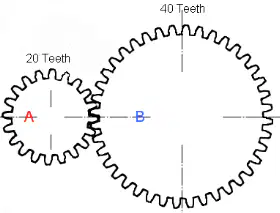
Input Gear A turns 5 times. How many turns does Output Gear B turn?
2.5
5
10
20

