
 Worksheets
Skeletal Anatomy 9.26
Total questions: 35
Worksheet time: 9hrs 45mins

The highlighted bones are the:
Humerus
Radius
Ulna
Scapula

The highlighted bones are known as:
Humerus
Radius
Ulna
Fibula

The bone (in green) is the:
Clavicle
Humerus
Spatula
Scapula

The bone (in red) is known as the:
Clavicle
Collarbone
Scapula
Sternum

What is the name of the highlighted bone?
Humerus
Radius
Scapula
Ulna

The highlighted bones are called:
Tarsals
Metatarsals
Phalanges
Feets

What bones is highlighted?
Femur
Humerous
Skull
Shin


Which of the following bones is part of the human skeletal system?
Femur
Tibia
Humerus
All of the above.
Which of the following is a function of the skeletal system?
Digestion
Support the body
Circulation
Respiration
How many bones does the average adult human body contain?
206
300
150
250
Which of the following is NOT a part of the axial skeleton?
Skull
Vertebral column
Humerus
Rib Cage
How many cranial bones are there in the human body?
8
10
12
14
What is the primary function of the appendicular skeleton?
Protection of internal organs
Formation of blood cells
Allowing for locomotion
Storing minerals.
Which of the following bones is part of the arm in the appendicular skeleton?
Femur
Ulna
Tibia
Fibula
Which of the following is an example of a flat bone?
Humerus
Sternum
Scaphoid
Patella
What type of bone is the patella?
Long bone
Short bone
Sesamoid bone
Irregular bone
Which of the following is an example of a long bone?
Scapula
Tibia
Sternum
Patella
What characteristic defines a long bone?
It is wider than it is long
It has a shaft and two ends, and is longer than it is wide
It is flat and thin
It is irregularly shaped.
Which of the following is an example of an irregular bone?
Femur
Tibia
Vertebrae
Radius
What characteristic defines irregular bones?
They are long and cylindrical.
They are flat and thin.
They vary in shape and structure and do not fit into any other category.
They are round and smooth.
What is a sesamoid bone?
A large bone found in the skull
A small bone embedded within a muscle or tendon near joint surfaces
A bone found only in the spine
A type of bone found in the ear.
What is a joint?
A place where two muscles meet
A place where two bones meet
A place where two nerves meet
A place where two ligaments meet.
How can joints be classified?
Structurally or chemically
Histologically or functionally
Biologically or chemically
Functionally or structurally
Which type of joint is characterized by fibrous connective tissue?
Synovial
Cartilaginous
Fibrous
None of the above
Which type of joint is immovable?
Synarthrosis
Amphiarthrosis
Diarthrosis
What type of movement is associated with Amphiarthrosis?
Immovable
Semi-movable
Freely movable
Diarthrosis joints are characterized by which type of movement?
Immovable
Semi-movable
Freely movable
What type of synovial joint is the elbow?
Ball and Socket
Hinge
Saddle
Pivot
Which of the following is an example of a ball and socket joint?
Elbow (Humeroulnar)
Knee (Tibiofemoral)
Shoulder (Glenohumeral)
Ankle (Talocrural)
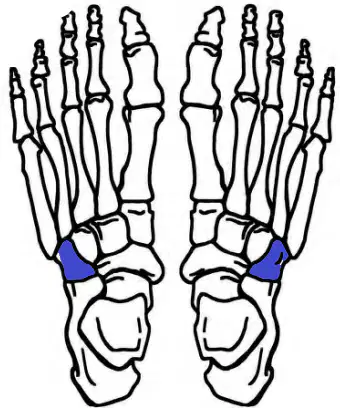
Which bone is highlighted?
Navicular
Calcaneus
Cuboid
Medial Cuneiform

