
Font size
 Worksheets
Q1 Exam Review 8th Grade Part 1_ 2024
Total questions: 63
Worksheet time: 2hrs 6mins
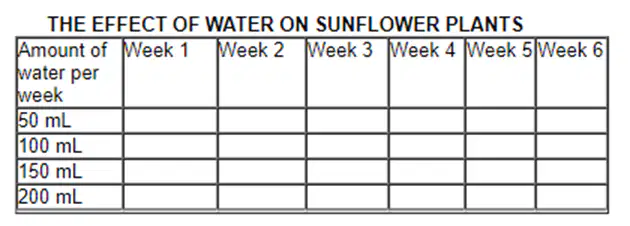
Krista is conducting an investigation to determine how much water is best for her sunflower plants. She uses five plants and gives each a different amount of water for six weeks. Each week, she measures the height of each plant. She records her findings in the chart. What information should be recorded in the chart?
The height of each plant every week
The amount of sun each plant received
The amount of water each plant received
The time it took each plant to reach a certain height
Matthew records the temperature outside for one day. - From 10:00 a.m. to 12:00 p.m., the temperature rises 4°C - From 12:00 p.m. to 2:00 p.m., it rises another 3°C. - From 2:00 p.m. to 4:00 p.m., it drops 2°C. Which of the following predictions about how the temperature will change between 4:00 p.m. and 6:00 p.m. is most reasonable?
The temperature will rise 3°C
The temperature will drop 4°C
The temperature will drop 14°C
The temperature will stay the same

A graph showing the annual expenses for the town of Ashfield is shown. What conclusion can be made from studying this graph?
Too much money is spent on public works.
Public services in Ashfield are not important.
The Fire department gets more funding than the Public Works department.
Half the budget goes to Public Works and the Police departments.
José has collected information about the colors of the cars that he observes driving down his street for one day. He wants to use a visual aid to show the percentages of each color of car that he observed. What would be the best type of visual aid for José to use?
a map
a diagram
a circle graph
a bar graph
Marissa wants to know which of four routes that she could possibly take on her walk to school is the fastest. Which of the following is the best way for Marissa to gather information to answer this question?
She should look on a map to see which route looks shortest.
She should walk each route herself at a normal pace and time how long each takes.
She should take a survey of her friends to find out what they think is the fastest route.
a. She should have four friends each take one route and observe who arrives at school first.
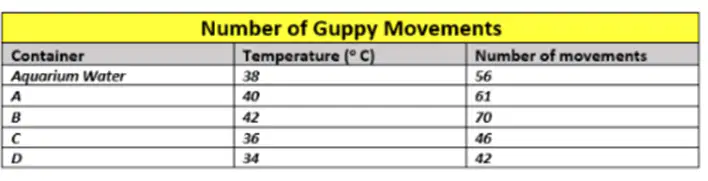
Jaylan noticed that his guppy fish moved differently in different temperatures. Jaylan created this chart. What is the dependent variable?
Temperature of the water
Container of water
Number of movements
The number of trials in the experiment.
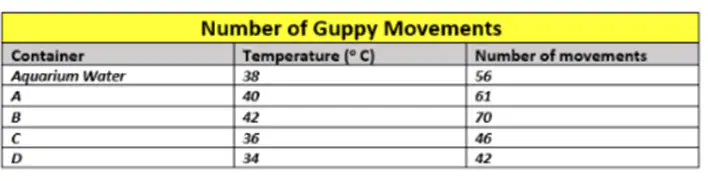
Using the chart, what evidence supports the claim that the higher the temperature of the water, the greater the number of movements by the guppy?
At 34°C the guppy moved 70 times, compared to 42 times at 36°C and 40 times at 61°C.
At 38°C the guppy moved 56 times, compared to 40 times at 61°C and 34 times at 42°C.
At 42°C the guppy moved 34 times, compared to 36 times at 46°C and 70 times at 42°C.
At 34°C the guppy moved 42 times, compared to 56 times at 38°C and 70 times at 42°C.
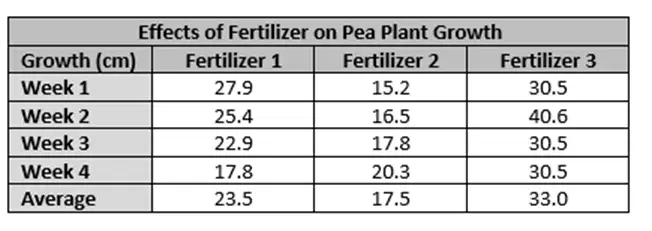
Fertilizer is a chemical added to the soil to help increase plant growth. Jenny conducted an experiment testing three different types of fertilizers on pea plants. She obtained the following results: What is the independent (test) variable in this experiment?
The type of fertilizer
The growth of the pea plants
The number of weeks the experiment lasted
The number of trials in the experiment
Samuel has hypothesized that opposing players should call tails in a coin toss. He believes that the head side of the coin has more material and will drop towards the ground first. Which of the following lab scenarios show the proper setup for an experiment that includes a valid independent and dependent variable?
Samuel will use 5 coins (penny, dime, nickel, quarter, and dollar) as his independent variable, the dependent variable will be how many times each lands with the tail side up.
Samuel will use 5 coins (penny, dime, nickel, quarter, and dollar) as his dependent variable, the independent variable will be how many times each lands with the tail side up.
Samuel will use 5 quarters as his independent variable, the dependent variable will be how many times each lands with the tail side up.
Samuel will use 5 quarters as his dependent variable, the independent variable will be how many times each lands with the tail side up.
Miranda tested five brands of bubble gum to determine with which brand she could blow the biggest bubbles. After testing each brand, she asked three friends to also do the tests to see if they got the same results. Asking her friends to help is an example of which of the following?
Repeated Trials
Prediction
Conclusion
Replication
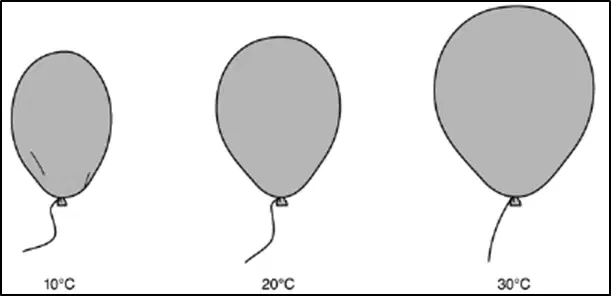
Marcus tests the effects of temperature on a gas by exposing three helium-filled balloons to three different temperatures. His results show that the balloons shrink as they are exposed to progressively colder temperatures. How could Marcus use repeated trials to verify his results?
Do the trial again using a different brand of balloons.
Do the trial several more times using new helium-filled balloons each time.
Do the trial again using one balloon filled with just regular air.
Do the trial again exposing the balloons to three temperatures above 30°C.
Martin has just completed an investigation to test how the amount of liquid water in a container affects how quickly an ice cube melts. Which of the following procedures would be a replication of Martin’s investigation?
Martin repeats the investigation following his previous steps.
Sandra repeats Martin’s investigation following the same steps.
Martin repeats the investigation, but changes some of the conditions.
Sandra repeats the investigation, but changes some of the conditions.
Sasha keeps her pet snake in an aquarium. She has just completed an investigation to test how the strength of the light bulb she uses in the aquarium affects how much the snake eats. Which of the following procedures would be a repetition of Sasha’s investigation?
Sasha repeats the investigation using stronger light bulbs.
Marcus repeats the investigation using an additional snake in the cage.
Sasha repeats the investigation following the same steps as her initial investigation.
Marcus repeats the investigation following the same steps as Sasha’s initial investigation.
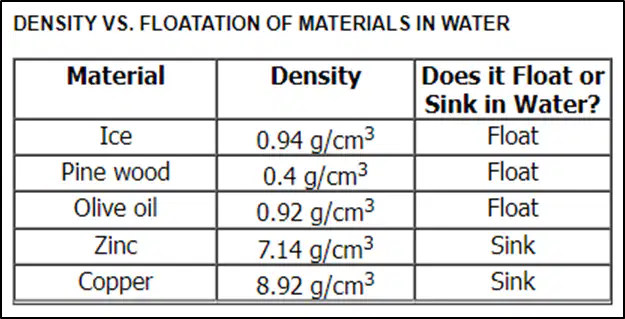
Matthew knows that the density of water is 1 g/cm3. He plans to conduct an experiment to determine if the density of a material plays a role in whether or not the material floats or sinks in water. He calculates and records the densities of several materials. Next, he places each material in water, observes whether the material sinks or floats, and record his observations. Matthew organizes all of the data he collects in the table shown. Which hypothesis do the results of Matthew’s experiment support?
The ability of an object to float or sink in water is unrelated to density.
Materials less dense than water sink in water, while those that are denser than water float.
Materials less dense than water float in water, while those that are denser than water sink.
Solid objects will sink in water while liquid objects will float.
Samuel conducts an experiment. He makes many observations and measurements and records each very carefully. At the conclusion of the experiment he discovers that the data he collected did not support his hypothesis. What should he do?
Report his observations and conclusions honestly, clearly stating that the data did not support the hypothesis.
Change his hypothesis to one that is supported by the data.
Change the data so that they support his hypothesis.
Throw all of his data and observations away and repeat the experiment.
Which of the following best describes the meaning of the phrase “results support the hypothesis”?
It means that the conclusion from the investigation matches the scientist’s observations.
It means that the conclusion from the investigation matches the hypothesis, but more testing is needed.
It means the results prove the scientist’s hypothesis to be correct and no further investigation is needed.
It means that the hypothesis is correct and will become a theory once another scientist tests it.
Lateesha conducted an experiment to determine if her bicycle’s frame would rust faster in saltwater than in rainwater. The results of her experiment showed that the bike’s frame rusted in 3 days in saltwater but rust did not appear on the bike’s frame for 10 days in rainwater. Based on these observations, she concluded that saltwater causes metal to rust faster than rainwater. What is the proper statement for Lateesha to include in her conclusion?
The observation supports the hypothesis because the bicycle did not rust faster in rainwater.
The observation failed to support the hypothesis because the rainwater made the metal rust faster than saltwater.
The hypothesis was correct because the bicycle rusted in saltwater.
The hypothesis was wrong because the experiment did not work.
Which best explains why hypotheses are valuable to scientists?
A hypothesis that is supported or unsupported requires no further investigation.
A hypothesis requires no further investigation if supported by an experiment.
A hypothesis can be used to explain a conclusion even if it is not supported by an experiment.
A hypothesis usually leads to further investigation regardless of whether it is supported by data or not.
Which of these is the best course of action for a scientist whose hypothesis is not supported by his or her experiment after a number of trials?
adjust one or more variables and repeat the experiment
continue to repeat the experiment
use the unsupported hypothesis to develop a new hypothesis
conclude that nothing valuable came from the hypothesis
When would it be appropriate to use a model instead of a controlled experiment?
if the study involves observation of behavior in a natural environment
if the study must determine how a single testable variable causes change
if the researcher wants to measure a change in a real environment over time
if the object of study is too large or small for direct experimentation
There are many different types of scientific investigations. In one type of investigation, all variables are kept the same except for one. What is this type of scientific investigation called?
a model
field study
controlled experiment
systematic observation
Albert Einstein’s general theory of relativity states that space can be curved by large masses, such as the sun. Einstein suggested that if a beam of light from a distant star passed near the sun, the light’s path would be bent as it passed through the curved space. A later experiment showed that Einstein was correct. What science skill was Einstein using when he described a beam of light from a distant star would be affected by curved space?
a guess
a prediction
an observation
a conclusion
Scientists use logical reasoning to help them make sense of evidence. Canadian geese are more aggressive towards humans during spring than at other times of the year. Which of the following conclusions demonstrate logical reasoning about the aggression of the geese?
a. The geese are cranky after a long, cold winter.
b. The geese are being protective of their nests and eggs.
c. The geese are hungry and view humans as potential food sources.
d. The geese are fearful, since spring is hunting season.
Darwin’s theory of evolution has been modified by discoveries in genetics that help explain how traits can change through mutation. What does this example show about the nature of scientific theories?
a. Scientific theories are modified as new evidence comes to light.
b. Scientific theories are static and permanent because they have been proven true.
c. Scientific theories are established and scientists do not need to verify them further.
d. Scientific theories are either right or wrong and if they are wrong, they are replaced.
Scientific theories are often refined, but they are rarely replaced. Which answer best describes why this is true?
a. Scientific theories are explanations of natural phenomena, based on observation and experimentation.
b. Theories are widely accepted by the scientific community, and it is too difficult to get so many scientists to switch their support from an existing theory to a new one.
c. Scientific theories cannot be disproved.
d. Theories are well supported by evidence generated through extensive testing.
Why is it important that scientists modify scientific theories when important new information is discovered?
to make sure the general public does not understand the theory
to keep the theory interesting and fresh
to keep the theory as accurate and effective as possible
to confuse other scientists
Chantal is giving a presentation on the Big Bang Theory and the beginning of the universe. With which sentence will she most likely end her presentation?
Scientists are still working to investigate and modify the Big Bang Theory.
No one disagrees with any part of the Big Bang Theory.
The Big Bang Theory has been completely discredited and discarded.
Now we know how the universe began and we can move on to other questions.
What causes scientific theories to change?
a single experiment
theories never change
the death of the scientist or scientists who wrote the theory
new evidence from multiple sources
Lillian decides to carry out a controlled experiment while on vacation. Which of the following projects fits the definition of a controlled experiment?
Finding the number of unique organisms that inhabit a square meter of the beach, using a randomly selected square.
Measuring the frequency of the tide at the same location for one week, using a stopwatch with precision of a hundredth of a second.
Comparing sunscreens by applying three different brands to the same size area of skin on the arm, leaving one area bare. The arm is exposed to the Sun for the same amount of time and the areas compared.
Determining the average number of starfish that wash onto the beach each day, tagging each starfish to avoid double-counting.
Scientists use different types of investigations to develop scientific explanations. In which scenario did a scientist conduct an experiment with a control?
A scientist determined the relative age of a fossil based on its position in a rock layer.
A scientist concluded that a new fertilizer doubled the growth of corn plants in a study.
A scientist identified and classified a new species of fish in the Amazon River in South America.
A scientist discovered a new galaxy in space after analyzing images from the Hubble Space telescope.
Which of the following represents quantitative and qualitative data correctly?
Red flowers are a qualitative observation. Six flowers is a quantitative observation.
Smelly flowers are a quantitative observation. Red flowers are a quantitative observation.
Red flowers are a quantitative observation. Six flowers is a qualitative observation.
Five flowers are a qualitative observation. Two red flowers are a qualitative observation.
What is the definition of a scientific law?
An explanation based on observations.
A description of cause and effect, usually with math.
Something the police should enforce.
Anything approved by the National Academy of Science.

Kenny planned an investigation that would test the effects of exercise on heart rate. He asked five classmates to run around the school track. He measured their heart rates before and after they ran. The results of his experiment are shown in the table. Which conclusion is BEST supported by the data in the chart?
The amount of sweat each student produced increased based on how far they ran around the track.
The heart rate of a person exercising changed based on what foods they ate.
The age of a student determines how much their heart rate increases with exercise.
Exercise causes heart rate to increase but not the exact same amount for every person.

Students place soil from the playground in a stream table. They sprinkle water on the upper end and observe the result. The students repeat the same process using soil from other places around the school campus. Which question are the students trying to test?
Does the stream table's slope affect erosion?
Does soil type affect soil erosion?
Does the stream table length affect soil erosion?
Does the volume of water affect soil erosion?
James is investigating the germination of been seeds. He plants 30 bean seeds each in three identical square containers and plans to give the same amount of sunlight and water to each container in a different room, with each room at a different temperature. Which of these hypotheses is the MOST appropriate for this research project?
If the size of the container is smaller, then the number of seeds that germinate will increase.
If the temperature of the room is lower, then the number of seeds that germinates will decrease.
If the amount of water given to the seeds is higher, then the number of seeds that germinate is higher.
If the number of seeds planted in the container increased, then the the number of seeds that germinate will increase.
Students in Ms. Smith's class are testing the effects of light on the growth of mold of bread. They have 6 slices of bread they plan to leave on a classroom table and monitor for two weeks. They place 3 of the slices in brown paper bags that light cannot pass through. Which type of bag would they use for the other 3 pieces of bread, considering that they want to test the effects of light on the growth of mold?
a white paper bag
a black paper bag
a bag made of clear plastic
a bag made of aluminum foil
Two students are rolling marbles down a ramp and measuring how long they take to teach the bottom. They each have a bag containing marbles made of different materials that are also different sizes and colors. What can the students do to be sure their results can be replicated?
Make sure that they both use the same color marbles.
Make sure that they test the marbles at different times.
Be sure to sue marbles of the same size and material each time.
Be sure they guess how long the marbles will take to go down the ramp.
Lucas theorizes that changing the slope of a ramp will affect how far a toy car travels down the ramp. To test this theory, Lucas builds two ramps with different slopes. Lucas sends a toy car down each ramp one time. After measuring the distance watch toy car traveled, Lucas concludes that the sleeper slope caused the toy car to travel further. What would be the benefit of Lucas conducting multiple trials on each ramp?
Lucas would replicate the study.
Lucas would improve the validity of the results
Lucas would prove the hypothesis was correct.
Lucas would increase the accuracy of his measurements.
A scientist has just finished an experiment that produced new evidence showing how DNA works. She wants to ensure that the evidence is accepted by other scientists. Which action will MOST LIKELY prevent the evidence from being accepted?
Other scientists cannot replicate the results of her experiment in a similar lab.
Other scientists publish a similar experiment that supports the results of her experiment.
The scientist repeats her experiment ten more times and gets similar results.
The scientist compares her experiment to another experiment showing how hers is different.

Curtis conducts an investigation to determine which brand of paper towels is most absorbent. He records his findings in the table. What is the test variable (independent variable) and outcome (dependent variable) in this investigation?
Test variable: brand of paper towels
Outcome: amount of water absorbed
Test variable: the liquid used
Outcome: amount of water absorbed
Test variable: the amount of water absorbed
Outcome: brand of paper towels
Test variable: the time the towels absorbed water
Outcome: brand of paper towels.
Simran is learning how to design an experiment to test a hypothesis. What is the most likely outcome of testing a hypotheses in controlled conditions?
avoiding dangerous conditions during experimentation
limiting the variables that that can affect the experiment
making the experiment easier to conduct
keeping the experimental area sterile
Caleb wants to know how salt affects the boiling point of water. What is the BEST way for Caleb to collect data to answer this question?
Bring 1 liter of water to a boil, then add 1 gram of salt and observe any changes.
Add 1 gram of salt to 1 liter of water and time how long it takes for the water to boil.
Add 1 gram of salt to 1 liter of water and leave a second liter free of salt; time how long it takes for each to boil.
Add 1 gram of salt to 1 liter of water and 10 grams of salt to a second liter; time how long it takes for each to boil.
Scientific investigations involve the collection of empirical evidence. Which of these statements is NOT true about empirical evidence?
Empirical evidence is influenced by personal feelings.
Empirical evidence can be collected by many scientists.
Empirical evidence is measurable.
Empirical evidence includes descriptive observations.
Scientific investigations involve the collection of empirical evidence. Which of these statements is NOT true about empirical evidence?
Empirical evidence is influenced by personal feelings.
Empirical evidence can be collected by many scientists.
Empirical evidence is measurable.
Empirical evidence includes descriptive observations.
Scientific investigations involve the collection of empirical evidence. Which of the following is NOT as example of empirical evidence that could be gathered to investigate the idea that consuming more calories than you use results in weight gain?
measurement data of people's calorie intake and weight
interviewing people about changes in weight
measuring people's changes in weight
determining the caloric values of foods

Owen is reading a study about a mysterious medical syndrome in adults. He sees the chart below, which shows how test subjects and control group subjects scored for particular symptoms using a scale from 1 to 10, with 10 being the highest experience of a symptom. He knows that control subjects are a group of people that are not experiencing the syndrome. What is the importance of the control subjects?
You can use the scores of control subjects to figure out which symptoms seem to be associated with the disorder and which do not.
You can use the scores of control subjects to figure out that some of the control subjects also have the syndrome.
You can use the score of control subjects to figure out the exact disease that the test subjects are suffering from.
You can use the scores of the control subjects to figure out that the test subjects are exaggerating the symptoms.
The collection of evidence in support of scientific theories is an ongoing process. What effect will contradictory evidence have on a scientific theory?
The scientific theory will be modified to account for the new evidence.
The scientific theory will be discarded in light of the new evidence , and a new theory will take its place.
The scientific theory will not change, since the evidence was collected after the theory had been formulated.
The scientific theory will be discarded, with no replacement, and the line of investigation abandoned altogether.
Sir Isaac Newton developed the theory of universal gravitation. Albert Einstein studied Newton's theory and later developed his theory of general relativity, which is considered more accurate. Which statement BEST describes the relationship between Newton's and Einstein's theories?
Both theories are incorrect.
Newton is responsible for Einstein's theory.
Einstein's theory built upon Newton's theory.
Newton was not as good a scientist as Einstein.

Students place soil from the playground on a stream table. They sprinkle water on the upper end and observe the results. The students repeat the same process using different soil from other places around the school campus.
Which questions are the students trying to test?
Does the stream table slope affect soil erosion?
Does the soil type affect soil erosion?
Does stream table length affect soil erosion?
Does volume of water affect soil erosion?
A student examines the effect of the number of D batteries in an electrical circuit on the brightness of a light bulb. In the experiment, circuits were built with 1, 2, 3, and 4 batteries. For each test, the brightness of the light bulb was measured using a light meter.
Which factor should the student keep constant?
the type of batteries
the number of D batteries
the brightness of the light bulb
the data collected from the light meter
A student examines the effect of the number of D batteries in an electrical circuit on the brightness of a light bulb. In the experiment, circuits were built with 1, 2, 3, and 4 batteries. For each test, the brightness of the light bulb was measured using a light meter.
Which factor should the student keep constant?
the type of batteries
the number of D batteries
the brightness of the light bulb
the data collected from the light meter
How do replication and repeated trials compare?
During both processes, the original investigator does the experiment again.
During both process, a different investigator does the experiment again.
During replication, a different investigator does the experiment again. During repeated trials, the original investigator does the experiment again.
During replication, the original investigator does the experiment again. During repeated trials, a different investigator does the experiment again.
How do replication and repeated trials compare?
During both processes, the original investigator does the experiment again.
During both process, a different investigator does the experiment again.
During replication, a different investigator does the experiment again. During repeated trials, the original investigator does the experiment again.
During replication, the original investigator does the experiment again. During repeated trials, a different investigator does the experiment again.
Scientists study changes in beaches, marshes, and other coastal areas. The movement of water causes coastal areas to change.
Which of these is NOT a source of evidence for studying coastal areas.
data of waves and tides
information on the size and shape of beaches
maps of hurricane paths in the past 10 years
surveys that ask peoples their opinions of beaches
Cicadas are insects that spend most of their lives developing underground, then emerge after a period of time. As part of their life cycle, cicadas molt and leave behind a shell, or exoskeleton, on tree trunks and shrubs.
How could a student use empirical evidence to determine the population of cicadas in the area?
The student could watch a video of insects in the wild.
The student could take a poll to find how many people have heard about cicadas.
The student could count the number of cicada shells left behind over a period of time.
The student could predict how many cicada shells would be collected in a particular forest area.
Which of the following is an example of pseudoscience?
Studying how the Moon creates tides.
Studying how acid rain forms.
Studying whether your birth month affects your personality.
Studying whether beak size determines the diet of certain birds.
A student keeps a science journal and records the conditions of her classroom. Every day when she enters the room, she writes down an observation under one of four observation categories.
Which of the following four observation categories are based on empirical evidence in the forms of quantitative data?
the number of students present
whether the room feels warm or cold to her
the color of the teacher's tie
whether she thinks the room is neat or messy
Some models are better suited to represent a certain system than others. Which is NOT a factor in evaluating the usefulness of a model?
simple and easy to understand
fits the data and explains the phenomenon
allows researchers to make accurate predictions
the number of researchers using the same model
John Dalton's atomic theory stated that all atoms of a given element are identical in mass and properties. More than one hundred years later, scientists learned that atoms of the same element could have different masses.
What does this illustrate about scientific theories?
Scientific theories are modified over time as new evidence is discovered.
Scientific theories are only guesses, which are by definition inaccurate.
Scientific theories are only guesses, which are by definition inaccurate.
Theories that have been revised are completely correct and will not be changed in the future.
The school board for a city in Florida wants to take steps to make school lunches healthier and more appetizing to students. What is the BEST way for scientists to help the school board make decisions about this issue?
Scientists could research which foods are available in recyclable containers.
Scientists could research which foods are least expensive and easy to prepare.
Scientists could research which foods are nutritious and popular among students.
Scientists could research which foods are most popular among parents of students.
Physical properties can be uses to describe objects. Changing which of the following properties would also affect the gravitational force?
color
hardness
mass
volume
Which of the following statements is true regarding mass and weight?
Mass is dependent upon force while weight is dependent on the amount of matter in an object.
Mass and weight will always be equal.
Mass is is dependent on the amount of matter in an object while weight is dependent upon force.
Mass and weight both change as gravity changes.
On Mars an object weighs approximately 40% what it weighs on Earth, how is the mass of an object different on Mars than it is on Earth?
The object's mass is the same as it is on earth.
The object's mass is greater than it is on earth.
The object's mass is less than it is on earth.
The object's mass changes proportionally with its weight.

