
NEW
Font size
 Worksheets
QUIZ 5.1 GAS
Total questions: 25
Worksheet time: 33mins


Charles' law
According to Charles' law, what happens to the volume of a gas when the temperature increases at constant pressure?
The volume decreases.
The volume remains constant.
The volume increases.
The volume fluctuates.
What is the primary assumption of the ideal gas law regarding gas particles?
Gas particles have significant volume.
Gas particles attract each other.
Gas particles are in constant random motion.
Gas particles do not collide with each other.
What happens to the pressure of a gas when its volume decreases at constant temperature?
The pressure decreases.
The pressure remains constant.
The pressure increases.
The pressure fluctuates.
Which of the following statements is TRUE regarding the behavior of real gases compared to ideal gases at high pressure and low temperature?
Real gases behave more like ideal gases.
Real gases deviate from ideal behavior.
Real gases have no intermolecular forces.
Real gases occupy no volume.
According to Avogadro's law, what is the relationship between the volume of a gas and the number of moles at constant temperature and pressure?
The volume is directly proportional to the number of moles.
The volume is inversely proportional to the number of moles.
The volume is independent of the number of moles.
The volume is equal to the number of moles.
Gas pressure is caused by
Gas molecules heating up
Gas molecules reacting with other gas molecules
Gas molecules hitting the walls of a container
Gas molecules hitting other gas molecules
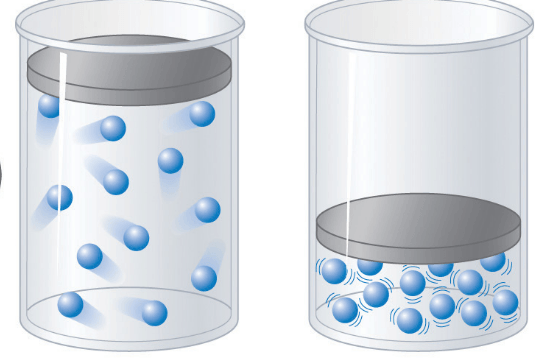
Which container will have a lower pressure exerted by gas particles?
left container
right container
they both have the same pressure
I don't know

Choose the correct statement
this is a graph representing Boyle's law
this is a graph representing Charles' law
A relationship between volume of gas with the number of mole of gas at constant Temperature and Pressure describes the gas law of
Boyle's
Charles'
Avogadro's
In CHARLES' LAW, at constant pressure, what happens to temperature of a gas when the volume doubles?
The temperature also doubles.
The temperature decreases to half of its original volume.
The temperature doesn't change.
The temperature quadruples.
Charles' Law
What does R stand for
Ideal gas constant
Real gas constant
Temperature constant
Ideal gas law
Choose the INCORRECT statement.
Boyle 's Law states that the volume of the gas is directly proportional to its pressure
Kinetic theory of gases postulates that the volume of the gas particle is too small hence it can be ignored.
Larger value of a, in the van der Waals equation for a real gas, indicates a stronger attractive force between gas molecules.
A sample of CO2 gas occupied 3.0 L at 35°C and 1 atm. What is the new volume if the temperature and pressure are changed to 48°C and 1.5 atm respectively. (Hint: Combined Boyle's and Charles' laws)
1.9 L
2.1 L
3.4 L
4.3 L
A gas behaves ideally at
low temperature and pressure
low temperature and high pressure
high temperature and low pressure
standard temperature and pressure
If 1.50 moles of nitrogen gas are contained in a 5.0 L vessel at 300 K, what is the pressure of the nitrogen gas?
14.10 atm
7.39 atm
0.00739 atm
73.90 atm
Which of the following statements about the Kinetic Molecular Theory of Gases is/are TRUE?
I. Volume of gas molecules is not negligible
II. Intermolecular forces between the gas molecules are negligible
III. The total kinetic energy of the gas molecules remain unchanged as the collide and bounce off one another
I only
I and II
II and III
I, II and III
What is the equation for Avogadro’s law?
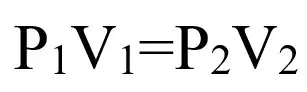
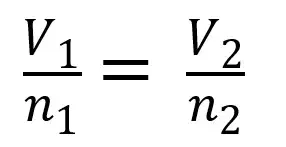
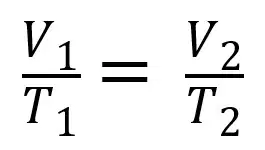
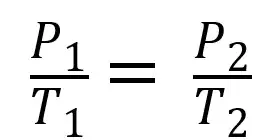

Which of the following laws describes the graph below?
Charles’ law
Boyle’s law
Avogadro’s law
Ideal Gas law
According to Boyle's Law, what happens to the pressure of a gas when its volume is halved at constant temperature?
The pressure decreases.
The pressure remains constant.
The pressure doubles.
The pressure quadruples.
In a mixture of ideal gases of volume, V and temperature, T, what is the pressure exerted by each individual gas if it occupies the total volume, V alone at temperature, T called?
Total pressure.
Partial pressure.
Divided pressure.
Individual pressure.

