
 Worksheets
quiz
Total questions: 150
Worksheet time: 2hrs 37mins
What are economics systems?
What is a command economy?
Economics is the study of how ______________, _________________, and ___________________ use their scarce or limited resources.
People
government
nations
businesses
What are the 4 factors of production?
Natural resources
capital
Air
labor
entrepreneurs
What is the difference between wants and needs?
(a)
What is specialization?
resources to produce a single or few kinds of goods/services
amount of goods/services produced by a worker or business in a given time frame
Not enough of a certain resource to satisfy persons wants or needs
Workers
What are the types of economics systems?
Command
Traditional
Market
Mixed
Government
What is a mixed economic system?
both individuals and government make decisions
completed run by the government
Individuals make the decisions
Corporations make the decisions
Russia after World War II was which type of government?
Traditional
Command
Market
Mixed
Tools and machines, a person or a business uses to produce goods and services is called _________?
Capital
Scarcity
Specialization
Opportunity Cost
A _____________________ buys and use goods and services.
Consumer
Seller
Profits
Standard of living
When people make and distribute goods as their ancestors did, what type of economic system is it?
Command
Traditional
Mixed
Market
In a pure market system, who controls production?
Government
Businesses
Individuals
When a central authority has control over the production and consumption decisions in an economy is called ____________?
Allocation Strategies
Government Regulation
Economic Systems
Opportunity Cost
Ability of individuals and businesses in an economy to buy, sell, and hold property as they wish without fear of government interference or seizure.
Private Ownership
Consumer Sovereignty
WHAT IS LABOR?
work people do for pay to produce good and services
actions people do for other people
any physical object
The money people get for inheritance
WHAT ARE THE 4 FACTORS OF PRODUCTION?
Land, Capital, Need & Want
Land, Labor, Capital, Entrepreneurs
Water, Air, Food & Shelter
Land, Capital, Good & Service
_______________ IS KNOWN AS THE NATURAL RESOURCES USED TO PRODUCE GOODS AND SERVICES
Entrepreneurs
Capital
Labor
Land

Which of the factors of production is this?
capital
entrepreneur
land
labor
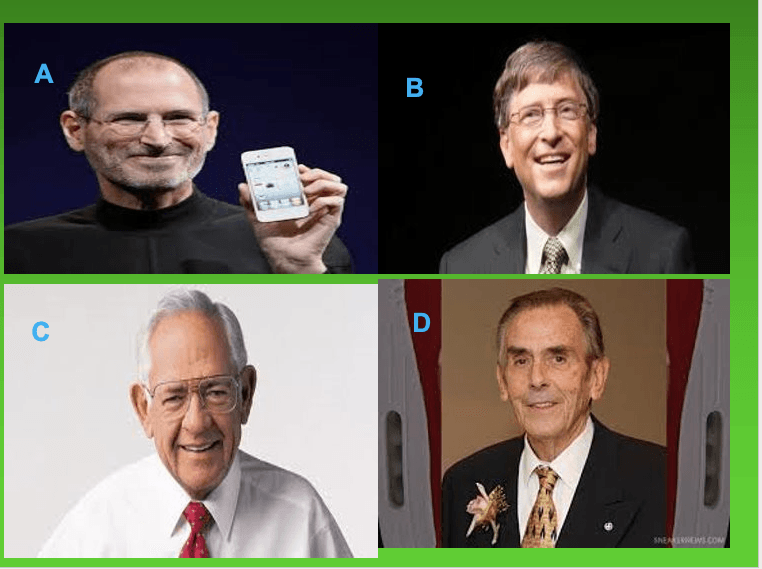
Steve Jobs the founder of Apple is holding up an I-phone. What is another name for someone who starts a business?
capital
entrepreneur
land
labor
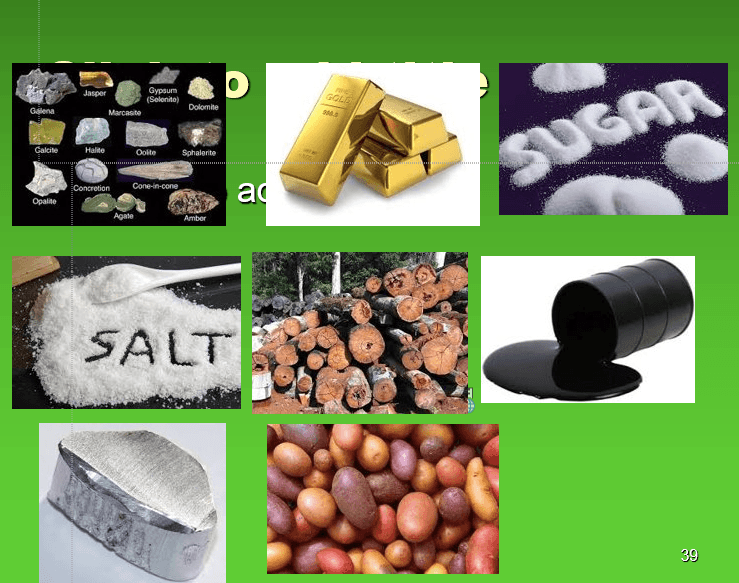
Which factor of production is this?
capital
entrepreneur
land
labor


Machinery
Land
Labor
Physical capital
Human capital
Entrepreneurship

Iron Ore
Land
Labor
Physical capital
Human capital
Entrepreneuership

Businesses provide government with...
taxes
sales
private goods & services
interest

In terms of resources, what do households provide for businesses?
loans
savings
labor
private goods
What are the four main parts of the circular flow diagram?
Product Market, Stock Market, Factor Market, Fish Market
Product Market, House Market, Factor Market, Good Market
Factor Market, Product Market, Households, Businesses
Factor Market, households, Stock Market, super market
Where are factors of production (land, labor, etc) exchanged in the circular flow model?
Resource Market
Product Market
Firms
Individuals
Where do factors of production (land, labor, etc) come from in the circular flow model?
Factor Market
Product Market
Firms
Individuals
Someone buys a car in exchange for a large amount of money. They have completed an exchange in which part of the circuclar flow model?
Product Market
Factor Market
Firms
Individuals
Money exchanged between an individual and a store for a good or service.
Revenue
Wages
Rent
Donation
Public sector is
all businesses and individuals participating in the economic system
all government programs
all local businesses
all corporations
When the demand curve shifts to the left, this suggests demand has
increased
decreased
Quantity demanded has increased
Quantity demanded has decreased
When the demand curve has shifted to the right, this suggests demand has
increased
decreased
quantity demanded has increased
quantity demanded has increased
When price increases, quantity demanded
increases
decreases
supply would decreases, not quantity supplied
supply would increase, not quantity supplied
What determines the prices of goods and services?
Supply
Demand
Supply and demand
Goods
What exists when quantity supplied is greater than quantity demanded?
Surplus
Shortage
Overflow
Mass outrage
A market is said to be in equilibrium when
when demand is higher than the supply
when demand is lower than the supply
when the demand and supply quantities are equal
when the supply is doubled the demand
Kanye West's new shoe the Yeezy Boost sold out in stores. This is an example of...
shortage
surplus
equilibrium
supply
Defined as: the performance of a duty or work for another person
good
service
export
import
Defined as: the act, process or business of buying, selling or exchanging goods and services
embargo
trade
tariff
quota

What does this curve represent?
demand
supply
equilibrium
shortage
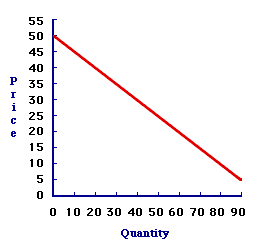
What does this curve represent?
supply
equilibrium
demand
surplus
A place where buyers and sellers of a particular good or service interact
Supply
Demand
Agency
Market
What kind of business is BEST described by these statements?
I am the only owner of my business.
I take all the risks of doing business.
I keep all the profits.
sole proprietorship
corporation
partnership
cooperative
Which of the following industries is an example of a monopoly?
utilities/water
department stores
auto industry
commercial airlines
In a Perfect Competition, products are basically..
differentiated
identical
similar
opposite
The economic problem is that
resources are limited and wants are limited.
resources are unlimited and wants are limited.
resources are limited and wants are unlimited.
resources are unlimited and wants are unlimited.
These are the things we desire to have.
Wants
Goals
Opportunity Costs
When "wants are greater than the resources available to satisfy them," it is called...
Scarcity
Needs
Opportunity Cost
None of these answers

Adam Smith encourages a market economy to limit the role of the government, because when the government interferes in the economy there is a negative impact on
consumers only
producers only
growth
public support for the government
Adam Smith describes the benefits to all through our selfish or self-interested actions. He calls it
Laissez Faire
the invisible hand
market efficiency
self-determination
What kind of monopoly does the granting of patents encourage?
Natural Monopoly
Technological Monopoly
Government Monopoly
Mr. Wonderful's Monopoly
Which piece of legislation outlawed price discrimination?
The Sherman Act
The Federal Trade Commission Act
The Morrisey Act
The Clayton Antitrust Act
How does the government break up and prevent monopolies?
Increased Taxes
Antitrust legislation and regulation
Deregulation
Laissez-faire
Market Economy
System in which economic decisions are made by tradition and customes
System in which economic decisions are made by the government
System in which economic decisions are made by supply and demand
Traditional Economy
economic decisions are made by tradition and customs
economic decisions are made by supply and demand
economic decisions are made by the government
Command Economy
economic decisions are made by the government
economic decisions are made by supply and demand
economic decisions are made by tradition and customs
Examples of Command Economy
China, North Korea, Russia
UK, US, Hong Kong
Brazil, Australia
Examples of Market Economy
US, UK, Hong Kong
China, North Korea, Russia
Syria, Saudi Arabia
Scarcity
a lot of something
not enough of something
to be afraid
economy
the flow of wealth, goods, and services in a country
not enough of something needed
type of government system
Examples of Traditional Economy, more than one correct
Maasia cattle traders in Africa
US and Canada
Mexico and France
Eskimo fur traders in Alaska
Producers and consumers determine how to use resources and make goods based on supply and demand in the market, without government interference.
Market Economy
Traditional Economy
Command Economy
Mixed Economy
People use the resources they have to make only what they need to survive.
Market Economy
Traditional Economy
Command Economy
Mixed Economy
Which economic system is based on customs and beliefs, people will do the same work as their parents, and the exchange of goods is through bartering (no money)?
Traditional
Command
Market
Mixed
Which economic system does the government make all economic decisions and owns most of the property - it is sometimes called communism?
Traditional
Command
Market
Mixed
Which economic system are all resources privately owned and the producers and consumers answer the three economic questions?
Traditional
Command
Market
Mixed
Which type of economic system is it when the market decides what needs to be produced, private businesses decide how to produce, and consumers decide what they are willing to pay for goods?
Traditional
Command
Market
Mixed
A country that has aspects of a market economy plus a command economy is called a
Market Economy
Command Economy
Mixed Economy
Traditional Economy
A tax on imports
tariff
import tax
supply
embargo
any activity which slows or outright blocks the free exchange of goods and services
sanctions
tariff
trade barriers
sovereign
"Free Market" and "Capitalism" are two other names for what economic system?
Command
Market
Traditional
Economic equity is the ________ with which an economy distributes its resources and wealth.
traditions
fairness
unfairness
all of these
Economies try to answer these fundamental economic questions:
What goods and services are to be produced?
How are goods and services to be produced?
For whom are goods and services to be produced?
all of these
In a ___________ economy, decisions about production and consumption are made by the government.
market
mixed
command
free enterprise system
_____________ equity involves the fair and just distribution of society's wealth?
Economic
Educational
Scholastic
Societal
A _________ economy is an economic system in which economic decisions are left up to individual producers and consumers.
Mixed
Command
Traditional
Market
An economic system in which both the government and individuals play important roles in production and consumption is a ____________ economy.
mixed
market
command
traditional
Economic _____________ is the ability to make our own economic decisions without interference from the government.
freedom
constraint
opportunites
dead end
The highest goals of a market economy are economic freedom and ___________.
efficiency
inefficiency
instability
all of these
The United States is an example of which type of economic system?
Command economy
Traditional economy
Free market economy
Mixed economy
In a free market economy, who owns the factors of production?
The government
Individuals and privately owned businesses
Large corporations
Foreign firms
Who owns the factors of production in a command economy?
Individuals and privately owned businesses
Large corporations
The government
Foreign firms
Innovation plays a large role in advancing an economy toward which economic goal?
Economic Security
Economic Equity
Economic Freedom
Economic Growth
One way in which government protects business property is to provide
Federal Reserve Banks.
Local governmental programs.
Patents or copyrights.
Fire insurance policies.
Why does government set and collect taxes?
To increase the use of technology
To help pay the expenses of government
To provide economic security
To help businesses grow and prosper
Which of the following is a public good that is provided by government:
Private schools
Marketing research
New automobiles
Interstate highways
Government tries to protect competition by
Controlling the prices of products.
Restricting the production of certain products.
Regulating monopolies.
Setting the minimum wage

Which economic system does the goals of freedom, growth, efficiency, and sustainability belong to?
Market
Command
Which economic system does the goals of equity, security, full employment, and stability belong to?
Market
Command
Select all that apply. What are the three basic economic questions?
What should be produced?
How should it be produced?
Why should it be produced?
Who gets to consume it?
It is when customs dictate the economy
Mixed economy
Market economy
Command economy
Traditional economy
It is when the government dictate the economy
Traditional economy
Command economy
Market economy
Mixed economy
It is when individuals in the market dictate the economy
Market economy
Command economy
Mixed economy
Traditional economy
One of the advantages of a traditional economy
poverty
innovative
promotes strong social bonds
creates national projects
One advantage of command economy
little technology
planning does not match reality
innovative
create large national projects
Select all that apply. Disadvantages of a command economy
planning does not match reality
innovative
little technology
does not meet people's needs
role of government in mixed economy
regulate the market
own the market
reject the market
A mixed economy combines the best parts of which other economies? This question has two correct answers.
Market and Command
Traditional and Market
Command and Traditional
Socialism and Capitalism
This characteristic of a mixed economy states that the vast majority of labor, resources, and capital goods are owned by individuals rather than by the government.
Private Property
Freedom of enterprise and choice
Motive of Self-Interest
Competition
This characteristic of a mixed economy states that business owners, consumers and workers are free to make choices that best fit their needs and interests.
Private Property
Freedom of enterprise and choice
Motive of Self-Interest
Competition
This characteristic states that the Invisible Hand is the driving force of a Mixed Economy.
Private Property
Freedom of enterprise and choice
Motive of Self-Interest
Competition
This characteristic of a Mixed Economy describes the natural rivalry created when two businesses offer the same, or similar, goods.
Competition
Freedom of Enterprise and Choice
Private Property
Motive of Self-Interest
The inspector from the health department visited your restaurant to ensure that your practices and the food you serve is safe.
Which characteristic of a Mixed Economy does this describe?
Limited Government
Competition
Motive of Self-Interest
Private Property
Archibald always purchased his groceries at Walmart Aldi opened a new store. A natural rivalry has been created and Archibald now has a choice as to where he buys groceries.
Which characteristic of a Mixed economy does this describe?
Private Proerty
Motive of Self-Interest
A system of markets and prices
Competition
Stephanie was happy with her job but one day, she heard about a job that would pay her more, give her more vacation, and better insurance. Because she always wants to improve her situation, Stephanie applied for the job.
Which characteristic of a mixed economy does this describe?
Limited Government
A system of markets and prices
Freedom of enterprse and choice
Competition
Elizabeth owns a large swath of farmland in Nebraska on which she grows corn, wheat, and soybeans. The Federal government approached her to inquire if she would be willing to lease portions of her property to install energy generating wind turbines. Elizabeth negotiated a deal in which the government would would pay her to use the land.
Which characteristic of a mixed economy does this describe?
Private Property
A system of markets and prices
Competition
Freedom of Enterprise and choice
A company owned by a private owner
Capitalism
Socialism
Prices determined by supply and demand
Capitalism
Socialism
Redistribution of income (distributing wealth and income)
Capitalism
Socialism
Communism
Health care left to the free-market (left to privately owned businesses to provide)
Capitalism
Socialism
Communism
Promotes competition
Capitalism
Socialism
Services owned by the government
Capitalism
Socialism
Encourages compliance
Capitalism
Socialism
Citizens pay high taxes
Capitalism
Socialism
Communism
Consumers determine the market
Capitalism
Socialism
Limited goods and services.
Capitalism
Socialism
The State produces goods, products and services.
Capitalism
Socialism
What is Karl Marx best known for writing?
The Communist Manifesto
Lord of the Flies
Proletariat Uprising
Capitalism II: Let's Make More Money
What happens in a true socialist society?
No government
More government
More crime
No equality
In a Capitalist system, which of the following would NOT be included?
Private ownership of businesses and resources
Widespread competition
Government ownership of businesses and resources
Different economic classes
Which of the following would be appealing about Communism for the average person?
Lack of Indivdualism
Limited Access to Resources
Strict Economic Classes
Economic Equality
How is capitalism DIFFERENT from communism?
In capitalism, businesses are owned by people.
In communism, businesses are owned by the government.
In capitalism, prices are high.
In communism, prices are low.
It capitalism, people share.
In communism, there is a big gap between rich and poor.

