
 Worksheets
Pre AP Chem - Unit 3 Test - Part 1
Total questions: 30
Worksheet time: 19mins
Name
Class
Date
1.
How many valence electrons are there in an F atom?
a)
1
b)
2
c)
7
d)
9
2.
What type of bond has formed between two atoms that share electrons equally?
a)
nonpolar covalent
b)
polar covalent
c)
ionic
3.
What type of bond forms between two atoms that are metals?
a)
polar covalent
b)
nonpolar covalent
c)
ionic
d)
metallic
4.
What force holds ions together in an ionic bond?
a)
force of gravity
b)
electrostatic force
c)
forces of repulsion between opposite charges
d)
the strong force
5.
What type of bond forms when electrons are shared between two nonmetals?
a)
covalent
b)
ionic
c)
metallic
6.
What type of covalent bond is formed with both electrons come from the same atom?
a)
polar covalent bond
b)
coordinate covalent bond
c)
nonpolar covalent bond
d)
resonance structures
7.
Which combination of atoms would most likely to produce an ionic compound?
a)
S, Br
b)
Al, F
c)
Si, C
d)
C, H
e)
O, Cl
8.
What type of bond forms when an electron is transferred from a metal to a nonmetal?
a)
nonpolar covalent
b)
polar covalent
c)
ionic
9.
Which of the following compounds are not ionic?
a)
A
b)
B
c)
C
d)
D
e)
E
10.
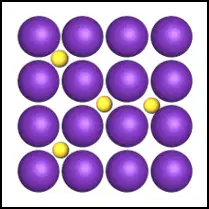
The following picture is a type of alloy. Which one does this best represent?
a)
substitutional alloy
b)
fractional alloy
c)
interstitial alloy
d)
transitional alloy
11.
What determines whether a molecule is polar or nonpolar? (Select all that apply)
a)
Difference in electronegativities
b)
Type of ion it forms
c)
Amount of ionization energy
d)
Symmetry of a molecule
12.
What types of elements typically make anions?
a)
metals
b)
nonmetals
13.
The weaker the intermolecular forces of a substance the ________ the boiling point.
a)
higher
b)
lower
14.

Which is the stronger intermolecular force present in the following compound?
a)
London Dispersion Force
b)
Dipole-Dipole
c)
Hydrogen Bonding
d)
All of them have the same strength
15.
Which intermolecular force requires hydrogen and one of the following: nitrogen, oxygen, fluorine?
a)
London Dispersion Force
b)
Dipole-Dipole
c)
Hydrogen Bonding
16.

Which type of intermolecular force(s) would be present with this substance?
a)
London Dispersion Force
b)
Dipole-Dipole
c)
Hydrogen Bonding
d)
All of would be present
17.

Which type of intermolecular force(s) would be present with this substance?
a)
London Dispersion Force
b)
Dipole-Dipole
c)
Hydrogen Bonding
d)
All of would be present
18.

What shape would this molecule form?
a)
linear
b)
tetrahedral
c)
triagonal planar
d)
triagonal pyramidal
19.

What shape would this molecule form?
a)
linear
b)
tetrahedral
c)
triagonal planar
d)
triagonal pyramidal
20.
Which type of shapes do not have lone pair electrons on the central atom?
a)
linear
b)
tetrahedral
c)
triagonal planar
d)
triagonal pyramidal
e)
bent
21.

Is this molecule polar or nonpolar?
a)
Polar
b)
Nonpolar
22.

Classify the picture as one of the following:
a)
physical property
b)
physical change
c)
chemical property
d)
chemical change
23.

Classify the following type of matter.
a)
element
b)
compound
c)
heterogeneous mixture
d)
homogeneous mixture
24.

How many electrons does this element have? (number only in the answer)
(a)
25.

How many neutrons does this element have? (number only in the answer)
(a)
26.
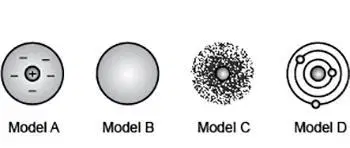
Which diagram best represents Bohr's model?
a)
A
b)
B
c)
C
d)
D
27.

Determine the type of bond that the following elements will form.
H-F (a)
C-H (b)
Si-Cl (c)
Rb-O (d)
F-F (e)
Choose from the below words
polar
nonpolar
ionic
28.

Based on the atomic sizes, determine the type of alloy that will form from the given elements.
Fe-Ni (a)
Cu-C (b)
Au-B (c)
Co-Zn (d)
Choose from the below words
substitutional
interstitial
29.
What will be the charge be of the following items when they form ions?
Li (a)
Se (b)
I (c)
Ga (d)
Choose from the below words
+1
-2
-1
+3
+2
-3
30.

Is this molecule polar or non-polar?
a)
Polar
b)
Non-polar
100 %

