
Font size
 Worksheets
Review Unit 03 Bonding & Nomenclature
Total questions: 50
Worksheet time: 4hrs 10mins
What is the chemical formula for aluminum sulfate?
AlS
AlSO4
Al2(SO4)3
Al3(SO4)2
Ammonia is a very commonly used covalent compound. It's scientific name is nitrogen trihydride. What is the chemical formula for ammonia?
HN4
NH3
H3N
NH4
What is the name for the compound Na3(PO4)?
Sodium phosphorus
Sodium phosphide
Sodium phosphite
Sodium phosphate
What is the formula for sodium fluoride?
NaF
Na2F
NaF2
Na2F2
What is the formula for copper (I) oxide?
Cu2O3
Cu2O
CuO2
CuO
Which of the following is the common name for NH3?
water
ammonia
nitric acid
methane

Which of the following are true regarding this element's electron dot structure?
Select TWO correct answers.
This is a group 13 element.
This is a group 17 element.
This element comes from a group that is stable.
This element has three valence electrons.
This element is in period three on the periodic table.

Which of the following are true regarding this element's electron dot structure?
Select TWO correct answers.
It represents an element that is classified as a noble gas.
It represents an element that is from the halogen group
It represents an element that will readily give an electron away.
It represents an element that will readily accept an electron.
It represents an element that is metallic.
Which of the following pairs correctly matches a compound with its molecular geometry?
Select TWO correct answers.
hydrochloric acid (HCl): trigonal planar
water (H2O): trigonal planar
carbon dioxide (CO2): tetrahedral
methane (CH4): tetrahedral
carbon tetrachloride (CCl4): tetrahedral
What is the shape of a CO2 molecule?
linear
tetrahedral
trigonal planar
bent

Examine the Lewis Dot Structure for potassium iodide.
Why are there 8 dots around the symbol for iodine (I)?
Select TWO correct answers.
Each dot represents a covalent bond, of which there are 8 in potassium iodide.
The valence electrons from potassium combine with those for iodine, adding up to 8.
Each dot represents an ionic bond, of which there are 8 in potassium iodide.
Eight electrons is the maximum to fill the outer shell for this compound.
Each dot represents the number of protons in the nucleus of both atoms.
Which of the following is a correct Lewis Dot diagram for a covalent bond?


Which of the following is a correct Lewis Dot diagram for an ionic bond?


Which of the electron dot structures correctly illustrates diatomic nitrogen with a triple bond?


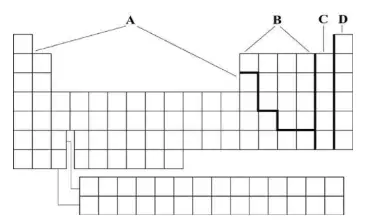
When elements from Group A combine with elements from Group C, these compounds form —
nonconductive metals
liquids
transition metals
ionic salts
In the compound MgCl2, the element Mg can be classified as which of the following?
Select TWO correct answers.
noble gas
metal
group 1 element
nonmetal
group 2 element

The diagram represents the electron dot formula for the bonding of Mg and Cl. Which of the following are true for the bonding type involved in MgCl? Select TWO correct answers.
The two electrons that the Mg atom loses are gained by the chlorine atom.
The one electron that the Mg atom loses is gained by the chlorine atom.
The two elements join together in a covalent bond.
The two elements join together in an ionic bond.
Type of bonding when atoms gain or lose electrons.
ionic
covalent
Atoms are bound together by shared electrons.
ionic
covalent
Bonding between a nonmetal and a nonmetal.
ionic
covalent
Bonding between a metal and a nonmetal.
ionic
covalent
Which statements are true concerning covalent bonds?
Select TWO correct answers.
Covalently bonded compounds usually have low melting and boiling points.
Covalent bonds form between two nonmetals.
Covalent bonds form between metals and nonmetals.
Covalent bonds form through the donation of electrons.
Which of the following elements will have metallic bonds at room temperature?
Select TWO correct answers.
krypton
sodium
bromine
sulfur
potassium
Which of the following properties would a substance that has metallic bonding normally have?
I. thermal conductivity
II. electrical conductivity
III. malleability
IV. ductility
I, II, IV
I, II
II, III, IV
I, II, III, IV
C6H12O6
2 H2 + O2 -> 2 H2O
What is the formula of ammonium chloride?
AmCl
NH4Cl
NaCl
MgCl2
What is the chemical formula of Diiodine heptaselenide
I2Se7
I2Se6
I2Se
ISe2
Which of these is the correct formula for carbon dioxide?
CO2
C2O
Co2
C2o
What is the chemical formula for water?
H2O2
HO2
H2O
H3O
Which of the following is the correct formula for hydrochloric acid?
HCl
H2Cl
ClH2
Cl2H
What is the common name for H2O2?
Water
Hydrogen peroxide
Hydrochloric acid
Ammonia
What is the chemical formula for sulfur hexafluoride?
SF6
S2F6
SF4
S6F
Which of the following is a property of ionic compounds?
High melting point
Low boiling point
Non-conductive in water
Soft and malleable
What is the common name for NaCl?
Sodium chloride
Table salt
Sodium bicarbonate
Potassium chloride
What is the chemical formula for calcium carbonate?
CaCO3
CaC2O4
CaO
Ca2CO3
What is the chemical formula for glucose?
C6H12O6
C12H22O11
C6H6O6
C5H10O5
What is the chemical formula for magnesium oxide?
MgO
Mg2O
MgO2
Mg2O2
Which of the following is the correct formula for sulfuric acid?
H2SO4
HSO4
H2SO3
HSO3
What is the chemical formula for potassium nitrate?
KNO3
K2NO3
KNO2
K2NO2


What is the formula for diphosphorus pentoxide?
P2O5
PO5
P5O2
P2O6

What is the chemical formula for this molecule?
SNa3
H3O
NaCl
H2O
What is the chemical formula for diphosphorus monoxide
PO
P2O2
PO2
P2O

