
 Worksheets
9 Season 3 Quiz: Eastern River Valleys
Total questions: 52
Worksheet time: 32mins
Jain monks cover their faces with masks ___________________________.
To avoid inhaling impurities in the air
To prevent harm to even the smallest insect
To safeguard each breath of Atman, the soul
To express disregard for the caste system
Daoism introduced the idea that divides the universe into two forces symbolizing the natural cycles of life:
Respect for elders
Yin and yang
Provincial governors
Unified currency system
The spread of Buddhism throughout Asia was primarily due to _____________
trade routes.
military conquest.
efforts of missionaries.
faithful pilgrimages.
Which of the following is NOT considered one of the three Dharmic Religions?
Hinduism
Judaism
Buddhism
All of the above are Dharmic Religions
Into what type of family was Siddhartha Gautama, the founder of Buddhism, born?
aristocratic family
impoverished family
agricultural family
middle-income family
Which statement about the Gupta Empire is accurate?
They were pioneers in iron-working
They earned minimal profits from the Silk Road
The empire employed spies and secret methods for control
It was a Christian empire
What made Buddhism an attractive religion in India, particularly for the underprivileged?
It was easy to practice
It did not rely on caste-based social distinctions
It permitted people to retain their possessions
It was inclusive of both genders
Which of the following did Siddhartha Gautama (Buddha) NOT encounter when he left his palace?
A deceased person
A person who is ill
An elderly person
A person filled with hatred
Who is known for establishing a bureaucracy in India, dividing the empire into four provinces, appointing district officials for tax assessment and law enforcement, and heavily taxing citizens to build a large army of men and elephants?
Chandra Gupta I
Ashoka
Chandragupta Maurya
Siddhartha Gautama
Which of the following is one of the four noble truths of Buddhism?
show respect to everyone
release attachment to material possessions
anyone can achieve enlightenment by following the 8-Fold path
honor your elders
Which of the following was an ancient invention originating from India?
A primitive plumbing system
Explosive powder
Writing material
Textile fabric
Which statement about Ancient India is FALSE?
They had two ancient cities called Harappa and Mohenjo-Daro
They utilized standard-size bricks for constructing their homes
They did not plan their buildings and improvised as they built
Most of our knowledge about Ancient India is derived from archaeology
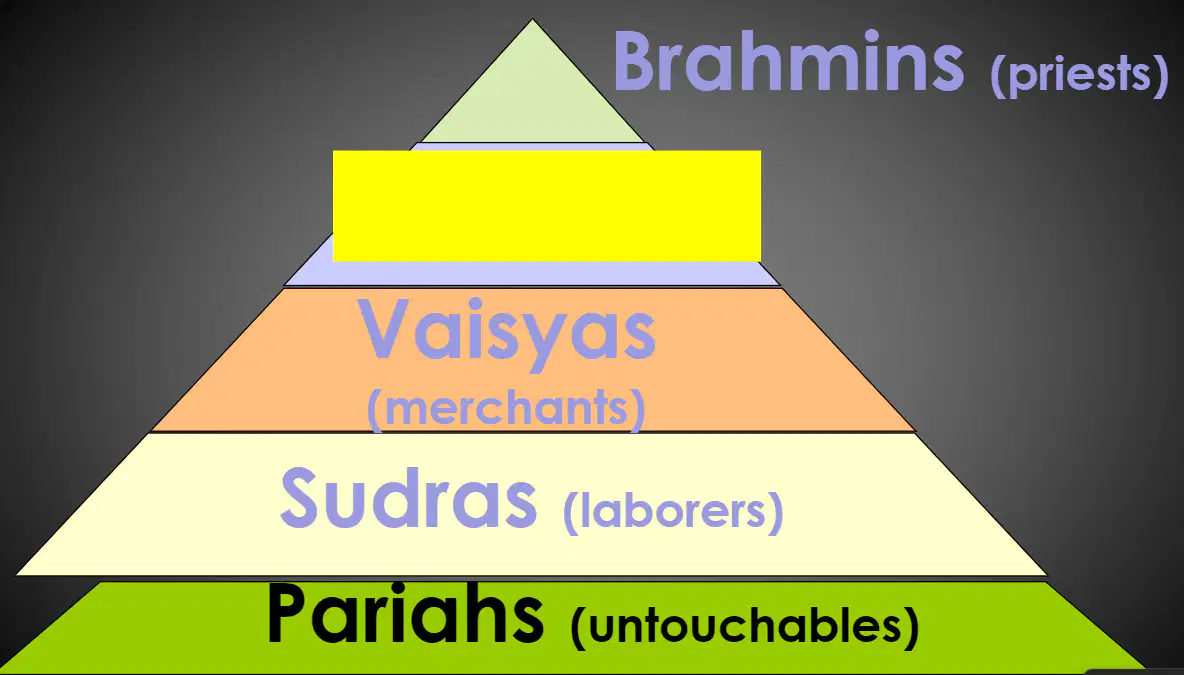
Refer to the Indian caste system pyramid below. Which class is represented by the yellow box (second from the top)?
Warriors
Nobles
Kings
Merchants
Identify one SPICE-T characteristic for India:
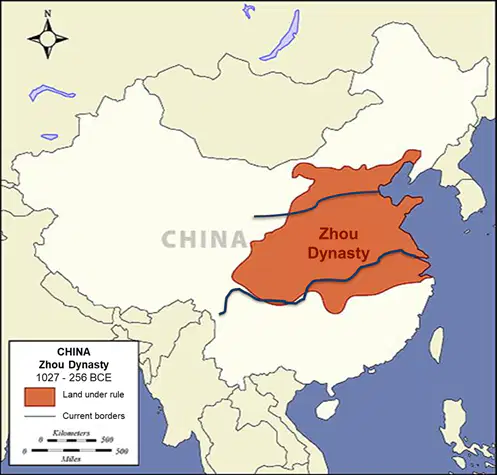
Which two rivers ran through the Zhou Dynasty?
The Tigris and Yellow Rivers
The Nile and Tigris Rivers
Huang He (Yellow River) and Yangtze River
No rivers ran through the Zhou dynasty
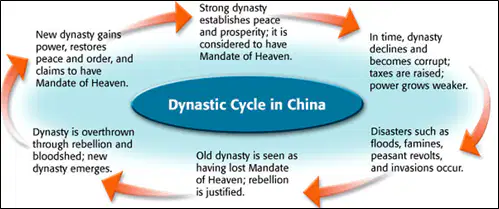
According to the dynastic cycle, where does royal authority originate?
Wealthy families
The Chee Clan
The Heavens
Central China
What was kept as a closely guarded secret in ancient China?
iron forging
the production of paper
the making of silk
historical documentation
In ancient China, if disasters like floods, poor harvests, or famine occurred, it was believed that the ruling dynasty had lost the...
Balance of Yin and Yang
Mandate of Heaven
Principles of Confucianism
State of Nirvana
What concept is asserted by a new dynasty when dynasties shift?
Taxation
The Desire of Chin
Mandate of Heaven
Authority of Rule
Which of the following is NOT a principle highlighted in Confucianism?
social order
effective governance
harmony
persuading others
What does filial piety mean?
showing respect to your parents and elders
giving up all material possessions
engaging in Confucian prayer
emphasizing the education of children
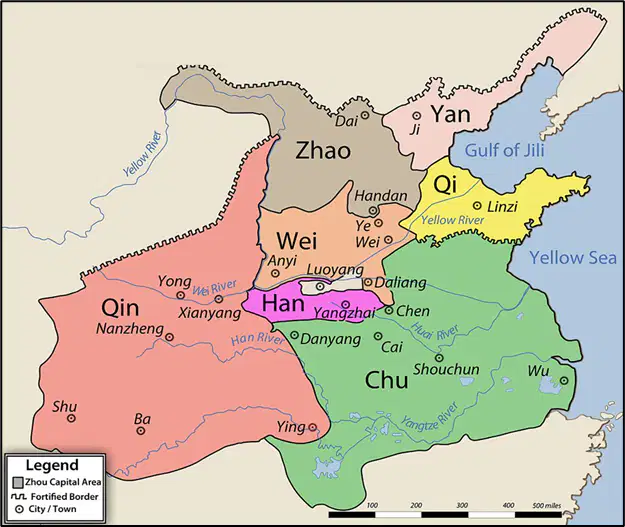
The map below illustrates a chaotic era when major Chinese states were vying for supremacy, known as...
The Great War of China
The Chinese War of 260
The Warring States Era
The Chinese Crusade
What is the central message of Daoism?
pursue a life of wealth and riches
live simply and harmoniously with nature
follow the emperor's commands
worship God and everything else will follow
During the Qin dynasty, what happened to those who criticized the regime?
hired to work in the Forbidden City
imprisoned, executed, or forced to labor on the Great Wall
allowed to express their thoughts freely
overlooked and treated as ordinary citizens
Which Chinese philosophy emphasizes respect for roles, family, and social order?
Confucianism
Legalism
Daoism
Hinduism
Which idea originated from the belief that humans are inherently selfish and immoral?
legality
legalism
justice
punishment
What was the main purpose of constructing the Great Wall of China?
showcase China's wealth and power to the world
experiment with new building technologies
prevent invasions from the north
create a route linking Northern and Southern China
What was the main reason India benefited the most from the Silk Road?
They possessed the finest materials
They were the largest silk producers
They acted as intermediaries between Asia, the Middle East, and parts of Europe
They spread their religion the most
Was the Silk Road a single pathway constructed from silk?
Yes
No
Which statement about the Silk Road is FALSE?
Camels were used for transporting goods
Traveling on the Silk Road was always free from danger
Diseases were sometimes spread unknowingly
They traded food, animals, clothing, materials, and even ideas
What can be inferred from the fact that the Great Wall still exists today?
China has never been invaded successfully
The wall continues to have a significant strategic role
There are still numerous nomadic tribes north of the Great Wall
It remains a vital symbol of Chinese heritage
What was the reason for constructing the Great Wall so tall?
To stop enemy forces from seeing beyond it
To prevent horses from jumping over
To defend against arrows and spears
To stop people from climbing over
What defines a dynasty?
A line of rulers from the same family
A nomadic tribe known for warfare
Another term for "empire"
A governmental system akin to democracy
When did the construction of the Great Wall start?
About 2,300 years ago
Approximately 23,000 years ago
Roughly 230 years ago
Around 12,300 years ago
According to Confucianism, how is a peaceful society established?
By seeking mercy from Confucius through prayer.
By individuals adhering to the societal roles appropriate to their status.
By ensuring that foreign influences are excluded.
Through democratic processes where individuals vote for their leaders.
In which country did Confucianism begin?
Japan
India
Arabia
China
According to Confucius, individuals in ____________ should lead by example.
positions of power
prison
relationships
difficulties
Confucius primarily aimed to achieve ___________ in society.
harmony
enjoyment
contentment
labor
Which philosophy or religion advocates living in harmony with nature?
Legalism
Hinduism
Confucianism
Daoism
What was the original name of the Buddha?
Genghis Khan
Emperor Ashoka
Siddhartha Gautama
State of Moksha
What is the source of human suffering?
From the natural world
Desire and craving
Fear and malice
Unfulfilled expectations
What is the term for the cycle of life, death, and rebirth?
Enlightenment (Moksha)
Soul (Atman)
Reincarnation (Samsara)
Universal Spirit (Brahman)
What is the path to eliminate desire and reach enlightenment according to the fourth Noble Truth?
Adhere to the Ten Commandments
Acquire as many material goods as possible
Practice the Eightfold Path
Engage in the 12-step Program
In the Eightfold Path, which principle emphasizes cultivating the mental focus necessary for meditation?
Right livelihood
Right effort
Right mindfulness
Right meditation

Which caste is considered the highest in the caste hierarchy?
Sudras
Untouchables
Brahmin
Karma

This group is viewed as impure and marginalized, often seen as societal outcasts.
Brahmin
Dharma
Untouchables
Sudras

What is it called when the soul returns in a new life?
Reincarnation
Karma
Sudras
Vedas
In Hinduism, the duty or role one must fulfill in life is known as
Karma
Dharma
Reincarnation
Vedas

The actions you take in this life, whether good or bad, are known as your ___________________. It's important to strive for the positive kind.
Karma
Dharma
Reincarnation
Vedas
In India, people were categorized into social groups known as the ___________________ system
Economic
Caste
Political
School

