wayground logo

Free Printable Worksheets

Font size

S
M
L
XL
Worksheets

Unit 2.1 Nervous System Exam Review

Total questions: 104

Worksheet time: 2hrs 44mins

Name
Class
Date
1.

This structure of the nervous system consists of two hemispheres, left and right, and is responsible for the integration of sensory and neural functions and the initiation and coordination of voluntary activity in the body.

a)

Cerebrum

b)

Cerebellum

c)

Spinal Cord

d)

Peripheral Nervous System

2.

This structure of the nervous system is at the back of the skull and functions to coordinate and regulate involuntary muscular activity.

a)

Cerebrum

b)

Cerebellum

c)

Spinal Cord

d)

Peripheral Nerves

3.

A groove or furrow on the surface of the brain.

a)

Cerebellum

b)

Gyrus

c)

Sulcus

d)

Lobe

4.

A ridge or fold between two clefts on the cerebral surface in the brain.

a)

Cerebellum

b)

Gyrus

c)

Sulcus

d)

Lobe

5.

Any of the cells that hold nerve cells in place and help them work appropriately.  There are many types of this cell.

a)

Sensory neuron

b)

Motor neuron

c)

Interneuron

d)

Glial Cells

6.

Nerve cells that are activated by inputs or that receive outside stimuli and then sends of signals to the rest of the nervous system.

a)

Sensory neurons

b)

Interneurons

c)

Motor neurons

d)

Glial cells

7.

Nerve cells that pass impulses from the brain or spinal cord to a muscle or gland.

a)

Sensory neurons

b)

Interneurons

c)

Motor neurons

d)

GLial cells

8.

A nerve cell which transmits impulses between other neurons.

a)

Sensory neurons

b)

Motor neurons

c)

Interneurons

d)

Glial cells

9.
The part of the neuron that insulates the axon and increases the speed of the neural message within the neuron.
a)
Synapse
b)
Dendrite
c)
Myelin Sheath
d)
Axon Terminal Button
10.
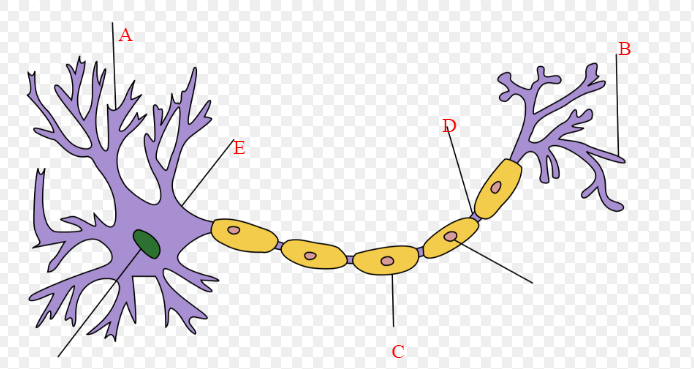
A
a)
Dendrite
b)
Axon
c)
Axon Terminal
d)
Cell Body
11.
B
a)
Dendrite
b)
Axon
c)
Axon Terminal
d)
Cell Body
12.
E
a)
Synapse
b)

Soma/Cell Body

c)
Axon 
d)
Dendrite
13.
The correct direction of the neural impulse within one neuron.
a)
Axon Terminal to Dendrite
b)
Dendrite to Axon Terminal
c)
Cell Body to Axon
d)
Axon Terminal to Cell Body
14.
This part of the neuron receives chemical messages from the neurotransmitters of other neurons.
a)
Axon Terminal
b)
Dendrites
c)
Myelin Sheath
d)
Cell Body
15.
A chemical produced by neurons that carries messages to other neurons
a)
myelin sheath
b)
neurotransmitter
c)
axon
d)
axon terminal
16.
The tiny gap between neurons where nerve impulses are sent from one neuron to another.  It is where communication occurs between an axon and dendrite
a)
synapse
b)
axon terminal
c)
impulse
d)
myelin
17.
This is the electrical charge that travels down an axon when a neuron is firing
a)
Resting Potential
b)

Action Potential/Electrical Impulse

c)
Threshold
d)
Refractory Period
18.
What is another name for a nerve cell?
a)
Muscle Fiber
b)
Connective Tissue
c)
Impulse
d)
Neuron
19.
The part of the neuron that brings information to the cell body is called a(n) ___________.
a)
dendrite
b)
axon
c)
nucleus
d)
node of Ranvier
20.
The part of the neuron that takes information away from the cell body is called a(n) _____________.
a)
dendrite
b)
axon
c)
cell body
d)
Schwann cell
21.
Location at which a neuron can transfer an impulse to another cell with the use of neurotransmitters is called __________.
a)
myelin sheath
b)
axon
c)
threshold
d)
synapse
22.
What is the chemical used by a neuron to transmit an impulse across a synapse to another nerve cell?
a)
Neurotransmitters
b)
Synapse
c)
Threshold
d)
Impulse
23.
What part of the neuron receives the message from the previous neuron?
a)
Terminal Fibers
b)
Dendrites
c)
Cell Body
d)
Myelin
24.
Which of the following is the correct order of the direction of a message?
a)
Dendrite-Cell Body-Axon-Synapse
b)
Synapse-Cell Body-Axon-Dendrite
c)
Dendrite-Synapse-Cell Body-Axon
d)
Axon-Cell Body-Dendrite-Synapse
25.
This part of the neuron stores then releases neurotransmitters into the synapse.
a)
Axon 
b)
Dendrite
c)
Myelin Sheath
d)
Axon Terminal
26.
A nerve cell that is the basic working unit of the brain and nervous system which processes and transmits information
a)
axon
b)
neuron
c)
dendrite
d)
neurotransmitter
27.
When a neuron is resting, the inside of the axon has a ____________ charge.
a)
positive
b)
negative
28.
When a neuron is not engaged in an impulse.
a)
Resting potential
b)
Action potential
c)
Neural potential
d)
Synaptic potential
29.
Neurotransmitters are released from the
a)
Dendrites
b)
Post-synaptic neuron
c)
Presynaptic neuron
d)
Axon
30.
In order for a neuron to have an action potential, the neuron must receive more
a)
excitatory neurotransmitters
b)
inhibitory neurotransmitters
c)
agnostic neurotransmitters
d)
antagonistic neurotransmitters
31.
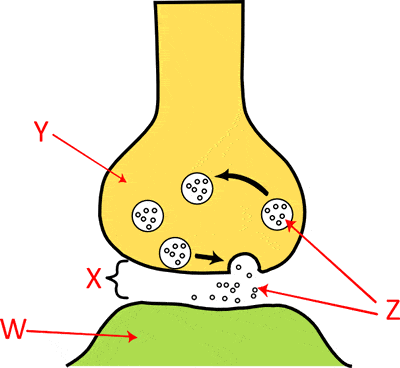
W
a)
Axon Terminal Button
b)
Neurotransmitters
c)
Dendrite
d)
Synapse
32.
Y
a)
Axon Terminal Button
b)
Neurotransmitters
c)
Dendrite
d)
Synapse
33.
-70 mV is the measure of a
a)
Threshold Potential
b)
Action Potential
c)
Resting Potential
d)
End Point Potential
34.
When a membrane potential reaches +30mV, ________ channels open, ________ occurs, and ________ channels close.
a)
Sodium, depolarization, potassium
b)
Potassium, depoloarization, sodium
c)
sodium, repolarization, potassium
d)
postassium, repolarization, sodium
35.
The area between the pre-synaptic cell and the post-synaptic cell is termed the synaptic cleft.
a)
True
b)
False
36.
The sodium-potassium pump is involved in establishing the resting membrane potential. 
a)
True
b)
False
37.
Multiple sclerosis is an autoimmune disease in which the body's own immune system destroys the _____________ of the nerve axons. 
a)
Myelin
b)
Dendrites
c)
Axon Terminal
d)
Nodes of Ranvier
38.
Nerve impulses within the neuron are sent in _____ form
a)
Electrical
b)
Chemical
c)
Electro-chemical
d)
Petrochemical
39.

Which organ is represented by letter A?

a)

Brain

b)

Spinal Cord

c)

Nerves

40.

Which organ is represented by letter B?

a)

Brain

b)

Spinal Cord

c)

Nerves

41.

Which organ is represented by letter C?

a)

Brain

b)

Spinal Cord

c)

Nerves

42.

The Nervous System is divided into two parts called

a)

The Central Nervous System & The Peripheral Nervous System

b)

The Central Nervous System & The Paradigm Nervous System

c)

The Corollary Nervous System & The Paradigm Nervous System

d)

The Corollary Nervous System & The Peripheral Nervous System

43.

This is the control center of the nervous system controlling both voluntary and involuntary processes.

a)

Central Nervous System

b)

Peripheral Nervous System

44.

The nerves that coordinate messages from the brain and spine to all other parts of the body.

a)

Central Nervous System

b)

Peripheral Nervous System

45.

Anything that occurs as a result of the organism thinking about it.

a)

Voluntary Processes

b)

Involuntary Processes

46.

Anything that occurs automatically and without thought.

a)

Voluntary Processes

b)

Involuntary Processes

47.

Digestion, Heartbeat, and Reflexes are examples of

a)

Voluntary Processes

b)

Involuntary Processes

48.

Speaking, Running, and Karate Chopping are examples of

a)

Voluntary Processes

b)

Involuntary Processes

49.

Letter B represents the

a)

Cerebrum

b)

Cerebellum

c)

Medula

50.

Letter A represents the

a)

Cerebrum

b)

Cerebellum

c)

Brain Stem

51.

Letter C represents the

a)

Cerebrum

b)

Cerebellum

c)

Medula

52.

Which brain structure is responsible for balance and is involved with movement?

a)

Cerebellum

b)

Cerebrum

c)

Medulla

53.

Which brain structure controls all involuntary processes such as breathing, heartbeat, peristalsis

a)

Cerebellum

b)

Cerebrum

c)

Brain Stem

54.

Which brain structure controls all voluntary activities and is responsible for thought, memory, emotions, and reasoning?

a)

Cerebellum

b)

Cerebrum

c)

Medulla

55.

Which structure connects the Brain to the Peripheral Nervous System, while also directing some of the body's reflexes?

a)

Spinal Cord

b)

Esophagus

c)

Pharynx

d)

Larynx

e)

Trachea

56.

The Peripheral Nervous System is entirely made of

a)

Nerves outside of the Central Nervous System

b)

Nerves inside of the Central Nervous System

c)

Muscle Tissues inside of the Central Nervous System

d)

Muscle Tissues outside of the Central Nervous System

57.
Which letter on the illustration represents the frontal lobe
a)
A
b)
B
c)
C
d)
D
58.
Which letter on the illustration represents the parietal lobe
a)
A
b)
B
c)
C
d)
D
59.
Which letter on the illustration represents the temporal lobe
a)
A
b)
B
c)
C
d)
D
60.
Which letter on the illustration represents the occipital lobe
a)
A
b)
B
c)
C
d)
D
61.
This structure connects the two hemispheres of the brain and allows them to communicate.
a)
Cerebral Cortex
b)
Cerebellum
c)
Corpus Callosum
d)
Caudate Nucleus
62.
This area of the brain is responsible for inhibitions and impulse control.
a)
parietal
b)
frontal
c)
temporal
d)
occipital
63.
What lobe of the brain is responsible for eyesight?
a)
parietal
b)
temporal
c)
occipital
d)
frontal
64.
What lobe of the brain is responsible for long-term memory?
a)
parietal
b)
temporal
c)
occipital
d)
frontal
65.
What lobe of the brain is responsible for emotional and personality characteristics?
a)
parietal
b)
temporal
c)
occipital
d)
frontal
66.
What part of the brain is responsible for muscle coordination?
a)
parietal lobe
b)
temporal lobe
c)
cerebellum
d)
brain stem
67.
A tumor on the temporal lobe would most affect the career of 
a)
an architect
b)
a musician
c)
a professor
d)
a researcher
68.
This part of the brain is responsible for balance and coordination.
a)
cerebrum
b)
cerebellum
c)
brain stem
d)
spinal cord
69.
This area of the brain is responsible for judgement and decision making.
a)
temporal lobe
b)
parietal lobe
c)
frontal lobe
d)
brain stem
70.
A person has a stroke on her occipital lobe.  What might happen to her?
a)
reduced planning abilities
b)
deafness
c)
coma
d)
blindness
71.
What is the largest part of the brain?
a)
Thalamus
b)
Cerebellum
c)
Spinal Cord
d)
Cerebrum
72.
This lobe of the brain helps us make decisions, plans, reasons, and carries out behaviors.
a)
Frontal Lobe
b)
Parietal Lobe
c)
Occipital Lobe
d)
Temporal Lobe
73.
This lobe of the brain controls hearing, speaking coherently, and comprehension.
a)
Frontal Lobe
b)
Temporal Lobe
c)
Occipital Lobe
d)
Parietal Lobe
74.
This lobe of the brain controls touch, pain, temperature sensation.
a)
Frontal Lobe
b)
Temporal Lobe
c)
Occipital Lobe
d)
Parietal Lobe
75.
What number(s) on the graph represents the Resting Potential?
a)
1 and 2
b)
1 and 5
c)
2 and 3
d)
3 and 4
76.
Which ions are involved in the electrical nerve impulse?
a)
Iodine and Sodium
b)
Potassium and Sodium
c)
Iron and Sodium
d)
Calcium and Iodine
77.
What number on the graph represents the Depolarization phase?
a)
1
b)
2
c)
3
d)
4
78.
Why is -55 mV a significant number?
a)
This is the largest charge achieved during an action potential
b)
This is the threshold required to complete an action potential
c)
This is the resting charge of a neuron
d)
This is the charge when all the sodium is inside the cell
79.

At what stage does Potassium end outside the neuron, and Sodium ends inside the neuron?

a)

Depolarizarion

b)

Repolarization

c)

Hyperpolarization (refractory period)

d)

Resting Potential

80.

At what stages do Sodium/Potassium Channels open?

a)

Repolarization/ Repolarization

b)

Depolarization/ Hyperpolarization (refractory period)

c)

Hyperpolarization (refractory period)/ Repolarization

d)

Depolarization/ Repolarization

81.
Which is the correct order of events in depolarisation then repolarisation? 
a)
Sodium channels close, potassium channels open
b)
Sodium channels open, potassium channels open, 
c)
Sodium channels open, potassium channels close
d)
Potassium channels open, sodium channels open
82.

Which one of the following is involved in maintaining a resting membrane potential?

a)

Na+/K+ ATPase pump moves 3Na+ in for every 2K+ out

b)

Na+/K+ ATPase pump moves 3K+ in for every 2Na+ out

c)

Na+/K+ ATPase pump moves 3Na+ out for every 2K+ in

d)

Na+/K+ ATPase pump moves 3K+ out for every 2Na+ in

83.
In resting potential, neurons have more _________ on the outside of the cell membrane.
a)
K+
b)
NaCl
c)
Na+
d)
Cl-
84.
When a neuron is depolarized, what are the first channels to open?
a)
Sodium
b)
Potassium
c)
Calcium
d)
ACTH
85.
When a neuron is resting, the inside of the axon has a ____________ charge.
a)
-55 mV
b)
-70 mV
c)
40 mV
d)
-75 mV
86.
What number on the graph represents the Hyperpolarization phase?
a)
1
b)
2
c)
3
d)
4
87.
At what stage are both ions present in large concentrations INSIDE the neuron?
a)
Depolarizarion
b)
Repolarization
c)
Hyperpolarization
d)
Resting Potential
88.
Why is hyperpolarization important?
a)
It makes sure the neuron is healthy
b)
It prevents a second, unwanted signal from being sent
c)
It makes sure the neurons are in the correct space
d)
It makes sure the charge is back at -70 mV
89.

In a reflex action, the __________ bypasses the ___________

a)

Motor neuron, brain

b)

Sensory neuron, brain

c)

Sensory neuron, spinal cord

d)

Motor neuron, spinal cord

90.

An example of a reflex action includes

a)

Touching a butterfly

b)

Brushing your hand against the side of your body

c)

Touching a hot stove

d)

Your legs moving as you walk

91.

In a reflex arc, the sensory neuron leads to the ___________ and the motor neuron leads to the __________

a)

Spinal cord, CNS

b)

CNS, muscle

c)

Spinal cord, muscle

d)

Muscle, CNS

92.

Reflex actions are important because

a)

They provide a quick, involuntary response

b)

They prevent injury

c)

They are essential to the survival of organisms

d)

All of the above

93.

What type of neuron is A?

a)

Sensory

b)

Inter

c)

Motor

94.

What type of neuron is B?

a)

Sensory

b)

Interneuron

c)

Motor

95.

What type of neuron is C?

a)

Sensory

b)

Inter

c)

Motor

96.
What is Acetylcholine mainly responsible for?
a)
mood
b)
alertness
c)
emotion
d)
muscle action/movement
97.
Which neurotransmitter is mostly responsible for alertness and arousal?
a)
Norepinephrine
b)
Serotonin
c)
Dopamine
d)
GABA
98.
A chemical that blocks a neurotransmitter from being absorbed, thus blocking its effects is a(n):
a)
Agonist
b)
Antagonist
c)
Endorphin
d)
L-Dopa
99.
A chemical that mimics or enhances the effect of a neurotransmitter:
a)
Agonist
b)
Antagonist
c)
Endorphin
d)
L-Dopa
100.
Parkinson's is the result of too little:
a)
Serotonin
b)
Glutamate
c)
Dopamine
d)
ACh
101.
Serotonin is responsible for ________
a)
movement
b)
learning
c)
alertness and arousal
d)
mood, sleep & hunger
102.
Which neurotransmitter inhibits brain activity?
a)
Acetylcholine
b)
GABA
c)
Endorphins
d)
Dopamine
103.
What is a neurotransmitter?
a)
fatty covering of the axon
b)
nerve cell
c)
chemical messenger
d)
gap between neurons
104.
Synapses that are ____________ cause a neuron to fire whereas ____________ synapses reduce the likelihood that a neuron will fire.
a)
excitatory; inhibitory
b)
synaptic; terminal
c)
postsynaptic; presynaptic
d)
dendritic; axon