
NEW
Font size
 Worksheets
Matter Test Review
Total questions: 40
Worksheet time: 32mins
How does the temperature of a substance relate to its density?
A warmer substance will be less dense, because the atoms are expanding.
A warmer substance will be more dense, because the atoms are contracting.
A cooler substance will be less dense, because the atoms are expanding.
There is no relationship between the temperature and density of a substance.

This diagram shows the particles that make up three different substances.
What state of matter does Substance 2 most likely exhibit?
solid
liquid
gas
plasma
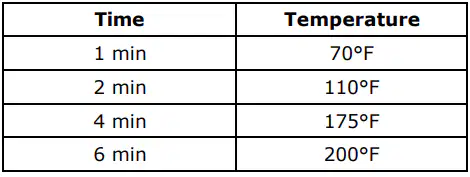
The table shows the times and temperatures for a solid substance being heated on a stove.
If the substance melts at 200°F, at which time did the particles in the substance move the slowest?
1 min.
2 min.
4 min.
6 min.
Which factor is most important for determining the phase in which a substance exists?
Its mass
Its density
Its volume
Its temperature
Scientists are observing molecules by using an advanced electron microscope. They notice the molecules are beginning to move faster and expanding. What is most likely happening?
Heat is being added, and a gas is turning into a liquid.
Heat is being added, and a solid is turning into a liquid.
Heat is being removed, and a gas is turning into a solid.
Heat is being removed, and a liquid is turning into a solid.
How are the temperature of a substance and the movement of atoms in a substance related?
When the temperature increases, the movement of atoms decreases.
When the temperature decreases, the movement of atoms increases.
When the temperature decreases, the movement of atoms decreases.
When the temperature decreases, the movement of atoms is unchanged.
A helium balloon is taken outside on a very cold day. The balloon wrinkles and becomes a little smaller. Why does the balloon deflate when it exposed to the cold air?
The colder temperature causes the gas in the balloon to expand because the particles are moving farther apart.
The colder temperature causes the gas in the balloon to contract because the particles are moving closer together.
The colder temperature causes the gas in the balloon to escape.
The colder temperature causes more gas to enter the balloon, and it expands.
Which statement best explains the relationship between temperature and the kinetic energy of atoms?
As temperature increases, the kinetic energy increases.
As temperature decreases, the kinetic energy increases.
As temperature increases, the kinetic energy converts into potential energy.
As temperature decreases, the kinetic energy converts into potential energy.

The diagram compares the movement of water particles when the water is cold compared to when it is hot.
What happens to the particles in the cold water?
The particles in the cold water contract and move more slowly
The particles in the cold water expand move more quickly.
The particles in the cold water move more freely.
The particles in the cold water do not move at all.
What will most likely occur if water is cooled until it becomes solid ice?
The particles of water will speed up and expand.
The particles of water will slow down and contract.
The particles of water will not change speed.
The particles of water will stop moving completely.
How are atoms affected when temperature increases?
Their motion slows down and the atoms move closer together.
Their motion speeds up and the atoms move farther apart.
They stay the same distance apart.
They stop moving.
Which property is exhibited by a liquid but not a solid?
Atoms vibrate faster, keeping a rigid and stable shape.
Atoms vibrate faster, taking the shape of the container.
Atoms vibrate more slowly, keeping a rigid and stable shape.
Atoms vibrate more slowly, taking the shape of the container.
Which best explains what will happen to the particles in a liquid when heat is removed?
The motion of the particles will immediately stop.
The motion of the particles will not change.
The motion of the particles will slow down and the liquid will turn into a solid.
The motion of the particles will speed up and the liquid will turn into a gas.
The atoms in a cup of water begin vibrating faster. What can most likely be inferred from this observation?
The atoms are splitting apart.
The temperature is increasing.
The temperature is decreasing.
The atoms are joining together.
What causes atoms to move and vibrate in solids, liquids, and gases?
Its mass
Its thermal energy
Its volume
Its density
Which statement best describes atoms?
They can be seen without a microscope.
They make up every substance.
They do not have volume.
They do not have mass.
Isabelle has two samples of metal with similar properties. What is the most likely reason that the two samples have similar properties?
The samples contain the same element.
The samples contain different types of atoms.
The samples are composed of different elements.
The samples have been formed into similar shapes.
Which statement is true about the properties of atoms?
All atoms can be seen without a microscope.
All atoms are larger than a water molecule.
All atoms have mass and occupy space.
All atoms are composed of elements.
Tony has a box of nails of various sizes. All of the nails are composed of pure iron, an element. What is true of the nails?
All of the nails have the same mass.
All of the nails have the same weight.
All of the nails have the same volume.
All of the nails are composed of the same type of atoms.
What is the smallest unit of an element?
compound
molecule
atom
cell
Which term describes a pure substance that is composed of only one type of atom?
element
matter
mixture
solution
Which statement describes carbon atoms and oxygen atoms?
They form the same element.
They have the same properties.
They have different properties.
They only combine with each other.
Which word best describes atoms of the same element?
different
identical
round
varied
A scientist determines the mass of three atoms. One atom has a mass unit of 16, while the other two atoms have a mass unit of 1 each. Which conclusion did the scientist determine about the atoms?
The atoms with a mass unit of 1 are the same element.
All three atoms are of the same element because each has a mass.
The atom with the larger mass unit is made up of more than one element.
All three atoms are from different elements because they are not bonded into a single molecule.
Pure aluminum foil is made up of how many kinds of atoms?
one
two
three
four
How would the size of atoms be described?
Atoms can be seen with a magnifying glass.
Atoms can be seen with a classroom microscope.
Atoms are large enough to be seen with the human eye.
Atoms are too small to be seen with a classroom microscope.
Which statement best explains the relationship between atoms and elements?
An atom is composed of two or more elements.
All atoms are made from the exact same elements.
All elements are made from the exact same atoms.
An element is composed of atoms of the same type.
What makes an element unique?
It contains only one type of atom.
It contains many different types of atoms.
It has protons but no electrons or neutrons.
It can easily be broken down into simpler substances.
What is the smallest particle of an element that retains the chemical properties of that element?
atom
compound
gas
neutron
What does all matter have in common?
All matter has mass and takes up space.
All matter takes up space and has temperature.
All matter has the same temperature and heat capacity.
All matter takes up space and has the same appearance.
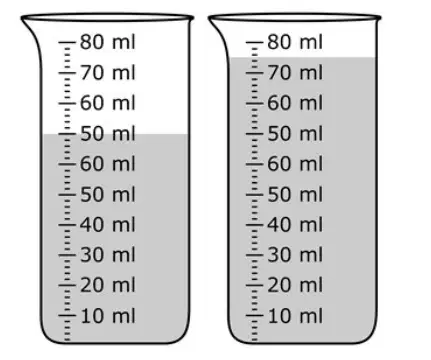
This diagram shows two beakers containing different amounts of water.
Which property is different when comparing the two beakers of water?
density
volume
melting point
boiling point
A 100-gram sample of liquid mercury has:
a melting point of –38.9°C,
a boiling point of 357.3°C,
and a density of 13.56 g/cm³.
What effect would doubling the sample size have on the liquid mercury’s properties?
All three properties would increase.
All three properties would remain the same.
Melting and boiling points would increase, while density would remain the same.
Density would decrease, while melting and boiling points would remain the same
A scientist has a 50-g sample of solid platinum. Platinum has a melting point of 1768.3 C and a density of 21.45 g/cm³. Which choice describes the properties of a 100-g sample of solid platinum?
Density and melting point will both double.
Density and melting point will both remain the same.
Density will double while the melting point remains stable.
Density will remain stable while the melting point doubles.
The boiling point of 4 cups of water is 212°F. What is the boiling point of 8 cups of water?
32°F
212°F
424°F
848°F

The image shows four boxes that each contain a different sample of gas. The atoms of each gas are represented by dots.
Which box contains the gas with the greatest density?
1
2
3
4
A bottle of water with a mass of 40g is left in a freezer overnight.
How does the mass of the frozen water compare to the mass of the liquid water?
The frozen mass is twice the liquid mass.
The liquid mass is twice the frozen mass.
The liquid and frozen masses are both 40g.
The frozen mass is four times the liquid mass.
Which factor would most likely increase the solubility of sugar in water?
an increase in the amount of sugar
a decrease in the amount of water
an increase in water temperature
a decrease in water temperature
A student pours some water into a beaker, pours some pure sugar into the water, and then stirs the mixture. The student notices that some of the sugar has dissolved, but some of the sugar remains as a solid at the bottom of the beaker. What could the student do to to get the remaining sugar to dissolve?
use a smaller beaker
add more water to the beaker
add more sugar to the beaker
decrease the water temperature
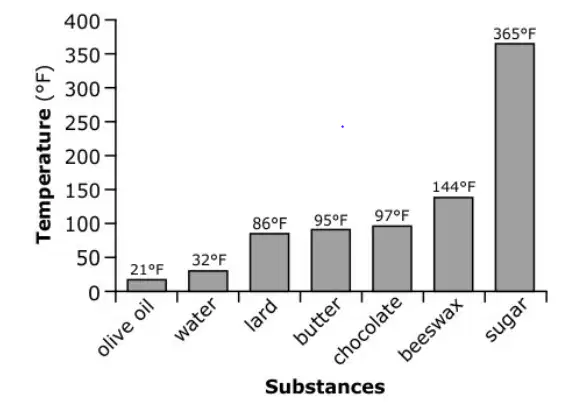
A scientist has samples of several substances in separate dishes. The bar graph shows the melting point of each substance.
Suppose the temperature of each substance is 90°F. Which substances would be in a liquid state?
olive oil, water, and lard
lard, butter, and chocolate
chocolate, beeswax, and sugar
butter, chocolate, and beeswax

If the temperature of this balloon suddenly decreased, how would the balloon change?
The mass of the balloon would increase.
The mass of the balloon would decrease.
The volume of the balloon would increase.
The volume of the balloon would decrease.

