
 Worksheets
IED Unit 1 Quiz
Total questions: 44
Worksheet time: 26mins


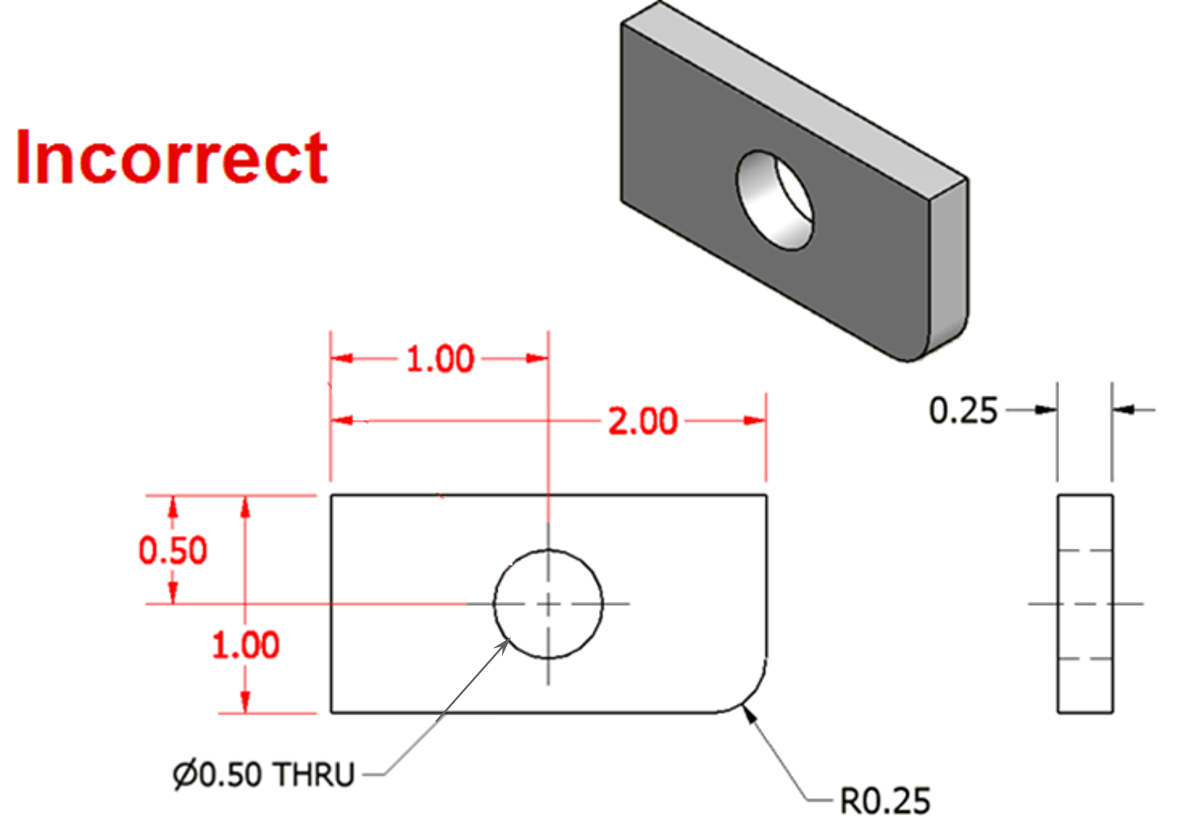
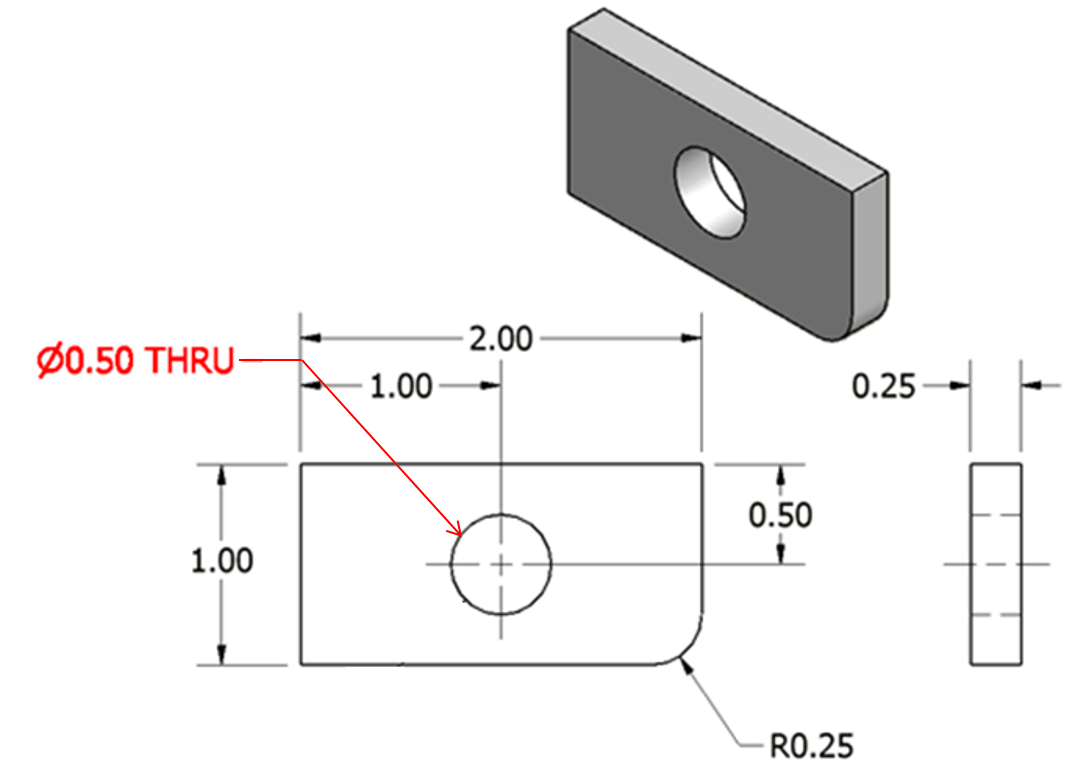


What is wrong with this drawing?
Dimension lines are crossed
Dimensions are outside view
It is over dimensioned
All of the above

Which dimensioning rule is broken with this drawing?
Dimensioned to a hidden line
Dimensions are on the drawing
Chain dimensions are not lined up
All of the above
Why is it important to have your drawing dimensioned completely?
To help the manufacturer guess undimensioned lines.
Completely dimensioned drawings are important to accurately communicate the specifications of a manufactured part.

Which view would be the best to add the hole note for this piece?
Front
Top
Right
Left

Which option is the best documentation for the hole?


What dimension guideline does this image violate?
Dimensions should not be duplicated
Place dimensions between adjacent views
Avoid dimensions over, through or inside an object.
When possible, avoid dimensions to hidden lines

What makes this the correct practice?
Dimension a circle by its diameter, an arc by its Radius
Avoid dimensions to hidden lines
Dimensions should not be duplicated
Dimension an arc by its diameter, a circle by its radius

The 4 red circles identify which dimension guideline for a circle?
Holes should have dimensions and sizes in the feature that shows them as a circle
Place dimensions between adjacent views
Avoid dimensions to hidden lines
When possible dimensions should not be duplicated.


The following image is an example of what type of dimensioning?
Datum
Chain
Group
Cluster
What does "THRU" mean on a hole note?
The extrusion goes through the part on a parallel plane.
The hole has a depth equal to the hole next to it.
The hole has a depth of 1"
Hole is drilled all the way through the part

What style of dimensioning is shown here?
Chain dimensioning (acceptable type)
Chain dimensioning (unacceptable type)
Datum dimensioning
Angular dimensioning
Is the first step in the design process. Includes the problem being identified, validated, and justified. The design requirements are determined and the design brief is created.
prototype
Valid
define the problem
present solution
construct/test prototype
This step in Design process includes creating a detailed design solution and detailed technical drawings.
present solution
define the problem
Valid
Prototype
develop solution
This step in Design process includes evaluating the solution's effectiveness, reflecting on design, making recommendation for improvements of the design, and revising design documents.
develop solution
evaluate solution
define the problem
Valid
Prototype
A group technique for solving problems, generating ideas, stimulating creative thinking, etc. by unrestrained spontaneous participation in discussion
define the problem
Iterative
evaluate solution
develop solution
brainstorm
Is the word "DESIGN" a verb or a noun?
verb
noun
both a noun and a verb
When you build your prototype it is really important to do this...
Rebuild it
Test it many times
Present it
Which step of the design process includes "Brainstorming"?
Define problem
Generate concepts
Build a prototype
Presenting your solution is like:
Looking for flaws
Pitching your sales idea
Brainstorming
Asking things like "What is the issue we need to solve?", or "What are my criteria/constraints?"...would be which step?
Design a solution
Generate Concepts
Define Problem
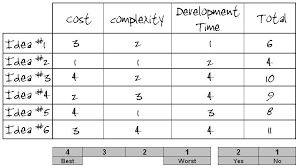
Using one of these will help your group decide on which model to build:
Design Brief
Design Evaluator
Decision Matrix
If I find flaws in my solution I should....
Create a technical drawing instead
Be formal and perfect
go back and make modifications before moving forward
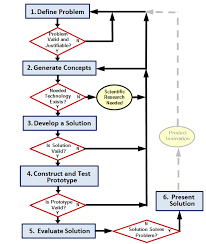
Why are there arrows going in all directions here?
To show that many ideas come from everyone
To show that the chart is incomplete
To show that you can go back to previous steps if needed

Based on this chart, which idea was best?
Idea 2
Idea 6
Idea 3
Idea 4
A manufacturer has developed a textured surface for plastic cups. The manufacturer has produced prototypes. Which of the following is the next step in the engineering design process?
market the new textured cups
redesign the textured surface
test and evaluate the prototypes
An automobile company plans to develop an electric car to sell in urban areas. Which of the following will help the company evaluate the potential market for these cars?
scale models
field tests
consumer surveys

