
 Worksheets
Periodic Table Terms and Vocab
Total questions: 60
Worksheet time: 33mins
What is the smallest unit of a chemical element?
Molecule
Atom
Compound
Ion
Which of the following is a substance that cannot be broken down into simpler substances by chemical means?
Mixture
Compound
Element
Solution
What is the term for the mass of an atom, typically expressed in atomic mass units (amu)?
Atomic Number
Atomic Mass
Molar Mass
Mass Number
What does the atomic number of an element represent?
Number of neutrons
Number of electrons
Number of protons
Number of atoms
What is the name of the table that arranges chemical elements in order of atomic number with repeating properties?
Chemical Chart
Elemental Table
Periodic Table
Atomic Table
What is a one or two-letter abbreviation for a chemical element called?
Chemical Formula
Chemical Symbol
Elemental Code
Atomic Notation
Which subatomic particle is found in the nucleus of every atom and has a positive electric charge?
Electron
Neutron
Proton
Positron
Which subatomic particle is neutral and found in the nucleus of atoms?
Electron
Neutron
Proton
Photon
Which subatomic particle has a negative charge and is found outside the nucleus of an atom?
Electron
Neutron
Proton
Positron
What is the term for the level that electrons orbit in around the atomic nucleus?
Orbit
Shell or Energy Level
Layer
Pathway
What is a horizontal row in the periodic table called?
Group
Period
Series
Line
Which of the following determines the element's place on the periodic table?
Atomic Mass
Atomic Number
Number of Neutrons
Number of Electrons
What are the vertical columns on the periodic table called?
columns
groups
periods
metals
What is a substance formed when two or more elements are combined chemically?
solution
air molecule
alloy
compound or molecule
What is the principle that the properties of the elements recur periodically as their atomic numbers increase?
periodic law
periodic table
ionization energy
electron affinity
What is electron configuration?


How many protons are in the element Nitrogen?
7
14.01
21.01
Nitrogen doesn't have protons

Explain why isotopes of the same element have different mass numbers.
They have different numbers of protons.
They have different numbers of neutrons.
They have different numbers of electrons.
They have different numbers of protons and electrons.
What is a model that can be used to make accurate predictions?
Scientific model
Statistical model
Elements that are malleable, ductile, conductors, and corrode with water and oxygen.
Metals
Nonmetals
Metalloids
Noble gases
Elements that are brittle as solids, good insulators, dull looking and many are gases
Metals
Nonmetals
Metalloids
Noble gases
Elements that are shiny or dull, are able to conduct electricity, and can be malleable and ductile
Metals
Nonmetals
Metalloids
Noble gases
Soft and silvery, most reactive metals, very reactive with water
Reactive metals, white, malleable, found in flares and flash grenades
Alkali metals
Precious metals
Alkaline Earth metals
Rare Earth Metals
The B Groups...used in coins, jewelry, wiring...make brightly colored compounds
Group 3A...one metalloid and five metals...has the most abundant metal in the Earth's crust
Boron Family
Carbon Family
Nitrogen Family
Oxygen Family
Group 4A...one nonmetal, 2 metalloids and three metals...has the element of life
Boron Family
Carbon Family
Nitrogen Family
Oxygen Family
Group 5A...2 nonmetal, 2 metalloids and 2 metals...has the element that makes up 78% of the atmosphere....has elements found in dynamite and matches
Boron Family
Carbon Family
Nitrogen Family
Oxygen Family
Group 6A...3 nonmetal, 2 metalloids and 1 metal...has the most element in the Earth's crust...reactive
Boron Family
Carbon Family
Nitrogen Family
Oxygen Family
Group 7A...5 nonmetals, 1 metalloid...most reactive nonmetals
Carbon Family
Nitrogen Family
Halogens
Noble Gases
Group 8A...colorless, odorless, unreactive gases...full energy levels.....all except one have an octet
Carbon Family
Nitrogen Family
Halogens
Noble Gases
Which answer states that atoms will react in order to have 8 electrons in their outer ring?
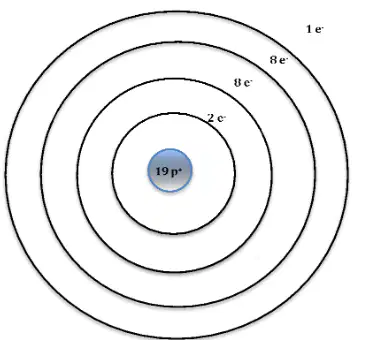
What element is shown in the diagram?
F
Ne
K
Ca
How many energy levels does the atom in the diagram have?
1
2
3
4
How many valence electrons does the atom in the diagram have?
1
2
10
18
How many shielding electrons does the atom in the diagram have?
1
2
10
18
What is the effective nuclear charge of the atom in the diagram?
+1
+2
-1
-2
What elements form positive ions, and what are those ions called?
Metals, cations
Metals, anions
Nonmetals, cations
Nonmetals, anions
What elements form negative ions, and what are those ions called?
Metals, cations
Metals, anions
Nonmetals, cations
Nonmetals, anions
What is the energy required to remove an electron from an atom?
electron affinity
Ionization energy
electronegativity
shielding effect
What is the energy absorbed or released when an atom takes an electron?
electron affinity
Ionization energy
electronegativity
shielding effect
What is the tendency of an atom to pull or tug on electrons in a bond?
electron affinity
Ionization energy
electronegativity
shielding effect
What describes the attraction between the nucleus of an atom and its electrons when the atom has more than one shell/energy level?
electron affinity
Ionization energy
electronegativity
shielding effect
Which of the following would have a higher ionization energy?
Na
Ba
C
F
Which of the following would have a higher electronegativity?
Na
Ba
C
F
Which of the following would have a higher electron affinity?
Na
Ba
C
F
Which of the following would have the largest atomic radii?
Na
Ba
C
F
Which of the following would have the smallest atomic radii?
Na
Ba
C
F
Which of the following would have the smallest atomic radii?
Li+1
Ba+2
P-4
F-1

Look at the bohr models of Li and Be. Imagine the first valence electron was already removed from both atoms, and now you are going to remove the second valence electron. The energy required to remove the second valence electron is called second ionization energy. Would lithium or beryllium have a higher second ionization energy ?
Li, because it has more protons
Be, because it has more protons
Li, because the second valence electron comes from an energy level closer to the nucleus
Be, because the second valence electron comes from an energy level closer to the nucleus
Li, because the beryllium has two valence electrons that repel each other

1s22s22p63s23p64s23d10

This Aufbau orbital diagram represents:


Which elements lose electrons?
Metals
Nonmetals
Which elements have a low ionization energy?
Metals
Nonmetals
Which elements have a high electronegativity?
Metals
Nonmetals
Which elements gain electrons?
Metals
Nonmetals

