wayground logo

Free Printable Worksheets

Font size

S
M
L
XL
Worksheets

2nd Quarter Review

Total questions: 60

Worksheet time: 1hrs 7mins

Name
Class
Date
1.
This instrument measures air pressure
a)
thermometer
b)
anemometer
c)
barometer
d)
wind vane
2.
This image demonstrates that air pressure is greater close to Earth's surface because
a)
the air is less dense at lower altitudes
b)
the air molecules are larger near the surface
c)
the air is more dense near the surface
d)
warm air is more dense than cold air
3.

As you climb up a mountain what happens to the air pressure?

a)

decreases

b)

increases

c)

stays the same

4.

Complex organisms were able to once this happened.

a)

asteroids stopped impacting Earth

b)

more sunlight was reflected instead of absorbed

c)

atmosphere's gases changed, and more oxygen was present from cyanobacteria

d)

comets began to impact Earth more frequently

5.

What process uses carbon dioxide and releases oxygen and who does this process?

a)

respiration, animals

b)

photosynthesis, plants

c)

oxidation, plants

d)

inhalation, animals

6.

What main led to the formation of Earth's modern day atmosphere (choose two)

a)

volcanic eruptions releasing Carbon Dioxide, Carbon Monoxide, and Water Vapor

b)

blue green algae taking in more carbon dioxide allowing the planet to cool down.

c)

meteor bombardment and release of hydrogen and helium

d)

cyanobacteria releasing larger amounts of oxygen into the atmosphere.

7.

Which process is believed to start the increase in oxygen in our atmosphere?

a)

condensation

b)

outgassing

c)

photosynthesis

d)

barometric pressure

8.
The early atmosphere contained smaller amounts of oxygen, do to the...
a)
lack of plant life
b)
lack of animal life
c)
early protists
d)
aquatic life forms
9.
What most likely formed the first abundance of oxygen in Earth's atmosphere?
a)
trees
b)
blue-green algae (cyanobacteria)
c)
dinosoaurs
d)
crinoids 
10.

78% of the Earth's atmosphere is ___________ and 21% of the Earth's atmosphere is _____________.

a)

Oxygen, Nitrogen

b)

Nitrogen, Oxygen

c)

Nitrogen, Carbon Dioxide

d)

Oxygen, Carbon Dioxide

11.

During which stage of Earth's atmosphere was there mostly Hydrogen and Helium being released back into space

a)

1

b)

2

c)

3

12.

Which which stage of Earth's atmosphere was there an abundance of carbon dioxide, carbon monoxide, water vapor, and nitrogen due to volcanic eruptions.

a)

1

b)

2

c)

3

13.

Which pie chart describes the composition of Earth's modern day atmosphere?

a)

A

b)

B

c)

C

d)

D

14.

What is a correct hypothesis to the beak-size variation graph?

a)

over a ten year period, a bird's beak will fluctuate in a size by 2mm

b)

over a ten year period, the size of a bird's beak will range between 9.6mm and 10.1mm.

c)

during times of increased precipitations, the size of a bird's beak will decrease

d)

During years of dry weather, bird's beak will not change size.

15.
What is happening to the temperature in New York City?
a)
It is remaining about the same.
b)
It is mostly decreasing.
c)
It is mostly increasing.
d)
There is a pattern of increasing and decreasing.
16.
What is the temperature on the thermometer?
a)
35
b)
28
c)
32
d)
30
17.
Earth's distance from the Sun allows it to be the only planet to have -
a)
auroras
b)
liquid water
c)
frozen water
d)
an atmosphere
18.
What type of tides would this arrangement of earth-moon-sun create?
a)
neap tide
b)
spring tide
c)
new moon tide
d)
full moon tide
19.
What do we call a tide that has a large range?
a)
gravity
b)
wind
c)
spring
d)
neap
20.
Tides are caused by ___________
a)
wind
b)
gravitational pull of moon
c)
waves gravitation toward land
d)
rain
21.
What is a difference between spring and neap tides?
a)
Spring tides occur when the earth and sun are IN LINE with the new or full moon. 
b)
Spring tides occur when moon in 3rd or 1st quarter phases
c)
Spring tides are LOWER than neap tides
d)
Spring tides occur in Spring and neap tides can occur in any season
22.
The lowest layer of the atmosphere, this is also where weather occurs.
a)
Exosphere
b)
Mesosphere
c)
Troposphere
d)
Stratosphere
23.
The _______  in the Stratosphere protects us from harmful UV rays.
a)
aurora
b)
weather
c)
convection currents
d)
ozone
24.
When warm air rises and cools high in the atmosphere and then sinks to the earth creates _________ currents
a)
convection
b)
surface
c)
deep
d)
precipitaiton
25.
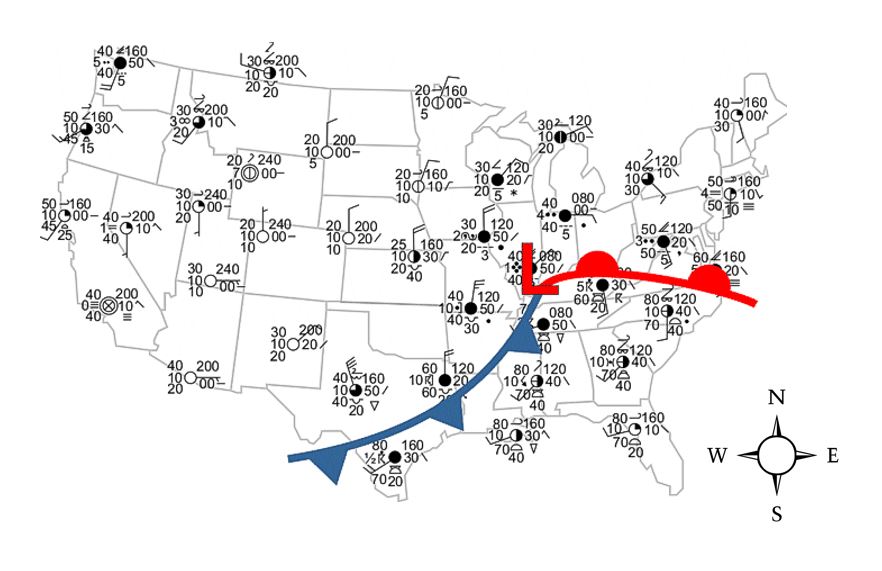
What direction is the warm front moving on the map? 
a)
North
b)
South
c)
East
d)
West
26.
What type of cloud produces thunderstorms?
a)
cumulonimbus cloud
b)
stratus cloud
c)
cirrus cloud
27.
In what areas of the world do hurricanes form?
a)
Warm ocean waters
b)
Polar ocean waters
c)
On lakes and rivers
d)
Over the central plains of the U.S
28.
What is the name of the steady winds that flow from west to east between latitudes 30*N and 60*N and 30*S and 60*S?
a)
trade winds
b)
land breeze
c)
westerlies
d)
jet stream
29.
Large bodies of water will be warmer than the land at night because -
a)
Water is a solvent.
b)
Water heats and cools more slowly than land.
c)
Water acts as a buffer.
d)
Water is non-polar.
30.
Which letter is pointing to a trench?
a)
A
b)
D
c)
G
d)
B
31.
What happens to the density (thickness)/ air pressure of the air as you increase in altitude?
a)
density increases
b)
density decreases
c)
density stays the same
d)
density disappears
32.
Which of these layers has the lowest pressure?
a)
thermosphere
b)
stratosphere
c)
troposphere
d)
mesosphere
33.
As you go higher in the troposphere, the temperature _______________.
a)
decreases
b)
increases
c)
stays the same
34.

Which of the following is the correct order of the atmosphere layers from Earth to space (Tropical Silly Monkeys Twerk Everyday)?

a)

troposphere, stratosphere, mesosphere, thermosphere, exosphere

b)

troposphere, mesosphere, thermosphere, exosphere, stratosphere

c)

thermosphere, stratosphere, mesosphere, troposphere, exosphere

d)

troposphere, stratosphere, mesosphere, exosphere, thermosphere

35.

How does wind always blow?

a)

movement of high pressure to low pressure

b)

movement of low pressure to high pressure

36.

Currents in the atmosphere (wind) are caused by

a)

warm air rising and cooler air sinking (convection)

b)

the pattern of currents in the ocean (surface currents)

c)

the concentration of ozone in the stratosphere

d)

solar heating of the upper atmosphere (thermosphere)

37.
Earth absorbs radiation from the sun during the day and at night, reradiates infrared wavelengths (heat) back to space. Clouds
a)
absorb the heat and send it back to Earth the next day
b)
reflect this heat to space even faster
c)
trap heat at night, keeping it warmer than a clear night might be
d)
do not play a role in Earth's heating or cooling cycles
38.

The layers of the atmosphere are based on:

a)

Temperature changes

b)

Altitude changes

c)

Density changes

39.
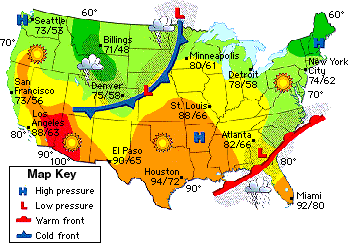
El Paso is currently __________, but will expect to  ________ within the next 24hrs. 
a)
cold, become warm
b)
warm, become cold
c)
warm, stay warm
d)
cold, stay cold
40.
The _____________ the isobars on a map are to/from one another the ___________ the wind.
a)
closer, slower
b)
closer, faster
c)
farther, faster
41.
A high pressure system is located north of New York City. What type of weather will be experienced there?
a)
clear, sunny skies
b)
cloudy and rainy
42.
This weather tool measures wind speed and direction
a)
thermometer
b)
barometer
c)
anemometer
d)
psychrometer
43.

Severe weather, like hurricanes and tornadoes, are associated with what type of cloud?

a)

altocirrus

b)

stratocumulus

c)

cirrostratus

d)

cumulonimbus

44.

What role do oceans play in hurricane formation?

a)

they provide cool, dense water

b)

warm water near equator supplies energy to hurricanes

c)

warm ocean water slows hurricane formation

d)

cold ocean water supplies energy to hurricanes

45.
The tropical winds running from 0 to 30 degrees latitude are called:
a)
subtropical westerlies
b)
polar westerlies
c)
trade winds
d)
polar winds
46.
Which graph best shows the general effect that differences in elevation above sea level have on the average annual temperature?
a)
1
b)
2
c)
3
d)
4
47.
What effect does a large body of water usually have on a nearby landmass?
a)
The water causes cooler summers and colder winters. 
b)
The water causes cooler summers and warmer winters. 
c)
The water causes hotter summers and warmer winters. 
d)
The water causes warmer summers and colder winters. 
48.
Why are temperature variations usually not as great on Long Island as they are in central New York State?
a)
Central New York State has a higher elevation.
b)
Central New York State is more heavily wooded.
c)
Long Island has a more southerly latitude.
d)
Long Island is surrounded by a large body of water. 
49.

What is letter C?

a)

Mid-Ocean Ridge

b)

Continental Shelf

c)

Continental Slope

d)

Abyssal Plain

50.

What is letter D?

a)

Continental Shelf

b)

Mid-Ocean Ridge

c)

Volcanic Island

d)

Seamount

51.

A seafloor feature that is a flat area of seafloor near a coastline that extends from the continent out into the ocean.

a)

continental slope

b)

continental shelf

c)

abyssal plain

d)

trench

52.
If you live near the ocean, in a marine climate, what kind of winters would you expect?
a)
Harsh, extreme winters
b)
Mild winters
c)
No winters at the beach.
53.
As you go to the top of a mountain, what happens to temperature?
a)
Nothing
b)
It increases
c)
It decreases
d)
It does what it wants
54.
El Nino occurs when the tropical ocean waters are warmer in which ocean?
a)
Atlantic
b)
Indian
c)
Pacific
d)
Arctic
55.

What is a correct statement that we can gather from this graph?

a)

As global temperatures rise, sea level rises due to more CO2 present

b)

As CO2 increases, global temperatures and sea level drop

c)

As CO2 decreases, global temperatures increase and sea level rises

d)

Sea levels rise due to global temperatures and CO2 decreasing

56.

Where do we find most of the water on Earth?

a)

in river systems as freshwater

b)

in glaciers on land as freshwater

c)

in oceans as saltwater

d)

in lakes as either salt or freshwater

57.
Melting of glaciers and polar ice caps....
a)
will result in cooler temperatures in the Arctic
b)
will result in sea-levels rising
c)
Will have no effect on ecosystems
d)
None of the above
58.
Surface currents are a result of
a)
Global Wind Patterns
b)
Earth's Rotation
c)
Density
d)
All of the above
59.

Deep Ocean currents are a result of

a)

salinity amounts

b)

Temperature

c)

Density

d)

All of the above

60.

Which atmosphere layer experiences the most temperature change?

a)

Thermosphere

b)

Mesosphere

c)

Stratosphere

d)

Troposphere