
 Worksheets
APES Unit 9
Total questions: 60
Worksheet time: 3600secs


Earth's average temperature has increased 1°C in the past century. Which reason best explains this increase in temperature?
lower levels of ozone in the atmosphere
lower levels of nitrogen in the atmosphere
higher levels of carbon dioxide in the atmosphere
higher levels of oxygen in the atmosphere
Which of the following gases is NOT a greenhouse gas?
carbon dioxide (CO2)
nitrogen (N2)
water vapor (H20)
methane (CH4)
Which of the following are evidence of climate change?
extreme weather events
increase in the average global temperature
melting of polar ice caps
all of the above
The main human activity that releases carbon dioxide (CO2) into the atmosphere is...
using bottled water
burning fossil fuels
texting on cellphones
eating meat
Which of the following is contributing to an increase in carbon dioxide (CO2) in the atmosphere?
deforestation
burning fossil fuels
burning down trees
all of the above
Which of the following is produced by cows?
Carbon Dioxide
Water Vapor
Argon
Methane
an area's climate changes and it gets LESS rainfall. what can happen?
more hurricanes
more forest fires
floods
more diseases
what human activities lead to an increase in the amount of greenhouse gases and therefore lead to climate change?
burning fossil fuels for energy
transportation (cars, planes, trains)
farming
all of the above
human activities lead to climate change and global warming because
there are LESS greenhouse gases in the atmosphere and the temperature decreases
there is the SAME amount of greenhouse gases in the atmosphere and the temperature stays the same
there are MORE greenhouse gases in the atmosphere and the temperature is increasing
Warming seas will...
Increase the number of storms
Decrease the number of storms
The number if storms will stay the same
Climate Change will cause...
More intense tropical storms
Less intense tropical storms
no more storms
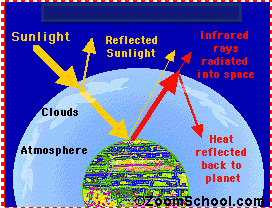
An example of a climate change mitigation strategy is
mandating more fuel efficient vehicles
building structures to protect from rising sea levels
species migration
using drought resistant crops
CFCs alter the natural formation of ozone by:
breaking up ozone
bonding with O3
preventing UV radiation to strike ozone

What is the main cause of coral bleaching?
Higher ocean temperatures
Not enough carbon dioxide is dissolved in ocean water
Whales chewing on coral reefs
Too much sunlight
One possible positive consequence of an increase in CO2 in the atmosphere?
Plants may grow faster and produce more sugars
Pests like pine beetles will die
Forest fires will be extinguished by the lack of oxygen
Corals will grow faster
What is Arctic (or polar) amplification?
the phenomenon that temperature near the poles is increasing at a higher rate than at lower latitudes
the intensification of the polar jet stream due to melting ice caps
the increased productivity of Arctic ecosystem due to increased upwelling
the migration of the polar front due to stronger pressure contrasts
Which of the following best describes the primary goal of the Paris Agreement?
to create a fund to help countries deal with disaster relief
to validate the science behind climate change for the global community
to keep the global climate temperature increase to under 2 degrees Celsius
to reduce deforestation worldwide

Which law regulates and protects endangered species within the US?
CITES
Endangered Species Act
Kyoto Protocol
Montreal Protocol
Which law regulates the trade in endangered species between countries?
CITES
Endangered Species Act
Kyoto Protocol
Montreal Protocol
Which of these attempts to reduce the rate of Global Warming by reducing greenhouse gas emissions?
CITES
Endangered Species Act
Kyoto Protocol
Montreal Protocol
Pick all of the following traits that make a species LESS likely to go extinct:
Ability to move to a new habitat
Inability to move to a new habitat
Being a specialist
Being a generalist
Pick all of the following traits that make a species More likely to go extinct:
Ability to move to a new habitat
Inability to move to a new habitat
Being a specialist
Being a generalist
Which of the following traits are most likely to be present in an invasive species?
Generalist
Specialist
r-selected species
K-selected species
Which of these is true about the melting of sea ice?
The cold, fresh water added helps to cools the ocean, counteracting the warming.
Ice has a higher albedo than the ocean's surface and so as ice melts, the ocean absorbs more heat.
The melting of sea ice strands polar bears who cannot swim between the "islands" of ice.
AcTUalLY ice ISN'T melting, it's all a conspiracy.
What is true about the melting of permafrost?
The melting of permafrost releases greenhouse gasses, which increases warming.
The melting of permafrost helps to regulate and cool down the air temperature in the arctic.
The melting of permafrost has no affect on anything.
The permafrost is a lie.
What is one of the main reasons for sea level rise?
As water melts, it expands.
Higher amounts of rainfall into the ocean.
As water heats up, it expands.
The ground is sinking down into the ocean.
Coral bleaching is most directly caused by:
Increasing plastic pollution
A parasitic symbiotic relationship
Increasing ocean temperatures
Invasive species
Coral bleaching is most directly caused by:
Increasing plastic pollution
A parasitic symbiotic relationship
Increasing ocean temperatures
Invasive species
Invasive species tend to be:
Generalists and K-selected
Generalists and r-selected
Specialists and K-selected
Specialists and r-selected
Which of the following is considered an indirect source of methane caused by human-lead climate change?
Increasing factory farming of cattle
Sea level change flooding wetlands
Droughts causing large wildfires
Melting of permafrost
Where is the ozone layer located?
Troposphere
Stratosphere
Mesosphere
Exosphere
Which of the following agreements lead to the reduction of CFC production?
Montreal Protocol
Kyoto Protocol
CITES
The Endangered Species Act
Which of the following GHGs does NOT have a global warming potential greater than 1?
Methane (CH4)
Nitrous Oxide (N2O)
HCFCs
Carbon Dioxide (CO2)
The type of energy that is trapped by greenhouse gases is:
Visible light
Ultraviolet (UV) radiation
Gamma radiation
Infrared (IR) radiation
The most severe effect resulting from an increase in insect species globally would likely be:
an increase in disease vectors
a reduction in water quality
an increase in soil erosion
a decline in food crop pollination
Which of the following aquatic species provides a habitat for thousands of other species?
coral reefs
zooxanthellae
phytoplankton
dolphins
The international legislation that establishes a list of species susceptible to international trade and thus endangerment is called the:
Endangered Species Act
Lacey Act
Marine Mammal Protection Act
CITES Treaty
Climate change would most likely have the greatest impact on which of the following groups of species?
generalists
organisms in the Arctic, such as polar bears
organisms in temperate communities adapted to seasonal changes
livestock
If a habitat has been fragmented by urban development, the best strategy to reduce harm to affected species is to implement:
catch-and-release programs
captive breeding in zoos
habitat corridors
introducing new species
Which of the following gases is the greatest overall contributor to the greenhouse effect?
carbon dioxide
methane
ozone
water vapor
Emissions of which GHG is most closely tied to the decreasing pH of ocean water?
methane
carbon dioxide
water vapor
nitrous oxide
Which of the following equations best represents the chemical changes that occur during ocean acidification?
CO2 + Ca + CO3 -> CaCO3
6CO2 + 6H2O -> C6H12O6 + 6O2
CH4 + 2O2 -> CO2 + 2H2O
CO2 + H2O -> 2H + CO3
Why are the poles warming at a faster rate than the rest of the world?
there are more GHGs being emitted near the poles
the melting of sea ice decreases the albedo
the melting of sea ice increases the albedo
the holes in the ozone layer are located over the poles
Habitat fragmentation will most likely harm which TWO groups of species?
generalists
specialists
large, apex predators
invasive species
Which group of chemicals is associated with destroying ozone in the ozone layer?
fertilizers
pesticides
CFCs
smog
Which of the following would increase in prevalence as a result of decreasing stratospheric ozone?
sunburns
melting of sea ice
air pollution
malaria, Zika, and other vector-borne illnesses
Which GHG is released from cows, landfills, and permafrost?
methane
nitrous oxides
carbon dioxide
HCFCs
Which GHG is released from agricultural practices, specifically fertilizers?
carbon dioxide
HCFCs
methane
nitrous oxides
Which GHG is primarily released from the combustion of fossil fuels?
methane
nitrous oxides
water vapor
carbon dioxide

