
Font size
 Worksheets
Bonding and Naming Test Review
Total questions: 38
Worksheet time: 19mins
Ionic bonds involve
attraction between water and salts.
electrostatic interactions between anions and cations.
the release of protons by negatively charged particles.
the sharing of electrons between two atoms of the same element.
An ionic bond takes place between
two metals.
two nonmetals.
a metal and a metalloid.
a metal and a nonmetal.
In the formation of the compound of sodium chloride
a chloride ion donates two protons to a sodium ion.
a chlorine atom donates an electron to a sodium atom.
a sodium atom donates an electron to a chlorine atom.
the sodium and chlorine atoms share a pair of electrons equally.
How do electrons move in a metallic bond?
freely around all of the atoms
around only the heaviest atoms
around only atoms with small diameters
tightly around the atom with the most bonds
Which rule must be fulfilled by sharing or transferring electrons to create bonds in order for an element to be stable?
octet rule
ionic rule
septet rule
covalent rule
Covalent bonds take place between
a metal and a nonmetal.
a metal and a metalloid.
two nonmetals.
two metals.
Which type of bond is formed by transferring electrons from one element to another?
ionic
partial
covalent
metallic
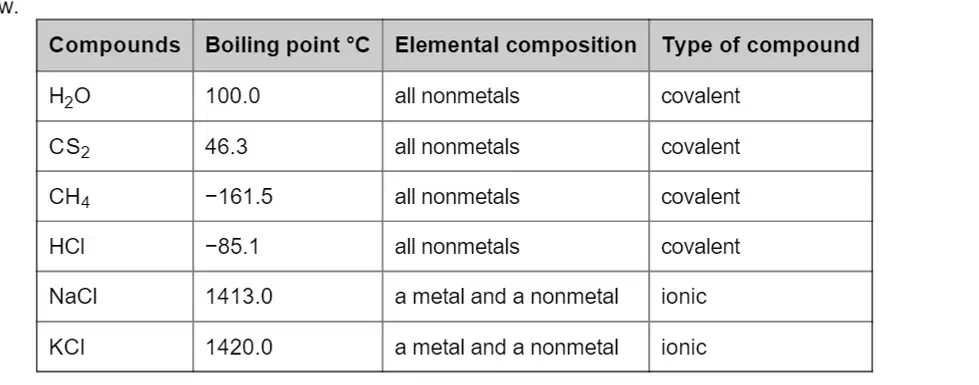
Galen lists the properties of four covalent compounds and two ionic compounds in the table below. If his teacher asks him about a different covalent compound, what can he predict about its properties? Select all that apply. Pick up to 6 answers.
It consists of all metals.
It consists of all nonmetals.
It has a high boiling point.
It has a low boiling point.
It consists of all semimetals.
How many electrons do most atoms seek to obtain in their valence shell?
8
2
4
6
Magnesium must bond with two atoms of chlorine to form magnesium chloride because
magnesium can share two electrons when bonding and chlorine can share one.
magnesium can share one electron when bonding and each chlorine can share two.
magnesium has one valence electron to use in bonding and each chlorine can receive two.
magnesium has two valence electrons to use in bonding and each chlorine can only receive one.

The following table summarizes melting points for different types of compounds. How does the type of compound relate to its melting point?
The melting points of ionic and covalent compounds show no relationship.
The melting points for ionic compounds are lower than for covalent compounds.
The melting points for ionic compounds are higher than for covalent compounds.
The melting points for ionic compounds are equal to those for covalent compounds.
Which chemical formula represents a covalent compound because they share electrons?
NaCl
MgO
CO₂
KI
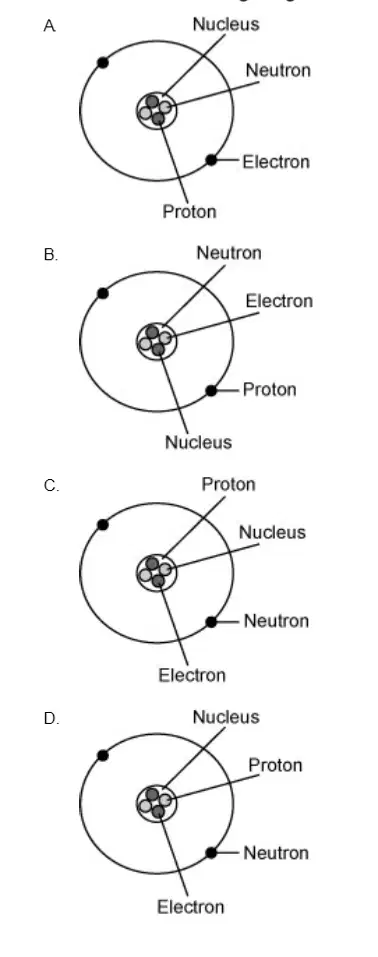
Which of the following diagrams has the parts of an atom correctly labeled?
A
B
C
D
Which type of compound is formed when potassium and chlorine react?
ionic
isotopic
molecular
nuclear
What happens when a sodium atom becomes a sodium ion?
A valence electron is gained.
A valence electron is lost.
A proton is gained.
A proton is lost.
What is the formula for the compound formed by aluminum (Al) and the carbonate ion, CO₃²⁻?
AlCO₃
Al₂CO₃
Al₂(CO₃)₃
Al(CO₃)₃
What is the formula for the compound formed by the barium ion, Ba²⁺, and the hydroxide ion, OH⁻?
BaOH
BaOH₂
Ba(OH)₂
Ba₂(OH)₁
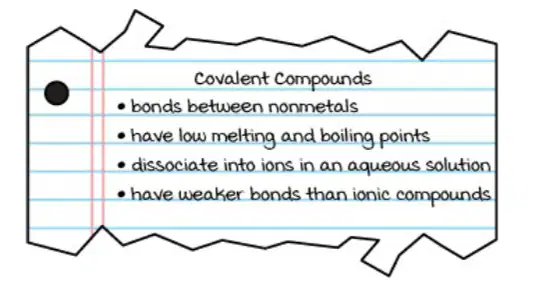
Julio wrote some facts about covalent compounds in his lab notebook. Julio made a mistake in his list. Which statement best describes the mistake he made?
Covalent compounds do not have bonds between nonmetals; they are between a nonmetal and a metal.
Covalent compounds do not have low melting and boiling points; they have high melting and boiling points.
Covalent compounds do not dissociate into ions in an aqueous solution; they are not conductive in an aqueous solution.
Covalent compounds do not have weaker bonds than ionic compounds; they have stronger bonds than ionic compounds.
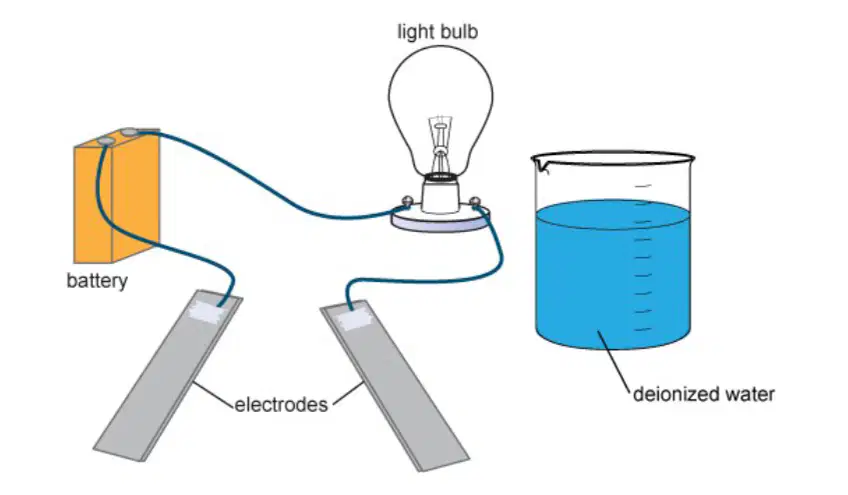
Tyrone is making a circuit at home. He knows if he puts the electrodes into the deionized water, it will not conduct electricity and his circuit will not work. Which compound could Tyrone mix into with the water so that his circuit will work?
NaCl (salt) because it is an ionic compound which will dissociate in water and make the water conduct electricity
NaCl (salt) because it is a covalent compound which will dissociate in water and make the water conduct electricity
C₆H₁₂O₆ (sugar) because it is an ionic compound which will dissociate in water and make the water conduct electricity
C₆H₁₂O₆ (sugar) because it is a covalent compound which will dissociate in water and make the water conduct electricity
How many total electrons are shared in a single covalent bond?
2
1
4
6
What subatomic particles are contained inside an atom?
Atoms contain neutrons and protons inside the nucleus and electrons in a space outside the nucleus.
Atoms contain electrons and protons inside the nucleus and neutrons in a space outside the nucleus.
Atoms contain nuclei and neutrons inside the electron and protons in a space outside the electron.
Atoms contain electrons and nuclei inside the proton and neutrons in a space outside the proton.
What is the compound that would result from mixing lithium with the polyatomic known as hydroxide (OH)?
LiOH
Li₃(OH)₂
OHLi
LiH
Iron and oxygen react to form iron(III) oxide which is also called rust. What is the chemical formula for iron(III) oxide?
Fe₂O
Fe₂O₃
Fe₃O₂
FeO₃
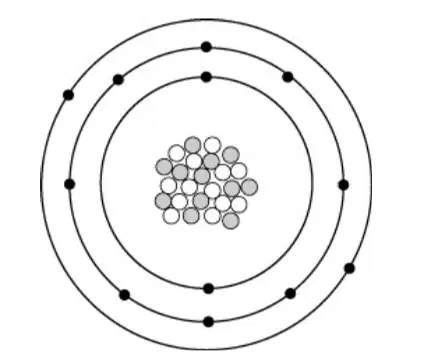
The picture shows a basic model of a neutral atom of an element. The model represents:
a magnesium isotope.
an aluminum isotope.
a manganese atom.
a chromium atom.

What is the net charge of the structure in the figure below?
1-
1+
2+
2-
A neutral atom contains eight protons, nine neutrons, and eight electrons. The atom must be
an oxygen isotope.
a nitrogen isotope.
a fluorine isotope.
a neon isotope.
Which describes an atom with a negative net charge?
It contains more electrons than protons.
It contains more protons than electrons.
It contains more neutrons than protons.
It contains more neutrons than electrons.
How many protons are in the nucleus of a sodium atom?
11
10
12
13
Which element has atoms that contain 50 protons in their nuclei?
strontium
tin
titanium
vanadium
Which ion has a charge of 2+?
an ion with 10 protons, 10 neutrons, and 10 electrons
an ion with 10 protons, 9 neutrons, and 8 electrons
an ion with 8 protons, 9 neutrons, and 10 electrons
an ion with 8 protons, 10 neutrons, and 8 electrons
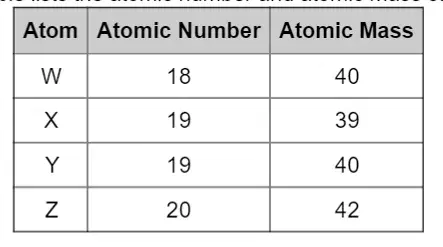
The table lists the atomic number and atomic mass of four different atoms. Which atoms are isotopes of the same element?
atom W and atom X
atom W and atom Y
atom X and atom Y
atom X and atom Z
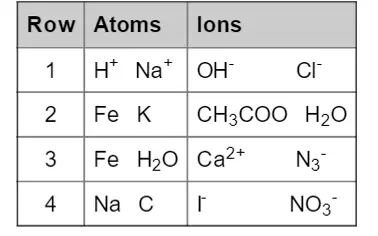
A table of atoms and ions is shown below. Which row correctly classifies atoms and ions?
1
2
3
4
Two atoms each contain 6 protons, but one has 6 neutrons and the other has 8 neutrons. What are these atoms called?
binaries
ions
isotopes
radicals
A neutral atom of nitrogen has an atomic number of 7 and an atomic mass of 15 amu. How many protons, electrons, and neutrons does a neutral atom of nitrogen have?
7 protons, 7 electrons, and 7 neutrons
7 protons, 8 electrons, and 8 neutrons
7 protons, 7 electrons, and 8 neutrons
7 protons, 8 electrons, and 7 neutrons
An atom of silicon (Si) contains how many electrons?
7
14
16
28
An aluminum isotope consists of 13 protons, 13 electrons and 14 neutrons. What is its mass number?
13
14
27
40
A sodium ion, Na⁺, has a positive charge because it
gained an electron.
lost a proton.
gained a neutron.
lost an electron.
Why is an atom neutral?
It has an equal number of neutrons and quarks.
It has an equal number of neutrons and electrons.
It has an equal number of protons and electrons.
It has an equal number of protons and quarks.

