
 Worksheets
Nuclear Review
Total questions: 34
Worksheet time: 2hrs 42mins
Name
Class
Date
1.
Solve this equation for alpha decay.
20985At = ___ + 42He
20985At = ___ + 42He
a)
20583Bi
b)
20986Rn
c)
20781Tl
d)
20885At
2.
Solve this equation for alpha decay.
22688Ra = ___ + 42He
22688Ra = ___ + 42He
a)
22286Rn
b)
22689Ac
c)
22484Po
d)
22588Ra
3.
Solve this equation for beta decay.
6027Co = ___ + 0-1e
6027Co = ___ + 0-1e
a)
5625Mn
b)
6028Ni
c)
5823V
d)
5927Co
4.
Solve this equation for beta decay.
146C = ___ + 0-1e
146C = ___ + 0-1e
a)
104Be
b)
147N
c)
102He
d)
136C
5.
The following is an example of what type of reaction?
24395Am → 23993Np + 42He
24395Am → 23993Np + 42He
a)
alpha decay
b)
beta decay
c)
gamma decay
6.
If we start off with element 5024X after an alpha decay we get another element Y that looks like
a)
5022Y
b)
4622Y
c)
4820Y
d)
5426Y
7.
Solve this equation for alpha decay.
20985At = ___ + 42He
20985At = ___ + 42He
a)
20583Bi
b)
20986Rn
c)
20781Tl
d)
20885At
8.
Solve this equation for alpha decay.
22688Ra = ___ + 42He
22688Ra = ___ + 42He
a)
22286Rn
b)
22689Ac
c)
22484Po
d)
22588Ra
9.
Solve this equation for beta decay.
6027Co = ___ + 0-1e
6027Co = ___ + 0-1e
a)
5625Mn
b)
6028Ni
c)
5823V
d)
5927Co
10.
Solve this equation for beta decay.
146C = ___ + 0-1e
146C = ___ + 0-1e
a)
104Be
b)
147N
c)
102He
d)
136C
11.
The following is an example of what type of reaction?
24395Am → 23993Np + 42He
24395Am → 23993Np + 42He
a)
alpha decay
b)
beta decay
c)
gamma decay
12.

What particle completes this reaction?
a)
alpha particle
b)
beta particle
c)
gamma particle
d)
neutron
13.
Solve this equation for alpha decay.
22688Ra = ___ + 42He
22688Ra = ___ + 42He
a)
22286Rn
b)
22689Ac
c)
22484Po
d)
22588Ra
14.

Which type of nuclear radiation is being emitted here?
a)
Alpha
b)
Beta
c)
Gamma
d)
none
15.
The half-life of strontium-90 is 25 years. How much strontium-90 will remain after 100 years if the initial amount is 4.0 g?
a)
3.0g
b)
0.25mg
c)
0.3g
d)
0.25g
16.
Takes two small nuclei and combines them into a larger nucleus
a)
fission
b)
fusion
17.
The splitting of a nucleus into smaller nuclei is
a)
fusion
b)
fission
c)
half-life
d)
gamma radiation
18.
How do nuclear power-plants work?
a)
Fusion
b)
Half-life
c)
Fission
d)
Fusion or fission
19.
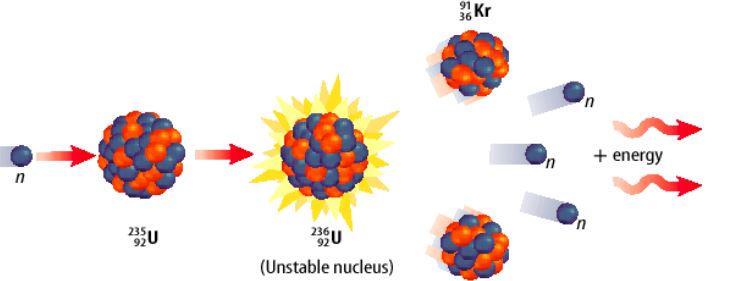
This is an example of...
a)
Fission reaction
b)
Fusion reaction
c)
Decomposition reaction
d)
Decay
20.
Where does fusion occur naturally?
a)
Underwater
b)
All around us
c)
In the radioactive waste
d)
On the sun
21.
An example of an uncontrolled fission reaction is _______________
a)
Nuclear power plants
b)
Radio active decay
c)
Atomic Bomb
d)
On the surface of the sun
22.
_________ happens naturally due to an unstable nucleus.
a)
fission
b)
fusion
c)
radioactive decay
d)
K-capture
23.
What is a benefit of nuclear fission?
a)
The ability to absorb energy
b)
The ability to release tremendous amounts of energy
c)
The ability to produce more energy than nuclear fusion
d)
There are no beneficial aspects of nuclear fission
24.
Very high temperature and pressure is required for:
a)
Fission
b)
Fusion
c)
Radioactive Decay
25.
What is Half-life?
a)
The amount of time it takes for some of the nuclei in a sample of the isotope to decay
b)
The amount of time it takes for half the electrons in a sample of the isotope to decay
c)
The amount of time it takes for half the nuclei in a sample of the isotope to decay
d)
the amount of time it takes to double the nuclei in a sample of the isotope to decay
26.
You have 100 grams of radioactive C-14. The half life of C-14 is 5730 years.
How many grams are left after 2 half lives?
a)
100 grams
b)
25 grams
c)
50 grams
d)
14 grams
27.
If 20 mg of iodine-131 is given to a patient, how much is left after 32 days? The half-life of iodine-131 is 8 days.
a)
32
b)
1.25
c)
10
d)
2.5
28.
The type of radioactive particle that can be stopped by a sheet of paper is the ____.
a)
alpha particle
b)
beta particle
c)
gamma ray
d)
uranium
29.
Gamma rays _________.
a)
have no mass and no charge
b)
have mass but no charge
c)
have no mass but have charge
d)
have mass and charge
30.
Negatively charged particles emitted from a nucleus at a high speed are ____.
a)
alpha particle
b)
gamma rays
c)
beta particles
d)
X rays
31.
Which are the 3 main types of nuclear decay?
a)
Alpha, beta, gamma
b)
Beta, gamma, positron emission
c)
Gamma, positron emission, electron capture
d)
Beta, positron emission, electron capture
32.
A material that can stop gamma radiation is
a)
lead
b)
jello
c)
sunscreen
d)
wood
33.
A material that can stop alpha radiation is
a)
lead
b)
paper
c)
sunscreen
d)
wood
34.
An isotope is an atom of an element with a different number of
a)
protons
b)
electrons
c)
neutrons
d)
pencils
100 %

