
 Worksheets
Unit 2 Review
Total questions: 114
Worksheet time: 1hrs 9mins

Identify cholesterol molecule
structure a
structure b
structure h
structure i

Identify a peripheral protein
structure a
strucure b
structure g
structure h
Plasma membranes are selectively permeable. This means
anything can pass in and out
the membrane regulates the passage of the material in and out of the cell
glucose cannot enter the cell
cholesterol cannot enter
Small, nonpolar, hydrophobic molecules such as fatty acids
easily pass through the membrane's bilayer
very slowly diffuse through the bilayer
require transport proteins
enter through endocytosis
What do diffusion and osmosis have in common?
They only happen in living cells.
They require transport proteins in the membrane.
They are passive transport mechanisms.
Net movement of substances is against the concentration gradient.

What is the difference between simple diffusion and facilitated diffusion?
A
B
C
D
Which one of the following is not a function performed by a membrane protein?
Cell adhesion
Enzyme
Hormone (Receptor) binding sites
Vesicle Transport
Which of the following is a feature of exocytosis but not endocytosis?
Shape changes of a membrane
Vesicle formation
Use of ATP
Secretion
What is essential for diffusion?
A concentration gradient
A selectively permeable membrane
A source of energy
A protein

Which pair of characteristics are correct for the cellular processes of exocytosis and endocytosis?
A
B
C
D
Which statements are characteristics of diffusion through membranes?
I. Polysaccharides can be transported.
II. It can be facilitated by special channels.
III. It is affected by concentration gradients.
I and II only
I and III only
II and III only
I, II and III

The graph shows the rate of transport of a molecule across the plasma membrane of a cell. It does not require ATP.
Which of the following is/are true for this graph?
The molecule is transported by simple diffusion
The graph is levelling out because channel proteins are becoming saturated
The rate of transport is initially limited by the number of empty channel proteins
The molecule is transported by active transport.
Salt is added to pure water.
Which of the following is/are true?
The solution will be more dilute
The solution will be less hypotonic
The solution will be more hypertonic
The solution will have a lower solute concentration

Potato cylinders were incubated in different concentrations of sucrose overnight. The graph shows their % change in mass at each sucrose concentration.
What was the concentration of sucrose inside the potato cells?
0.30 M
0.45 M
0.70 M
0.85 M
Explain how the fluid mosaic model of the cell membrane supports its function in regulating the internal environment of the cell. Consider the arrangement and movement of molecules within the membrane.
The model suggests a rigid structure where molecules are fixed, preventing any substance from entering or leaving the cell.
The model depicts the membrane as a dynamic structure with proteins and lipids that move laterally, allowing selective permeability and fluidity.
It proposes that the membrane is completely permeable to all molecules, which helps in the unrestricted exchange of substances.
The model indicates that the membrane is impermeable, enhancing the cell's ability to maintain a stable internal environment by isolation.
Design an experiment to test the selective permeability of a cell membrane to different sized molecules. Describe the setup and predict what your results would indicate about the membrane's properties.
Use a dialysis tubing filled with starch and glucose solutions, submerged in water, and measure the diffusion of each molecule after a set period.
Place a cell in a solution of large proteins and observe the cell's growth over time.
Submerge a cell in pure water and measure the rate of water entering the cell.
Expose a cell to varying temperatures and record the structural changes in the membrane.
You put a cell into a solution, the cell grows. Is the solution hypotonic or hypertonic to the cell?
hypertonic
hypotonic
isotonic
not enough information

What type of solution is this cell in?
Isotonic
Hypertonic
Hypotonic
Diffused
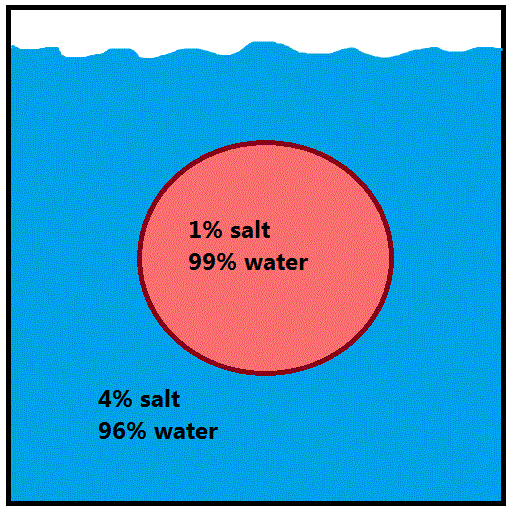
Where will the water go?
Into the cell
Out of the cell
Equally in & out - it's isotonic
There is no water
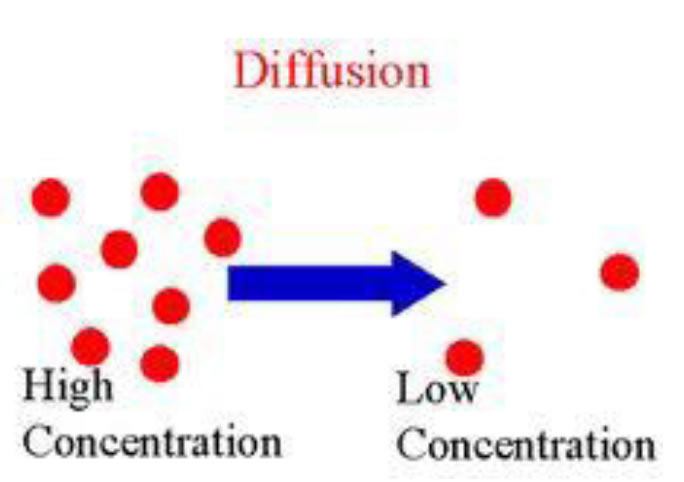
The cell membrane helps to maintain homeostasis by ...
regulating what enters and leaves the cell.
fighting foreign substances that enter the cell.
providing a rigid support system for the cell.
assisting the cell in movement
one layer
two layers
laminated
bilateral
Lipids
Carbohydrates
Proteins
Nucleic acids

E
B
C
A

A
C
D
E

The structure in the membrane that would most likely serve as a carrier protein is ...
Structure A
Structure B
Structure C
Structure D
The main difference between passive transport and active transport is ...
passive transport requires energy
active transport moves substances "down" their concentration gradient
active transport requires energy
passive transport moves substances "up" their concentration gradient
When solutes diffuse, they move ....
from low concentration to high concentration
from high concentration to low concentration
"up" the concentration gradient
randomly
Osmosis is strictly about ....
the movement of solutes
the movement of solutes across a membrane
the movement of gases
the movement of water across a membrane
Particles diffuse naturally due to ...
gravity
the kinetic energy of the particles
attractive forces between the atoms in the different particles
the motion of the Earth
In the lab we did with food coloring in hot and cold water, we observed that ....
the rate of diffusion decreases when the particles are hot.
the rate of diffusion decreases when the particles are cold.
the rate of diffusion was not affected by temperature.
particles cannot diffuse in very cold water.

The U-shaped tube has 2 different mixtures of salt water in it and the 2 solutions are separated from each other by a semi-permeable membrane. The membrane is not permeable to salt but it is to water. What will the tube look like in a few hours if it is left to rest a it is?
The salt particles (red dots) will move to the right side of the tube.
The salt particles (red dots) will move to the left side of the tube.
water will move to the left side of the tube.
water will move to the right side of the tube.

This tube has 2 solutions in it. They are separated by a semipermeable membrane at the bottom of the tube. How would you describe the 2 solutions in the tube?
Side A is hypertonic to side B
Side A is hypotonic to side B
Side A is isotonic to side B
Side B is hypertonic to side A.
The 2 characteristics that determine if a molecule can diffuse through a plasma membrane are _________ and ________ .
mass and state
density and charge
color and state (solid, liquid or gas)
size and charge
A molecule that could diffuse through the cell membrane would have to be ....
light-weight and opaque
non-polar and small
heavy and small
polar and small
An example of a molecule that could MOVE BY DIFFUSION across a cell membrane is ....
oxygen (O2)
glucose
water
proteins
Solutes in a solution will continue to diffuse until ....
they get old and worn out
they lose their charges
they are equally dispersed.
they become too small
Once the particles in a solution hit equilibrium, they ....
quit moving
move back in the same direction they came from
continue to move in the direction they were going
continue to move but in no particular direction

If the semi-permeable membrane in this image is not permeable to the solute (sugar) but is permeable to water, what will occur next?
The overall net change in molecules will be water molecules into solution B.
The overall net change in molecules will be water molecules into solution A.
The overall net change in molecules will be sugar molecules into solution A.
Their will be no (zero) overall net change in any of the molecules (water or sugar).

Tonicity refers to the concentration of solutes. Observe the diagram. If a cell is in a hypotonic environment, this means that..
there is less solute outside the cell than inside the cell.
there is an equal amount of solutes inside as outside the cell.
there is more solute outside of the cell than in the cell.

Match option A to the type of environment that cell is in:
Hypotonic
Isotonic
Hypertonic
A cell will swell when it is placed in a(n)
Hypotonic Solution
Hypertonic Solution
Isotonic Solution
None of the above.

The yellow and brown portion of this image is:
protein
phopholipid
carbohydrate
cholesterol
How does a cell maintain homeostasis?
It is selectively permeable
Flexibility
Protective barrier
Structure and support
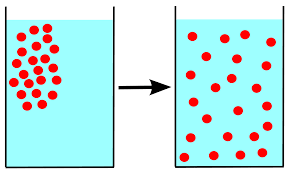


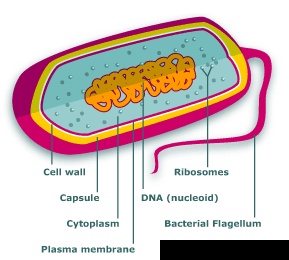


True or False: Both prokaryotes and eukaryotes have ribosomes and a plasma membrane.
True
False

What type of cell is shown?
Plant cell
Prokaryotic cell
Bacteria cell
Eukaryotic cell

What type of cell is shown?
Eukaryotic cell
Bacteria cell
Prokaryotic cell
Animal cell
I have DNA but no membrane-bound organelles, what am I?
Eukaryote
Prokaryote
Animal cell
Plant cell
I have membrane-bound organelles and DNA, what am I?
Prokaryote
Chloroplast
Bacteria
Eukaryote
Which of the following has organelles?
prokaryotes
eukaryotes
prokaryotes and eukaryotes
Which of the following has DNA?
prokaryotes
eukaryotes
prokaryotes and eukaryotes
Animals are an example of __________.
prokaryotes
eukaryotes


Molecules that contain mostly carbon and hydrogen are called (a) .


All living things are made of...
atoms
cells
bacteria
plants

Where is the DNA found in a prokaryotic cell?
floating around in the cytoplasm
in the nucleus

Under a microscope, what kind of cells lack (do not have) membrane-bound organelles?
Prokaryotes
Eukaryotes
Plants
Animals

Controls what enters/leaves a cell
cell membrane
Nuclear membrane
cell wall
cytoplasm

control, read, and direct the cell using DNA instructions
nucleus
mitochondria
endoplasmic reticulum
lysosome

stiff, protective outer layer of plant cells
cell membrane
nuclear membrane
cell wall
cytoplasm

releases the energy for cells to use by creating ATP
mitochondria
ribosomes
lysosomes
nucleolus

Amino acids link together to form proteins. In which organelle would this process occur?
Lysosome
Ribosome
Centriole
Mitochondria

packages proteins for delivery
Endoplasmic reticulum
ribosomes
golgi apparatus
lysosomes

hold/store water, mainly found in plant cells
nuclolus
ribosomes
golgi bodies
vacuoles

break down (digest) worn out cell parts, mostly in animal cells
cytoplasm
lysosomes
mitochondria
vacuoles

Jello-like material, fills the space between cell organelles and holds them securely in place.
cytoplasm
chromatin
chloroplast
cell membrane



