
 Worksheets
Reading 3 - Statistical Measures of Asset Returns
Total questions: 61
Worksheet time: 31mins
A company reports its past six years' earnings growth at 10%, 14%, 12%, 10%, –10%, and 12%. The company's average compound annual growth rate of earnings is closest to:
8.0%.
7.7%.
8.5%.
Cameron Ryan wants to make an offer on the condominium he is renting. He takes a sample of prices of condominiums in his development that closed in the last five months. Sample prices are as follows (amounts are in thousands of dollars): $125, $175, $150, $155 and $135. The sample standard deviation is closest to:
370.00.
19.24.
38.47.
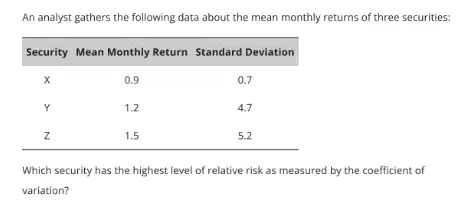
X.
Z.
Y.
An analyst takes a sample of yearly returns of aggressive growth funds resulting in the following data set: 25, 15, 35, 45, and 55. The mean absolute deviation (MAD) of the data set is closest to:
16.
12.
20.
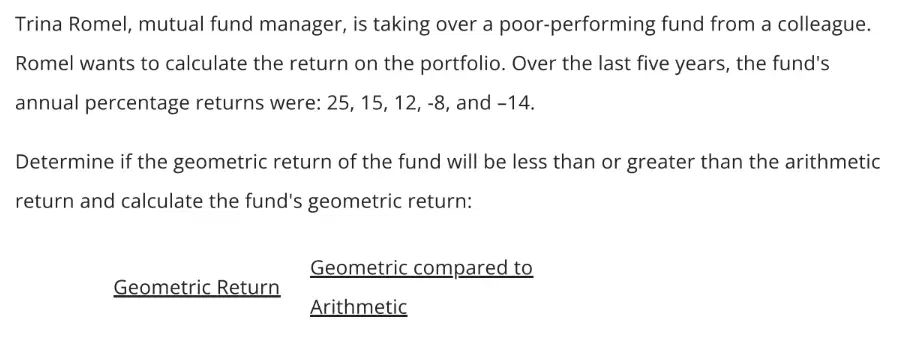
12.86%greater than
4.96%greater than
4.96% less than
What is the compound annual growth rate for stock A which has annual returns of 5.60%, 22.67%, and -5.23%?
7.08%.
6.00%.
8.72%.
A portfolio is equally invested in Stock A, with an expected return of 6%, and Stock B, with an expected return of 10%, and a risk-free asset with a return of 5%. The expected return on the portfolio is:
7.0%.
7.4%.
8.0%.
Consider the following set of stock returns: 12%, 23%, 27%, 10%, 7%, 20%,15%. The third quartile is:
20.0%.
21.5%.
23%.
A portfolio's monthly returns follow a distribution with a kurtosis measure of 4.2. Relative to a portfolio with normally distributed returns, this portfolio has a:
higher probability of extreme upside returns and higher chance of extreme downside returns.
lower probability of extreme upside returns and higher chance of extreme downside returns.
higher probability of extreme upside returns and lower chance of extreme downside returns.
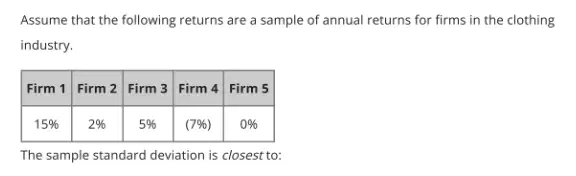
5.7.
7.2.
8.0.
For a unimodal distribution with negative skewness:
the mean is greater than the mode.
the median is greater than the mean.
the mode is less than the median.
In a negatively skewed distribution, what is the order (from lowest value to highest) for the distribution's mode, mean, and median values?
Mean, median, mode.
Median, mode, mean.
Mode, mean, median.
For the past three years, Acme Corp. has generated the following sample returns on equity (ROE): 4%, 10%, and 1%. What is the sample variance of the ROE over the last three years?
21.0(%^2).
4.6%.
21.0%.
An analyst observes the following four annual returns: R1 = +10%, R2 = –15%, R3 = 0%, and R4 = +5%. The average compound annual rate over the four years is closest to:
0.0%.
–0.5%.
–5.0%.
A distribution with a mode of 10 and a range of 2 to 25 would most likely be:
positively skewed.
negatively skewed.
normally distributed.
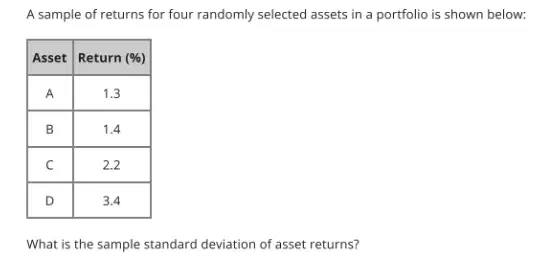
0.88%.
0.97%.
1.13%.
For the last four years, the returns for XYZ Corporation's stock have been 10.4%, 8.1%, 3.2%, and 15.0%. The equivalent compound annual rate is:
9.1%
8.9%
9.2%
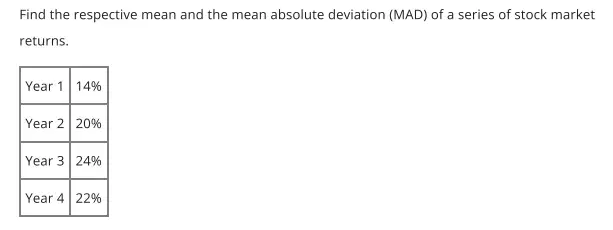
20%; 12%
22%; 3%
20%; 3%
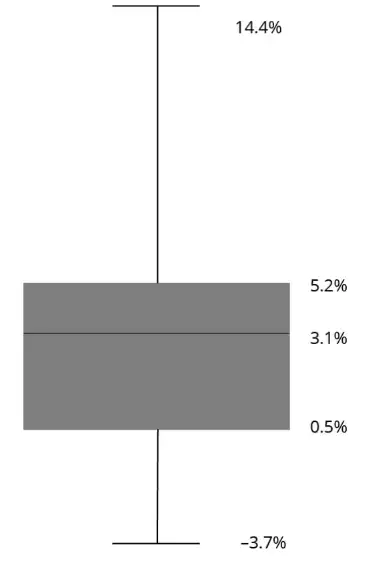
Given the following box-and-whisker plot: The interquartile range is:
0.5% to 5.2%
3.1% to 5.2%
0.5% to 3.1%
If Stock X's expected return is 30% and its expected standard deviation is 5%, Stock X's expected coefficient of variation is:
0.167
1.20
6.0
Given the following set of data: 17, 3, 13 , 3, 5, 9, 8 The value 8 is most accurately described as the:
mean
median
mode
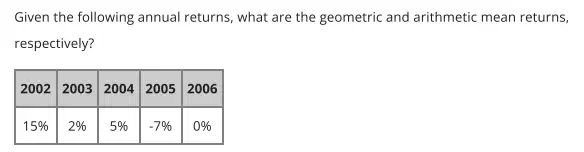
1.45%; 3.00%
2.75%; 3.00%
2.75%; 5.80%
A distribution of returns that has a greater percentage of small deviations from the mean and a greater percentage of large deviations from the mean compared to a normal distribution:
has positive excess kurtosis
has negative excess kurtosis
is positively skewed
If a distribution is positively skewed, then generally:
mean < median < mode
mean > median < mode
mean > median > mode
The following data points are observed returns. 4.2%, 6.8%, 7.0%, 10.9%, 11.6%, 14.4%, 17.0%, 19.0%, 22.5% What return lies at the 70th percentile (70% of returns lie below this return)?
14.4%
17.0%
19.0%
Which of the following statements about kurtosis is least accurate? Kurtosis:
describes the degree to which a distribution is not symmetric about its mean
is used to reflect the probability of extreme outcomes for a return distribution
measures the peakedness of a distribution reflecting a greater or lesser concentration of returns around the mean
Consider the following statements about the geometric and arithmetic means as measures of central tendency. Which statement is least accurate?
The geometric mean may be used to estimate the average return over a one-period time horizon because it is the average of one-period returns
The difference between the geometric mean and the arithmetic mean increases with an increase in variability between period-to-period observations
The geometric mean calculates the rate of return that would have to be earned each year to match the actual, cumulative investment performance
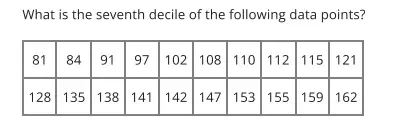
142.0
141.0
141.7
The mean monthly return on a sample of small stocks is 4.56% with a standard deviation of 3.56%. If the risk-free rate is 1%, what is the coefficient of variation?
1.28
1.00
0.78
What is the coefficient of variation for a distribution with a mean of 10 and a variance of 4?
20%
25%
40%
A distribution that has positive excess kurtosis is:
more peaked than a normal distribution
more skewed than a normal distribution
less peaked than a normal distribution
An investor has a portfolio with 10% cash, 30% bonds, and 60% stock. If last year's return on cash was 2.0%, the return on bonds was 9.5%, and the return on stock was 25%, what was the return on the investor's portfolio?
12.17%.
18.05%.
11.77%.
An investor has a $12,000 portfolio consisting of $7,000 in stock P with an expected return of 20% and $5,000 in stock Q with an expected return of 10%. What is the investor's expected return on the portfolio?
15.8%.
15.0%.
30.0%.
Michael Philizaire decides to calculate the geometric average of the appreciation/deprecation of his home over the last five years. Using comparable sales and market data he obtains from a local real estate appraiser, Philizaire calculates the year-to-year percentage change in the value of his home as follows: 20, 15, 0, –5, –5. The geometric return is closest to:
0.00%.
4.49%.
11.60%.
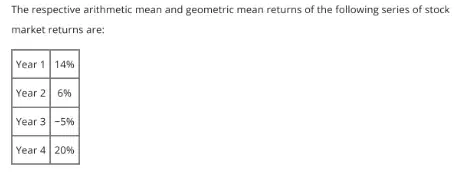
8.75%; 8.62%.
8.90%; 8.62%.
8.75%; 8.34%.
Which of the following statements concerning kurtosis is most accurate?
A distribution with kurtosis of +2 has fatter tails than a normal distribution.
A leptokurtic distribution has excess kurtosis less than zero.
A leptokurtic distribution has fatter tails than a normal distribution.
What are the median and the third quintile of the following data points, respectively? 9.2%, 10.1%, 11.5%, 11.9%, 12.2%, 12.8%, 13.1%, 13.6%, 13.9%, 14.2%, 14.8%, 14.9%, 15.4%
12.8%; 13.6%.
13.1%; 13.6%.
13.1%; 13.7%.
An analyst compiles the returns on Fund Q over the last four years respectively: 4%, 3%, 2%, and 30%. Which of the following will result in the lowest measure of the mean return?
The arithmetic mean.
The geometric mean.
The harmonic mean.
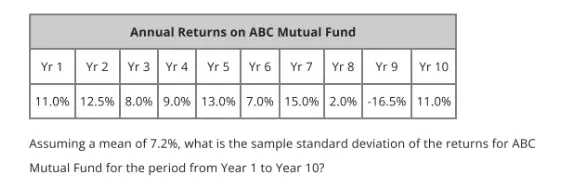
7.8%.
9.8%.
9.1%.
Which of the following statements concerning skewness is least accurate? A distribution with:
skew equal to 1 is not symmetrical.
negative skewness has a large number of outliers on its left side.
positive skewness has a long left tail.
A 5% trimmed mean ignores the:
highest and lowest 5% of observations.
highest and lowest 2.5% of observations.
lowest 5% of observations.
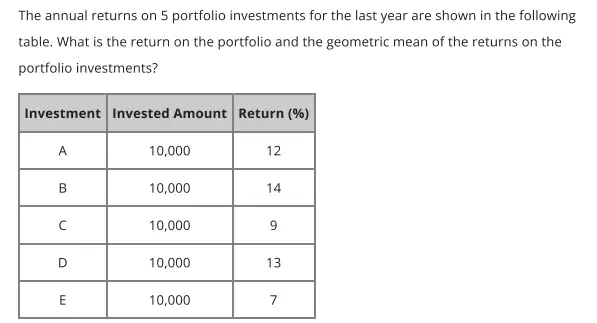
11.00; 10.78.
11.00; 10.97.
11.64; 10.97.
Twenty Level I CFA candidates in a study group took a practice exam and want to determine the distribution of their scores. When they grade their exams they discover that one of them skipped an ethics question and subsequently filled in the rest of his answers in the wrong places, leaving him with a much lower score than the rest of the group. If they include this candidate's score, their distribution will most likely:
have a mean that is less than its median.
be positively skewed.
have a mode that is less than its median.
The correlation between two variables is –0.74. The most appropriate way to interpret this correlation is that:
if one of the variables increases, there is a 74% probability that the other variable will decrease.
the two variables have a negative linear association.
there is unlikely to be a strong linear relationship between the two variables.
The following annualized monthly return measures have been calculated for an investment based on its performance over the last 72 months. Arithmetic mean = 6.8%, Geometric mean = 6.0% and 90% Winsorized mean = 5.5% If for one month in the period the return was extremely high, which measure best reflects the central tendency of the investment's returns?
Winsorized mean.
Geometric mean.
Arithmetic mean.
In a positively skewed distribution, what is the order (from lowest value to highest) for the distribution's mode, mean, and median values?
Mode, mean, median.
Mode, median, mean.
Mean, median, mode.
The owner of a company has recently decided to raise the salary of one employee, who was already making the highest salary in the company, by 40%. Which of the following value(s) is (are) expected to be affected by this raise?
mean only.
both mean and median.
median only.
Which of the following statements concerning a distribution with positive skewness and positive excess kurtosis is least accurate?
It has a lower percentage of small deviations from the mean than a normal distribution.
It has fatter tails than a normal distribution.
The mean will be greater than the mode.
The mean monthly return on a security is 0.42% with a standard deviation of 0.25%. What is the coefficient of variation?
168%.
60%.
84%.
What does it mean to say that an observation is at the sixty-fifth percentile?
The observation falls within the 65th of 100 intervals.
65% of all the observations are below that observation.
65% of all the observations are above that observation.
If the historical mean return on an investment is 2.0%, the standard deviation is 8.8%, and the risk free rate is 0.5%, what is the coefficient of variation (CV)?
0.17.
4.40.
0.23.
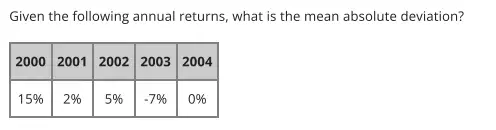
0.0%.
3.0%.
5.6%.
A distribution that is more peaked than a normal distribution is termed:
platykurtic.
leptokurtic.
skewed.
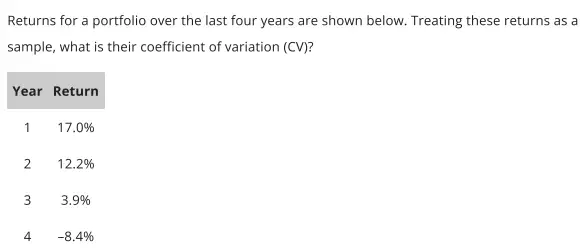
1.80.
1.56.
0.55.
An analyst calculates a winsorized mean return of 3.2% for an investment fund. This measure most likely:
equally weights all returns.
replaces outliers with less extreme returns.
captures the compounded growth rate of the fund.
Over the last five years, an investment fund's monthly returns were relatively stable apart from last year, where two extremely high returns were recorded. If the arithmetic mean for the fund's monthly returns over the period is 6.7%, a trimmed or winsorized mean return is most likely to be:
higher than the arithmetic mean.
lower than the arithmetic mean.
equal to the arithmetic mean.
The correlation coefficient between the return on an investment and the rate of economic growth is –0.065. An analyst should most likely interpret this correlation coefficient as indicating that returns on this investment are:
not related linearly to economic growth.
unrelated to economic growth.
negatively related to economic growth.
If an analyst concludes that the distribution of a large sample of returns is positively skewed, which of the following relationships involving the mean, median, and mode is most likely?
Mean > median > mode.
Mean < median < mode.
Mean > median < mode.
An investor has the following assets:
$5,000 in bonds with an expected return of 8%.
$10,000 in equities with an expected return of 12%.
$5,000 in real estate with an expected return of 10%.
What is the portfolio's expected return?
10.50%.
11.00%.
10.00%.
For a positively skewed distribution, the median is greater than:
the mean, but less than the mode.
the mode, but less than the mean.
both the mode and the mean.
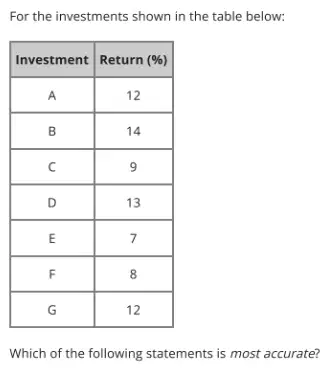
The mean is equal to the median.
The median is equal to the mode.
The mean is equal to the mode.

