
 Worksheets
GB1 Reviewer (Cell Membrane, Transport Mechanisms, Biomolecules)
Total questions: 35
Worksheet time: 25mins
The plasma membrane contains proteins that assist in transporting substances. What are these proteins called?
Enzymes
Lipids
Transport proteins
Structural proteins
Which process involves the movement of water molecules across a semipermeable membrane?
Diffusion
Osmosis
Active transport
Facilitated diffusion
Which of the following statements correctly describes the phospholipid bilayer?
The heads are hydrophobic, and the tails are hydrophilic
The heads are hydrophilic, and the tails are hydrophobic
Both heads and tails are hydrophobic
Both heads and tails are hydrophilic
Which of the following best describes active transport?
Requires energy and moves substances against the concentration gradient
Does not require energy and moves substances along the concentration gradient
Only moves water molecules
Moves substances in random directions without energy
Which molecule cannot easily pass through the plasma membrane without the aid of transport proteins?
Oxygen
Carbon dioxide
Glucose
Water
The sodium-potassium pump moves ions across the membrane. What type of transport protein is this?
Uniporter
Symporter
Antiporter
Aquaporin
David notices that his skin becomes wrinkled after soaking in a bathtub for too long. What process is responsible for this change?
Diffusion
Osmosis
Active transport
Facilitated diffusion
When you sprinkle salt on a snail, it shrinks because:
Water moves out of the snail’s cells by osmosis.
The salt enters the snail’s cells by diffusion.
The snail produces more waste as a response to the salt.
The salt blocks oxygen uptake by the snail.
What would happen to a red blood cell placed in a solution that is hypertonic?
Swell
Shrink
Remain the same
Undergo active transport
Maria places a slice of apple in distilled water. After several hours, the apple slice becomes more firm. What best explains this result?
The distilled water caused the apple to absorb more solute.
The distilled water is hypertonic to the apple, causing it to lose water.
The distilled water is hypotonic to the apple, causing water to enter the cells.
The distilled water diffused into the air, making the apple firmer.
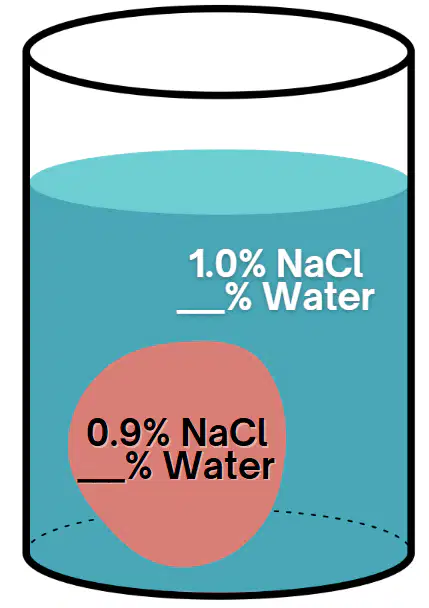
What is the type of tonicity of the solution inside the cell?
hypertonic
isotonic
hypotonic
What will be the movement of the water?
into the cell
out of the cell
in and out of the cell (equal rates)
Given this situation, the cell will
Given this situation, will osmosis occur?
YES
NO
The cell is in what type of solution?
hypertonic
isotonic
hypotonic
What is the % of solute inside the cell?
(a)
What is the % of water inside the cell?
(a)
What is the % of water outside the cell?
(a)
What is the % of solute outside the cell?
(a)
Statement 1: Both carbohydrates and lipids can be made into simpler molecules.
Statement 2: Both carbohydrates and lipids are made out of Carbon, Hydrogen, and Oxygen.
Only statement 1 is TRUE
Only statement 2 is TRUE
Both statements are TRUE
Both statements are FALSE
Statement 1: Simple diffusion and facilitated diffusion both require transport proteins to move substances across the membrane.
Statement 2: Both types of diffusion involve movement of substances along their concentration gradient.
Only statement 1 is TRUE
Only statement 2 is TRUE
Both statements are TRUE
Both statements are FALSE
Statement 1: Osmosis is the movement of solutes from low to high concentration.
Statement 2: Osmosis occurs only when there is a semipermeable membrane present.
Only statement 1 is TRUE
Only statement 2 is TRUE
Both statements are TRUE
Both statements are FALSE

This picture represents which type of cellular transport?
passive transport
endocytosis
exocytosis
osmosis
Yum! Something smells good. The neighbors are grilling delicious food! Is this diffusion, osmosis or active transport?
diffusion
osmosis
active transport
What molecules need the help of proteins to move through the cell membrane?
large, nonpolar molecules
small, nonpolar molecules
ions
small, polar molecules
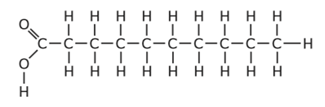
Which of these best represents a fatty-acid molecule?
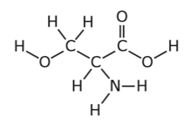
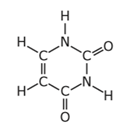
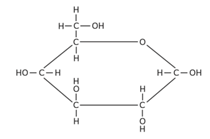
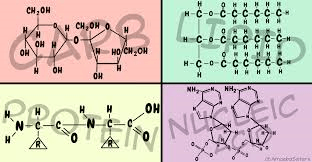
What elements are common to all 4 biomolecules?
Carbon, hydrogen, nitrogen
Carbon, Nitrogen, Phosphorus
Carbon, Hydrogen, Oxygen
Carbon, Hydrogen, Phosphorus
What is the difference between active and passive transport?
Active does not need energy and passive uses ATP (energy)
Active uses ATP (energy) and passive does not need energy
Active stores transport proteins and passive releases
Active uses hormones and passive does not
In diffusion, materials always move from areas of _____________ concentration, to areas of _____________ concentration.
low, high
high, low
low, low
high, high
Human red blood cells contain 0.9% sodium chloride as a component of their cytoplasm. What would happen if an IV solution containing 3.5% sodium chloride is introduced into a person?
The red blood cell would get bigger and burst.
The red blood cell would stay the same size.
The red blood cell would shrink.
The red blood cell would first loose water and then absorb water.
Which component contributes to maintain the fluidity of the cell membrane?
carbohydrates
cholesterol
proteins
saturated fatty acids
Phagocytosis
Taking in Solid food particles
Pinocytosis
Taking in dissolved or broken down substances
Receptor-mediated
The cell brings in specific substances using receptors.
Match the description to the appropriate cell membrane structure.
Hydrophobic
Hydrophilic
Match each biomolecule with its main function:
Storing genetic information
Nucleic Acids
Long-term energy storage
Lipids
Quick energy supply
Carbohydrates
Catalyzing reactions & structural support
Proteins
Match the following situations with their corresponding type of cellular transport:
Oxygen enters the cell without the need for energy.
Simple diffusion
A cell expels waste materials using vesicles.
Exocytosis
Glucose is transported into the cell via a protein channel.
Facilitated diffusion
Large molecules are engulfed by the cell.
Endocytosis
Ions are pumped out of the cells against their concentration gradient.
Active transport via carrier protein

