
 Worksheets
CBA #2 Review: Force/Motion/Avg Speed/Thermal Energy
Total questions: 59
Worksheet time: 2hrs 2mins
An object’s rate of change, calculated by dividing the total distance an object traveled by the total time it took the object to travel the distance (S=D/T)
Average Speed
Motion
Speed
Velocity

Forces on an object that do not change the motion of the object
Balanced
Unbalanced

The change in an object’s position with respect to time and in comparison with the position of other objects used as reference points
Speed
Motion
Time
Graph
What is the term for the speed of an object in a specific direction?
Speed
Velocity
Acceleration
Force
A push or pull that can change the motion of an object
Motion
Velocity
Force
Which of the following is a measure of how fast something is moving without regard to direction?
Velocity
Speed
Acceleration
Force


An unbalanced force is when objects move in one direction because the force is greater from that direction.
true
false


Maxine walks 4 m/s east. Which of the following best describes Maxine’s travel?
speed
distance
time
velocity

Which answer choice best describes the movement of the object between the times of 0 and 6 seconds on the graph?
Moving at a constant speed
Accelerating
Moving toward the north
Stopped

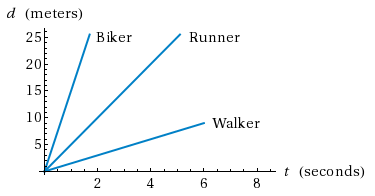
Which person moved the fastest in 3 seconds?
biker
runner
walker
they are all moving equally

Speed in a specific direction is.......
A. acceleration
B. distance
C. position
D. velocity


What is the difference between distance and displacement?
Distance counts all the motion, displacement is only how far you are from where you started.
Displacement counts all the motion, distance is only how far you are from where you started.
Distance is how far you've moved, displacement is how fast you move.
What is the sum of all forces acting on an object?
Unbalanced force
Net force
Friction
Balanced force
What unit do scientist use to measure force?
Grams
Newtons
Meters
Liters
You and your friend are moving a couch from one side to another. You push with a force of 20 N to the right and your friend pushes with a force of 25 N to the right.
5 N to the right
45 N to the left
45 N to the right
A change in motion is caused by
Balanced forces
Unbalanced forces

What is the net force?
0 N
10 N to the left
20 N to the right
20 N to the left
True or False: A vector quantity always has a direction.
True
False
What is the original source of the most of the energy that people use?
By radiation from the sun.
By convection from the sun.
By radiation from the Earth's core.
Conduction from Earth's core.
Which best explains how this roasting marshmallows happens?
Heat from the fire is conducted into the marshmallow.
Heat from the fire is radiated into the marshmallow.
The coolness of the marshmallow is conducted into the fire.
The coolness of the marshmallow is radiated into the fire.
Which best describes heat transfer by radiation?
A slice of bacon frying in a pan.
A pot on a stove boiling water.
Cooking a hotdog in a microwave.
A hot air balloon.
Which of the following best describes CONVECTION?
When heat is transferred through waves.
When heat is transferred through objects that are touching.
The movement of gas or liquid in which warmer parts move up and the colder parts moves down.

What kind of heat transfer is occurring when the sun warms the sand?
Conduction
Convection
Radiation
All of them

What heat transfer happens when you put the pan in the open stove?
Conduction
Convection
Radiation
None

Warm air rises and the cool air sinks demonstrates this type of heat transfer.
Conduction
Convection
Radiation

Heat transfers from an area of ________ temperature to an area of _______ temperature.
high to low
low to high
high to high
low to low
The ______ air rises and the cold air sinks in convection heat transfer.
warm
cold
same
very cold


Clark accidentally grabbed the handle of the hot pot. This shows ______________.
radiation
conduction
convection
This method of heat transfer is when two objects are directly touching.
Conduction
Convection
Radiation
This method of heat transfer happens through electromagnetic waves.
Conduction
Convection
Radiation

A student throws a football three times. Another student records the distance, the amount of time the ball travels and the average speed in the table above. How many seconds did it take for the ball to travel 40 m during the third throw?
0.5 s
1.0 s
1.5 s
2.0 s
Which of the following is a UNIT for speed?
m/s2
m/s
d/t

Using the information in the graph, what is the average speed Josh’s car traveled to get home?
8 km/hour
160 km/hour
16 km/hour
40 km/hour
Which graph represents an object moving at the greatest speed?


The graph shows the distance an object moved in 11 seconds. Which answer choice best describes the movement of the object between the times of 0 and 6 seconds on the graph?
Moving at a constant speed
accelerating
Moving toward the north
stopped

Select the times that the object is NOT moving according to the graph. (Could be more than one)
0-10 minutes.
10-20 minutes.
20-30 minutes.
30-40 minutes.

What is the average speed of the Worm's Journey?
2.25 meters/minute
2 meters/minute
1 meter/minute

Some students were investigating the speed of a toy car they built. They performed two trials and recorded their data in the table above.
What was the average speed of the toy car during the two trials to the nearest tenth of a m/s?
Be sure to use the correct place value.
1.5 m / s2
1.5 m/s
what is newtons first law?
An object remains at rest and an object in motion maintains its velocity unless it experience an unbalanced force
acceleration (gaining speed) happens when a force acts on a mass (object)
The horizontal line with labels on a coordinate grid; often used for representing time
Z axis
Y axis
X axis
A worker is pushing a cart straight across a factory floor. When are the forces on the cart balanced?
When it slows to a stop
When it travels at a constant speed
When it first starts moving
When it begins to speed up
What is the term for the rate of change of velocity?
Speed
Acceleration
Force
Momentum
Which of the following is an example of conduction?
Heat from the sun warming your face
Heat from a stove warming a pot
Warm air rising in a room
Microwaves heating food
True or False: An object in motion will stay in motion unless acted upon by an unbalanced force.
True
False

