wayground logo

Free Printable Worksheets

Font size

S
M
L
XL
Worksheets

Biology DA Review Part 2

Total questions: 62

Worksheet time: 1hrs 16mins

Name
Class
Date
1.

In mitosis the ​ (a)   daughter cells that are created are ​ (b)   . In meiosis the ​ (c)   daughter cells that are created are ​ (d)  

Choose from the below words
two
diploid
four
haploid
2.

Which of these correctly compliments the following DNA strand during replication: AGGTCA

a)

UCCAGU

b)

TCCAGT

c)

ACCAGU

d)

TGGAGT

3.

In which phase of the cell cycle is DNA replicated?

a)

Mitosis

b)

G1 phase

c)

G2 phase

d)

S phase

4.

Adaptations that result from natural selection are expected to increase the fitness of an organism. In terms of natural selection, what is fitness?

a)

being able to escape from predators

b)

being among the strongest organisms in a population

c)

being able to survive, find a mate, and produce offspring

d)

being able to survive long enough to reach an adult age

5.

In cattle the allele for cloven hooves (H) is dominant over the allele for mule-foot hooves (h). The phenotype for each trait is shown in this picture.


What is the probability of cloven hooves in the offspring of parents that are heterozygous for the trait?

a)

25%

b)

50%

c)

75%

d)

100%

6.
What phase is this cell in?
a)
Cytokinesis
b)
Mitosis
c)
Prophase
d)
Metaphase
7.
What phase is this cell in?
a)
Mitosis
b)
Interphase
c)
Anaphase
d)
Telophase
8.
What phase is this cell in?
a)
Mitosis
b)
Cytokinesis
c)
Prophase
d)
Telophase
9.
In mitosis, the two resulting cells are
a)
different from the starting cell and identical to each other.
b)
different from the starting cell and different from each other.
c)
identical to the starting cell and different from each other.
d)
identical to the starting cell and identical to each other.
10.
Put the following stages of mitosis in order: anaphase, prophase, metaphase, and telophase. 
a)
prophase, metaphase, telophase, anaphase
b)
prophase, anaphase, metaphase, telophase
c)
prophase, metaphase, anaphase, telophase
d)
prophase, telophase, metaphase, anaphase
11.
Which of the following is a phenotype?
a)
Aa
b)
red hair
c)
heterozygous genes
d)
mutated DNA
12.
G = green, g = yellow
The genotype for a yellow plant is...
a)
GG
b)
Gg
c)
gg
d)
all of the choices result in yellow
13.
Natural selection is
a)
survival of the fittest
b)
humans change
c)
two species are the same
d)
more animals survive
14.

What is a change in an organism that allows for it to survive in its environment?

a)

homologous

b)

vestigial

c)

variation

d)

adaptation

15.
What is a producer?
a)
an organism that gets energy from eating other organisms
b)
an organisms that uses sunlight to make its own food
c)
an organism that gets energy from eating dead organisms, non-living material or waste
d)
an organism that uses chemical energy to make its own food
16.
succession that occurs in an area with no soil
a)
ecological succession 
b)
primary succession 
c)
secondary succession
d)
pioneer speciles
17.
How do lichens contribute to primary succession?
a)
Lichens decompose organic matter from animals and plants
b)
Lichens begin to break down rock to form soil
c)
Lichens are nitrogen fixing bacteria
d)
Lichens convert carbohydrates into fossil fuels.
18.
After a forest fire, an ecosystem would start regrowth through -
a)
primary succession
b)
secondary succession
c)
climax community
d)
limiting factors
19.

What are the three main parts of a nucleotide?

a)

carbon, hydrogen, and oxygen

b)

phosphate, sugar, and nitrogen base

c)

phosphate, sulfate, and nitrate

d)

adenine, thymine, and uracil

20.

NUCLEOTIDES ARE THE BUILDING BLOCKS OF...

a)

CARBOHYDRATES

b)

LIPIDS

c)

NUCLEIC ACIDS

d)

PROTEINS

21.
Guanine bonds with ______________.
a)
Adenine
b)
Guanine
c)
Cytosine
d)
Thymine
22.
Adenine bonds with ______________.
a)
Guanine
b)
Thymine
c)
Cytosine
d)
Adenine
23.
The ability of an organism to survive and reproduce in its specific environment 
a)
diversity.
b)
evolution
c)
adaptation
d)
 fitness
24.
What is the order of succession shown in this figure?
a)
A, B, C, D
b)
B, A, D, C
c)
C, D, A, B
d)
D, A, B, C
25.
What is the name given to lichen or algae after a primary succession?
a)
pioneer species
b)
volunteer species
c)
founder species
d)
conqueror species
26.
After a volcanic eruption, lava covers the land. What is the order that plants grow to repopulate the area?
a)
Lichens → Shrubs → Grasses → Trees
b)
Lichens → tree → shrubs→Grasses
c)
Grasses → Lichens → Shrubs → Trees
d)
Lichens → Grasses → Shrubs → Trees
27.
Final illustration (#8) shows
a)
pioneer species
b)
climax community
c)
only biotic factors
d)
only abiotic factors
28.
What best describes the genetic material shown in photograph B. 
a)
The chromosomes are in anaphase
b)
The chromosomes are in metaphase
c)
DNA is possibly being replicated 
d)
The genetic material is around the poles and cytokinesis is occurring
29.
All of the following are true of the cell cycle shown in the diagram except ___.
a)
A, B, and C represent interphase
b)
DNA is replicated at B 
c)
Cytokinesis and new daughter cells are found at E
d)
Mitosis and cytokinesis are represented by D 
30.
Which of the following are true of the cell cycle?
a)
The cell spends most of its time dividing 
b)
The cell spends most of its time growing
c)
Replication of DNA occurs at M 
d)
Cells enter G0 after M
31.
When is DNA replicated during the cell cycle?
a)
During the G1 phase
b)
During the G2 phase 
c)
During the S phase
d)
 During the M phase
32.
What best describes the genetic material shown in photograph E.
a)
The chromosomes are in anaphase
b)
The chromosomes are in metaphase 
c)
DNA is possibly being replicated
d)
The genetic material is around the poles and cytokinesis is occurring 
33.
In DNA replication, complementary base pairing occurs between ___.
a)
Cytosine and uracil 
b)
Adenine and guanine
c)
Adenine and uracil
d)
Adenine and thymine
34.
What best describes the genetic material shown in photograph A. 
a)
The chromosomes are in anaphase
b)
The chromosomes are in metaphase
c)
DNA is possibly being replicated 
d)
The genetic material is around the poles and cytokinesis is occurring
35.
All of the following are true about DNA replication except ___.
a)
It is semiconservative
b)
It occurs during the S-phase of the cell cycle 
c)
It allows daughter cells to have exact copies of the genetic code
d)
It reduces the chromosome number by half for the production of gametes
36.
Replication of DNA 
a)
Produces mRNA and tRNA molecules
b)
Produces only new DNA 
c)
Produces two molecules, each of which is half new and half old DNA joined lengthwise to each other
d)
Generates excessive DNA, which eventually causes the nucleus to divide
37.
DNA polymerase 
a)
Is an enzyme 
b)
Adds new nucleotides to the template strand 
c)
Proofreads DNA strands to see that they are correct 
d)
All of these are functions of DNA polymerase
38.
In DNA replication, three of the four choices listed below are correctly paired.  Select the exception.   A.  A – C B.  C – G C.  A – T D.  T – A
a)
A-C
b)
C-G
c)
A-T
d)
T-A
39.
Identify this process.
a)
Replication
b)
Transcription
c)
Translation
d)
Proof reading 
40.
When, during the cell cycle, does this occur?
a)
During G1 
b)
During S
c)
During G2
d)
During M
41.
.  In step b, the original strands have separated because ___.
a)
DNA polymerase has stopped functioning
b)
Hydrogen bonds between the bases have broken
c)
Water hydrolyzes the bases into their subunits
d)
Bases naturally repel each other
42.
When step d is completed, the two DNA molecules formed will be ___.
a)
Identical to each other but not to the parent 
b)
 Identical to the parent but not to each other 
c)
Identical to each other and to the parent
d)
Different from each other and from the parent 
43.
The ability of the genetic material to ___ provides the genetic variability required for evolution to occur in a population.
a)
Store information
b)
Be replicated
c)
Undergo changes
d)
 All are correct 
44.
Which is a characteristic of cancer?
a)
rapid and uncontrolled cell growth
b)
 cell growth delayed at the G1 checkpoint. 
c)
cell growth delayed at the G2 checkpoint. 
d)
damage to a cell’s cytoplasm
45.
Why do cancer cells not respond properly to cell signals and controls?
a)
damage to a cell’s cytoplasm
b)
damage to a cell’s sister chromatids 
c)
damage to a cell’s DNA
d)
damage to a cell’s wall and membrane 
46.
.  Cancer is a disorder in which some cells have lost the ability to control their ___.
a)
size
b)
spindle fibers
c)
growth rate
d)
surface size
47.
Which of the cells depicted in the line graph are most likely cancerous?                  
 
a)
Line A
b)
Line B
c)
Line C
d)
Line D
48.
The genetic code is nearly universal. That means, with few exceptions, the same codons code for the same amino acids in all organisms. What does the near universality of the genetic code suggest? 
a)
All life-forms can reproduce with one another
b)
All life-forms have the same number of genes. 
c)
All life-forms have a common evolutionary ancestor. 
d)
All life-forms arose about the same time in Earth’s history.
49.
The intersection of the left, top, and right nitrogenous bases indicates which amino acid a mRNA codon represents.  This is true for all organisms.  This indicates that the ___.
a)
The genetic code is universal. 
b)
We, as organisms, differ only in our sequence of bases
c)
The genetic code determines the sequence of amino acids making up a protein 
d)
 All of the above
50.
What do all of these organisms have in common?
a)
Universal genetic code
b)
Components that make up the genetic code
c)
Traits that are determined by genes that are translated into proteins
d)
Organisms have all of above in common 
51.
Organisms have all of the following in common except ___. 
a)
Traits that are determined by genes that are translated into proteins
b)
Sequence of nitrogenous bases in the genetic code 
c)
A universal genetic code
d)
The same components that make up the genetic code
52.
 Which sequence depicts the correct order of protein synthesis within a cell? 
a)
DNA → mRNA → amino acids → proteins
b)
DNA → amino acids → mRNA → proteins
c)
 DNA → mRNA → proteins → amino acids
d)
DNA → proteins → amino acids → mRNA
53.
The figures show four process involving DNA and RNA.  Which figure shows the process of transcription?
a)
Figure A
b)
Figure B
c)
Figure C
d)
Figure D
54.
Which molecule is paired with its correct role in protein synthesis? 
a)
Nucleus – forms peptide bonds 
b)
Ribosome – carries DNA instructions
c)
mRNA – joins amino acids 
d)
 tRNA – transfers amino acids
55.
Which best describes the interaction between DNA and RNA during protein synthesis?
a)
RNA carries the code to the nucleus where DNA translates the code into a protein
b)
DNA travels to the ribosome where RNA translates the code into a protein 
c)
RNA carries the code from DNA in the nucleus to the ribosome for protein synthesis
d)
DNA travels to the cytoplasm while RNA remains in the nucleus 
56.
During the process of protein synthesis, a section of the DNA molecule is copied into which other molecule?
a)
nucleic DNA 
b)
cytoplasmic DNA
c)
messenger RNA
d)
transfer RNA
57.
Which molecule carries amino acids to the ribosomes?
a)
mRNA
b)
tRNA
c)
DNA
d)
ATP
58.

**THIS QUESTION HAS MULTIPLE ANSWERS**


Select all of the choices that fall under the category below:


functions of lipids

a)

Provides quick energy

b)

Provides long-term energy

c)

Backup source of energy

d)

Main source of energy

e)

Insulation

59.

If more lions were introduced to the ecosystem

a)

the amount of hyenas would increase

b)

the amount of giraffes would decrease

c)

the amount of zebras would decrease

d)

the cheetahs would have less competition
60.
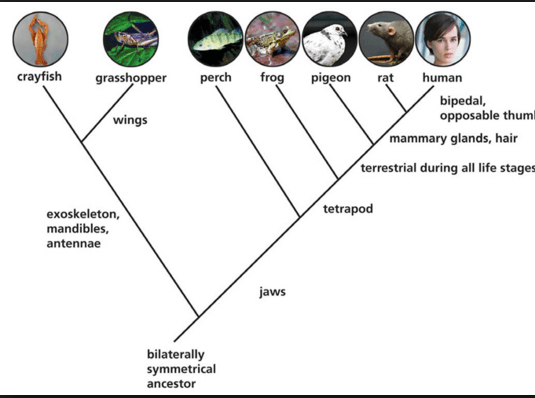
According to the cladogram, which organism is most distantly related to the human?
a)
crayfish
b)
grasshopper
c)
perch
d)
frog
61.
A  population of cockroaches was sprayed with an insecticide.  Some cockroaches survived and produced a population of cockroaches that was resistant to this spray.  What can BEST be inferred from this example?
a)
species will adapt no matter what the environment
b)
environment has no effect on the survival of an organism
c)
Individuals with favorable variations survive and reproduce
d)
Insecticides cause mutations that are passed on to the next generation
62.
Which best represents one fundamental difference between the processes of mitosis and meiosis?
a)
meiosis results in 4 haploid cells, mitosis results in 4 diploid cells
b)
meiosis results in 4 haploid cells, mitosis results in 2 diploid cells
c)
meiosis results in 2 diploid cells, mitosis results in 2 haploid cells
d)
meiosis results in 2 diploid cells, mitosis results in 4 haploid cells