
 Worksheets
Kennedy--Interim #2 Review (solutions and stoichiometry)
Total questions: 74
Worksheet time: 6hrs 10mins
Solid solutes dissolve quicker in _________ water.
cold
warm
Gas solutes dissolve better in _________ water.
cold
warm
The substance being dissolved in a solution is the?
solution
solute
solvent
mixture
The substance in which a solute is dissolved is a?
solution
solvent
alloy
mixture
If I dissolve sugar in water, what is the solvent?
Sugar
There is no solvent
Oxygen
Water
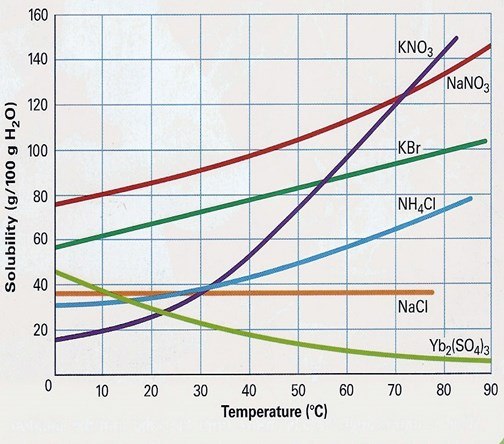
At 80'C, KBr's solubility is:
100g
90g
80g
0g
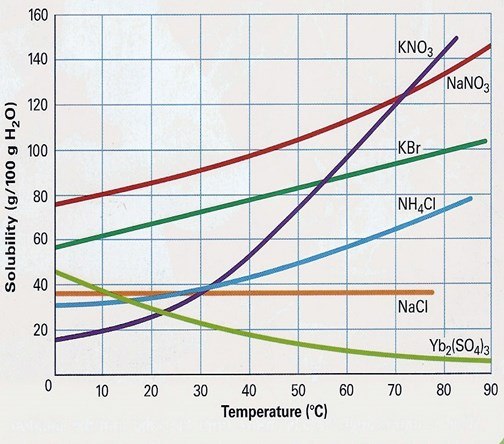
Identify if the following solution would be saturated, unsaturated, or supersaturated: 103 g KBr at 70'C.
Unsaturated
Saturated
Supersaturated
Which of these solutes is a gas and how do you know?
Yb2(SO4)3 because it has a negative slope
NaCl because it has a zero slope
KNO3 because it has a positive slope
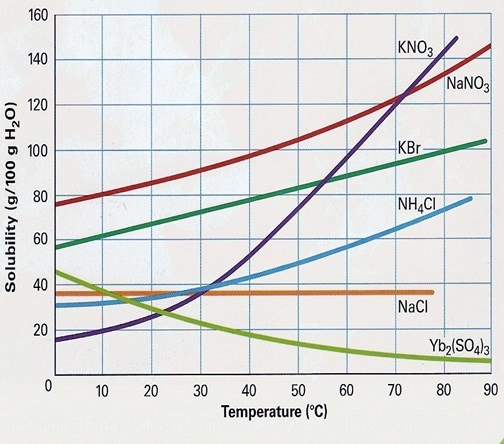
Identify how many grams of KNO3 is required to make a saturated solution at 40'C.
50 g
45 g
60 g
33 g

What distinguishes the boiling point from the melting point of a substance?
The boiling point is the temperature at which a liquid turns into a gas, while the melting point is the temperature at which a solid turns into a liquid.
The boiling point is the temperature at which a solid turns into a gas, while the melting point is the temperature at which a gas turns into a liquid.
The boiling point is lower than the melting point.
The boiling point and melting point are the same for all substances.

Which one of the following statements is true about solutions that conduct electricity?
The salt solution conducts electricity because ionic compounds dissociate into ions when dissolved in water.
The sugar solution conducts electricity because covalent compounds solvate and the molecule stays intact when dissolved in water.
The pure water conducts electricity really well on its own.
Calculate the molar mass of KOH.
28 g/mol
56 g/mol
84 g/mol
112 g/mol
Calculate the molar mass of CO2.
14 g/mol
28 g/mol
36 g/mol
44 g/mol
Calculate the molar mass of Ba(C2H3O2)2
255.3 g/mol
237.3 g/mol
228.3 g/mol
196.3 g/mol
Avogadro's number of atoms is equal to one_____ of atoms.
What is the Ratio of moles of Mg to moles Fe?
How many moles of Cl2 are needed to react with 3 moles of H2?
What is the total number of moles of CO2 needed to make 2 moles of C6H12O6?
Determine the volume, in liters, of 1.2 mole SO2 gas at STP.
13 L
26 L
6.5 L
Match the following units to their correct category.
Grams
Mass
Liters at STP
Volume
Units, Atomes, Molecules
Particles
How many molecules are in 2.5 mol of NaCl?
1.51x10²³
146
4.15
1.51x1024
44.01 moles
1421.52 moles
32.3 moles
0.73 moles
What is the mass of 2.50 mole of oxygen gas O2?
40 g
80 g
16 g
32 g
How many moles there are in 5.68 x 1024 formula units of AlCl3?
3.42 x 1024 moles
9.44 x 1024 moles
9.44 moles
3.42 moles
How many moles are in 8.30 X 10²³ molecules of H2O?
1.38 X 10²³ moles H2O
1.38 moles H2O
2 moles H2O
1 mole H2O

Match the following...
You convert moles to grams by...
multiplying by the molar mass
You convert liters to moles by...
dividing by 22.4L
You convert moles to particles by...
multiplying my avagadro's constant
You convert grams to moles by...
dividing by the molar mass
You convert moles to liters by...
multiplying by 22.4L
What is the percent composition of oxygen in MgO?
20%
40%
50%
60%
When reacting Na with Cl2, we calculated that the theoretical yield should be 13 grams. Our actual yield was 12.5 grams. What is the percent yield?
90.4%
104%
96.15%
1.04%
Actual yield = 62g
Calculate the percent yield.
How many grams of hydrogen are produced if 120 g of Na are available?
5.3 g
What mass of O2 will be needed to burn 36.1 g of B2H6?
125 g O2
Which of the following is necessary to switch from one substance to another in a stoichiometry problem?
Molar Mass
Molar Ratio
Periodic Table
Specific Heat
Put the following steps in the correct order to solve the stoichiometry problem.
10.1 grams HCl/1
1 mol HCl/36.460 grams HCl
2 mol Cl/1 mol HCl
35.453 grams Cl/1 mol Cl
19.6 grams Cl/1
Balance the following equation with the correct coefficients:
___ SnO₂ + ___ H₂ → ___ Sn + ___ H₂O
1, 2, 1, 2
2, 1, 1, 2
1, 1, 1, 1
2, 2, 3, 2
Balance the following equation with the correct coefficients:
KOH + H₃PO₄ → K₃PO₄ + H₂O
3, 1, 1, 3
2, 1, 3, 2
1, 1, 1, 1
2, 2, 3, 2

Using the diagram, determine the limiting reactant, the product formed is water.
oxygen
hydrogen
none of the reactant are limiting
both hydrogen and oxygen
It refers to the substance(s) that are considered to be "ingredients" of a chemical reaction.
reactants
products
catalysts
enhancers
The ____ in a balanced chemical reactions gives the MOLE RATIO used in stoichiometry problems.
coefficients
reactants
subscripts
products

In this image, what is the information to the right of the arrow (in black) is called the_______.
Product
Reactant
Chemical Subscript
Yield

Hydrogen and oxygen molecules combine to form water molecules as shown in the reaction below. Given the molecules provided, which of the following is true about the products of this reaction?
2 H2O molecules are produced, O2 is the limiting reactant
4 H2O molecules are produced, H2 is the limiting reactant
4 H2O molecules are produced, O2 is the limiting reactant
6 H2O molecules are produced, H2 is the limiting reactant
Which of the following describes an excess reactant?
The reactant that is not completely consumed during a reaction
None of this reactant is left over after the reaction take place
The reactant that is completely consumed during the reaction
Which of the following describes a limiting reactant?
The reactant that is not completely consumed during a reaction
The reactant that is completely consumed during the reaction
Some of this reaction is left over after the reaction
Molecular Formula = C2F6
Choose the correct empirical formula.
CF
C2F6
C3F
CF3
Empirical Formula = CF2
Molecular formula mass = 192 g/mol
Molecular Formula = ?
C4F8
C8F4
C3F6
C2F4
The empirical formula of a substance is CH2O. The molar mass is 180g/mol. What is the molecular formula?
CH2O
C3H6O3
C6H12O6
C12H6O12

