
 Worksheets
Electrons & the Value of Valence E to EVERYTHING chemistry!
Total questions: 90
Worksheet time: 3hrs 45mins
State the number of valence electrons in an atom of sulfur-32 in the ground state
16
6
8
10
Which of the following are accurate and equivalent electronic configurations for an atom of sulfur in the ground state?
2-8-6
[Ne] 3s23p4
2-6-8
[Ne] 3s23p6
2-8-8
[Ar]
2-6-8
[Ne] 3s23p4
Which of the following are correct representations of the electronic configuration of the sulfide anion, S2-?
1s22s22p63s23p6
[Ar]
1s22s22p63s23p4
[Ne] 3s23p4
1s22s22p63s23p54s1
[Ar]
1s22s22p63s23p44s2
[Ne]3s23p44s2
Which of the following include two correct and equivalent electronic configurations for oxide anion, O2-?
1s22s22p6
[Ne]
1s22s22p43s2
[Ne]
1s22s22p53s1
[He]2s22p53s1
1s22s22p4
[He]2s22p4
Which of the following contain TWO correct representations of the electronic configuration of an atom of the element oxygen?
1s22s22p2
[He]2s22p2
1s22s22p6
[Ar]
1s22s22p4
[He]2s22p4
1s22s22p4
[He]2p4

Which subatomic particles were discovered as the result of experiments with cathode ray tubes?
positrons
electrons
protons
neutrons
As the atomic number increases in Group 2 from Be to Ba, the first ionization energy
Hint :if atomic number is going up and we're in a group, we must be going DOWN A GROUP
decreases, and the atomic radius decreases
increases, and the atomic radius decreases
increases, and the atomic radius increases
decreases, and the atomic radius increases
Which change in electron location in an atom of calcium is accompanied by the greatest amount of energy emitted?
from shell 1 to shell 2
from shell 2 to shell 1
from shell 1 to shell 4
from shell 4 to shell 1

What is represented in diagram 2?
a positive ion of hydrogen
a negative ion of hydrogen
an atom of hydrogen in an excited state
an atom of hydrogen in the ground state
Which atom forms an ion with a radius larger than the atomic radius?
calcium atom
oxygen atom
lead atom
tin atom
According to the wave-mechanical model, in the ground state, the 10 electrons of a neon atom would be located
in the nucleus
in the first shell
in orbitals
in the valence shell
What is the overall charge on the nucleus of a fluorine atom?
+19
-9
+9
-1
The modern model of the atom shows that electrons are
orbiting the nucleus in fixed paths
found in regions called orbitals
combined with neutrons in the nucleus
located in a solid sphere covering the nucleus
Which of the following atoms has the greatest tendency to attract electrons?
barium
beryllium
boron
bromine
What are two properties of most nonmetals?
high ionization energy and poor electrical conductivity
high ionization energy and good electrical conductivity
low ionization energy and poor electrical conductivity
low ionization energy and good electrical conductivity
As an atom becomes an ion, its mass number
increases
decreases
remains the same
Which of the following ions has the smallest radius?
F-
Cl-
K+
Ca2+
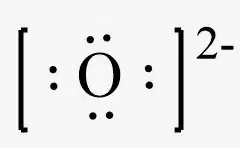
Which of the following has the most similar Lewis Dot Structure to an atom of oxygen?
Hint: Think purpose - as I've said from the beginning - have it! What is the purpose of LDS?


Compare the energy of an electron in the first shell of a technetium atom to the energy of an electron in the third shell of the same atom.
electron in the third shell is lower in energy than that of the first shell
electron in the third shell is higher in energy than that of the first shell
both electrons are of equal energy since they are part of the same atom
both electrons are of equal energy because neither are valence electrons (those are the highest energy electrons)
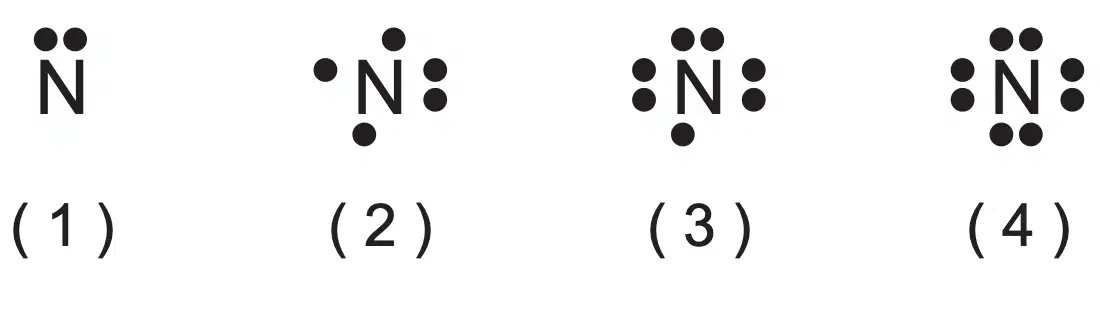
Which Lewis electron-dot diagram represents an atom of nitrogen in the ground state?
1
2
3
4
When a ground state electron in an atom moves to an excited state, the electron
absorbs energy as it moves to a higher energy state
absorbs energy as it moves to a lower energy state
releases energy as it moves to a higher energy state
releases energy as it moves to a lower energy state

State, in terms of electrons, why the ionic radius of a Group 17 element is larger than the atomic radius for the same element.
It loses an electron which causes it to inflate with the stronger nuclear charge typical of right side elements.
it loses an electron, which creates an imbalance in protons to electrons causing a nuclear decay reaction by disrupting the proton-neutron balance
it gains an electron and thus there is more negative density surrounding the nucleus so the ionic radius is bigger
it gains a negatice charge and becomes an anion when it loses a proton, leaving a disproportionate amount of neutrons which increase the radius.
How many dots should surround the atomic symbol, Si, in a lewis dot structure of the atom of the METALLOID silicon?
6 valence e-, 6 dots
5 valence e-, 5 dots
4 valence e-, 4 dots
3 valence e-, 3 dots
Which quantity is conserved in all chemical reactions?
moles
density
volume
charge
Which change occurs when an electron returns from a higher energy state to a lower energy state?
Hint: Are they talking about bonding or reacting with anyone else here or just one particular electron in some unnamed atom?
An ionic compound is formed, and energy is absorbed.
An ionic compound is formed, and energy is emitted.
A specific amount of energy is emitted
A specific amount of energy is absorbed.

see text in image
choice 1
choice 2
choice 3
choice 4
What is the highest principal quantum number (n) for an electron in the ground state of a sulfur atom?
1
2
3
4
What is the total number of electrons in a totally filled 4th principal energy level?
8
10
16
32
Which of these group 14 elements has the most metallic properties?
metallic = metal-like
C
Ge
Si
Sn
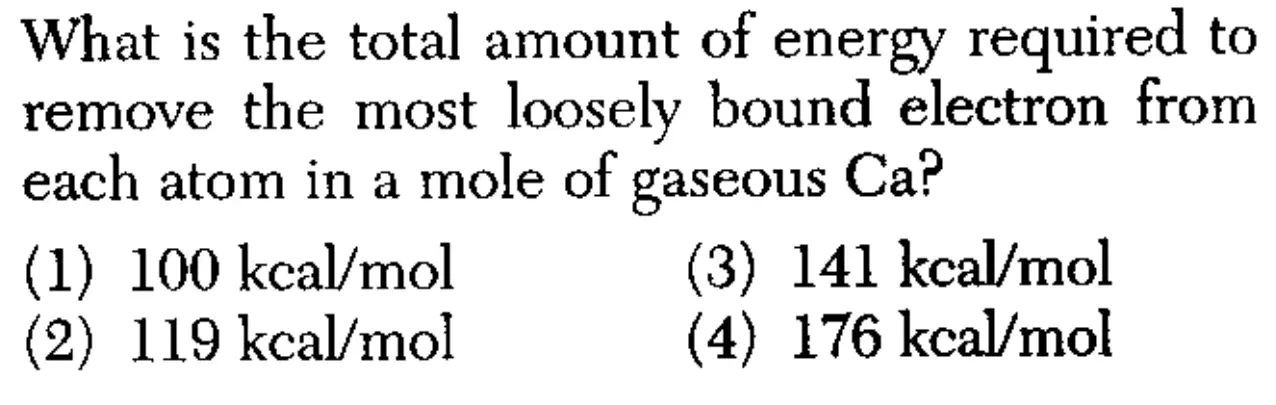
See text in image for question.
Hint 1: Why guess when you have table s?
Hint 2: Don't forget you need kcal...
choice 1
choice 2
choice 3
choice 4
The characteristic bright line spectra of an element is produced when its electrons
form a covalent bond
form an ionic bond
move to a higher energy state
move to a lower energy state
Which statement describes how an atom in the ground state becomes excited?
The atom absorbs energy, and one or more electrons move to a higher electron shell.
The atom absorbs energy, and one or more electrons move to a lower electron shell
The atom releases energy, and one or more electrons move to a higher electron shell.
The atom releases energy, and one or more electrons move to a lower electron shell.
Which substance is the best conductor of electricity?
nitrogen
sulfur
neon
silver
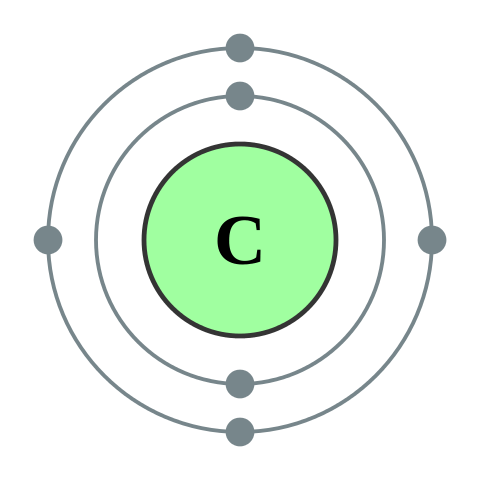
How many valence electrons does carbon have?
4
5
6
7
Which element has the highest melting point?
You have a ref table - why guess when you have table s!
rhenium
tantalum
hafnium
osmium
Compared to the valence electrons of a nonmetallic atom, the valence electrons of a metallic atom are generally
fewer in number and more strongly held
fewer in number and less strongly held
greater in number and less strongly held
greater in number and more strongly held
Which of the following ions has the smallest radius?
Think of how many energy shells it will still have as an ion, one choice is smaller than the rest
F-
Cl-
K+
Ca2+
Which element's ionic radius is smaller than its atomic radius?
Na
Ne
N
S
Which is the electron configuration of a neutral atom in the ground state with a total of four valence electrons?
2-4
2-6
1-2-2
2-8
Which metal atoms can form ionic bonds by losing electrons from both the outermost and next to outermost principal energy levels?
Mg
Rb
Li
Cu
T/F: Higher n (principal energy level) higher energy
T
F
T/F: Electrons emit energy as bright line spectra when they return FROM an excited state to the ground state?
T
F
An atom in an excited state has an electron configuration of 2-7-2. What is its ground state configuration?
2-8-2
1-8-2
2-8-1
2-6-2
State the relationship between atomic number and first ionization energy as the elements in Group 1 are considered in order of increasing atomic number.
As atomic number increases, the effective nuclear charge increases (more protons). More protons pull on the electrons more, decreasing the size which increases IE (stronger nuclear charge attracts and holds onto electrons more tightly so they are harder to remove).
As atomic number increases down a group, the ionization energy (the energy needed to remove a valence e- increases). Because the atoms get bigger, the nucleus is less powerful and electrons are easier to remove, that is why IE goes up
As atomic number increases, the effective nuclear charge increases (more protons). More protons pull on the electrons more, increasing the size which decreases IE (weaker nuclear charge attracts and holds onto electrons less tightly so they are easier to remove).
As atomic number increases down a group, the ionization energy (the energy needed to remove a valence e- decreases). Because the atoms get bigger, the nucleus is less powerful and electrons are easier to remove, that is why IE goes down.
Which electron configuration represents the atom with the largest atomic radius?
2
2-8-1
2-8-2
2-8-8
Which electron configuration represents the atom with the largest atomic radius?
1
2
2-8-2
2-8-8-2
Which electron configuration is associated with the atom with the highest electronegativity?
2-8
2-7
2-1
2-4
Which of the following electron configurations has the smallest radius atom?
2-2
2-4
2-6
2-8-1
The atom with which electron configuration has the highest ionization energy?
Hint 1: if it has a HIGH IE it is HARD to remove its valence e-
Hint 2: Who on the PT will give you a hard time if you try to take away its valence e-?
Hint 3: Who has HIGH EN (and thus HIGH IE) and strongly attracts e-?
2-8-1
2-8-2
2-8-4
2-8-6
An electron of an atom of Chlorine in the ground state compares to that of an atom of Chlorine in the excited state in. Choose ALL that apply
the ground state electron is lower energy and associated with a more stable configuration
the ground state electron is lower energy and associated with a less stable configuration (hence the "need" to jump around)
the excited state is when an electron is higher in energy and at a higher principal energy level (bigger n) whereas the electron in the ground state is lower in energy.
the electron in the excited state is at a higher energy than the electron if it were in the ground state and that's why energy is released when electrons rise to the excited state
. What is conserved during a chemical reaction?
mass, only
neither mass nor charge
both mass and charge
charge, only
The forces between atoms that create
chemical bonds are the result of interactions
between
protons and electrons
protons and nuclei
nuclei
electrons
Which symbol represents a particle that has
the same total number of electrons as S2–?
Ar
Si
O2-
Se2-
Which of these elements has an atom with the
most stable outer electron configuration?
Na
Ca
Ne
Cl
When a sodium atom reacts with a chlorine
atom to form a compound, the electron
configurations of the ions forming the compound
are the same as those in which noble gas atoms?
krypton and neon
krypton and argon
neon and argon
neon and helium
In an atom, an orbital represents
the most probably location of a proton
the most probable location of an electron
the least probably location of a neutron
photons emitted as electrons move to lower energy levels
During a flame test, sodium chloride produces an intense yellow flame. This yellow color is produced when electrons in excited atoms
are gained by the atoms
are lost by the atoms
move to higher energy states within the atoms
move to lower energy states within the atoms
An atom that has 8 protons and 10 neutrons is an isotope of the element
nitrogen
oxygen
fluorine
neon
Which elements have the most similar chemical properties?
Ge, As, and Sb
Mn, Fe, and Co
S, Se, and Te
P, S, and Cl
Which atom has the lowest electronegativity?
Nitrogen
Oxygen
Fluorine
Neon
What is the overall charge of an ion that has 9 protons, 11 neutrons, and 10 electrons?
+1
-1
+2
-2
Which electron configuration represents the atoms of a bromine atom in the excited state?
2-8-18-7
2-8-18-8
2-8-17-8
2-8-18-7-1
As the elements in Group 2 in the periodic table are considered in order of increasing atomic number, there is a general increase in
stability
atomic radius
electronegativity
first ionization energy
Which list of symbols represents nonmetals, only?
B, Al, Ga
Li, Be, B
C, Si, Ge
P, S, Cl


Emission spectra (bright line spectra) are created when electrons move from ___.
higher to lower energy levels.
lower to higher energy levels.
s orbitals to p orbitals.
one atom to a different atom.
During a flame test, sodium chloride produces an intense yellow flame. This yellow color is produced when electrons in excited atoms
are gained by the atoms
are lost by the atoms
move to higher energy states within the atoms
move to lower energy states within the atoms
Which of these elements has physical and chemical
properties most similar to silicon (Si)?
germanium (Ge)
lead (Pb)
phosphorus (P)
chlorine (Cl)

This could be the dot diagram of
Mg
Cl
C
O


Which of the following is the correct electron-dot diagram for an atom with an electron configuration of 2-8-18-5?


The diagram represents the bright-line spectra of four elements and a bright-line spectrum produced by a mixture of three of these elements. Which element is not present in the mixture?
A
D
X
Z

The unknown emissions spectra belongs to the element
Hydrogen
Mercury
Neon
Sodium

The unknown emissions spectra belongs to the element
Hydrogen
Mercury
Neon
Helium

The unknown emissions spectra belongs to the element
Hydrogen
Mercury
Neon
Sodium

