
 Worksheets
Protein Synthesis
Total questions: 40
Worksheet time: 13mins

The first stage of protein synthesis is called a
mitosis
replication
translation
transcription
The second stage of protein synthesis is called a
mitosis
replication
translation
transcription

Which of the following summarizes what is happening during transcription?
mRNA ⇒ DNA
DNA ⇒ mRNA
mRNA ⇒ protein
protein ⇒ mRNA

Which of the following summarizes what is happening during translation?
mRNA ⇒ DNA
DNA ⇒ mRNA
mRNA ⇒ protein
protein ⇒ mRNA

Which statement about transcription and translation is correct?
Transcription takes place in the nucleus, whereas translation takes place in the cytoplasm.
Translation takes place in the nucleus, whereas transcription takes place in the cytoplasm.

Which of the following is the complementary mRNA sequence to this DNA strand: AAA TCG TTG CCC
AAA TCG TTG CCC
TTT AGC AAC GGG
UUU AGC AAC GGG
UUU TGC TTC GGG

Which of the tRNA anticodons are complementary to the following mRNA codons: UUU-CCG-AAA
UUU-CCG-AAA
AAA-GGC-TTT
AAA-GGC-UUU
TTT-GGC-UUU

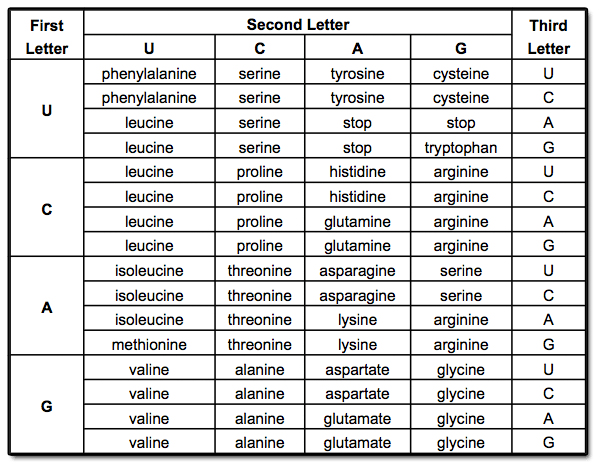
What amino acid is represented by the codon UUA?
Phenylalanine
Tyrosine
Leucine
Stop codon

Which codon can code for tryptophan?
U G G
A G U
C A A
A U G

Transcription takes place in the
Cytoplasm
Cell Membrane
Nucleus
vacuole

Translation takes place in the
cytoplasm
cell membrane
nucleus
vacuole

A group of three nucleotide bases in mRNA that specify a particular amino acid is called a/an
codon
anticodon

Proteins are made at the
nucleus
ribosome
vacuole
nuclear membrane

Which represents the correct flow of genetic information (central dogma)?
DNA → RNA → Protein
RNA → DNA → Protein
Protein → RNA → DNA
DNA → Protein → RNA

________ can leave the nucleus.
DNA
RNA
Both DNA and RNA
nothing
Amino acids are attached to the top of which type of RNA?
tRNA (transfer RNA)
mRNA (messenger RNA)
rRNA (ribosomal RNA)
RNA does not contain which base?
Adenine (A)
Cytosine (C)
Thymine (T)
Uracil (U)
Guanine (G)

Replicate the following strand of DNA:
AAT CAT GGA
AAT CAT GGA
TTA GTA CCT
UUA GUA CCU
GGA TAU CUA



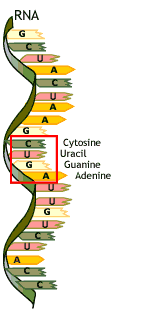
Choose the sequence of the mRNA strand that would be match up with to the following strand:
G T A G T C A
U A T U A G A
A C G A C T G
C A U C A G U
C A T C A G T
Why does a human body need proteins?
To place amino acids in a specific order
To guard against harmful mutations
To send messages to the cell's cytoplasm
To perform important bodily functions
When a nitrogen base (nucleotide) is removed from a gene, this is called a ________ mutation.
removal
deletion
substitution
insertion
change in the DNA sequence
protein
error
mutation
mutagen
when one or more nucleotides are deleted
substitution
addition
remake
deletion
one nucleotide is replaced with a different nucleotide
addition
substitution
deletion
inversion
when one or more nucleotides are inserted
addition
deletion
insertion
remake
when a portion of the DNA is shifted in one direction due to a deleition or insertion
frameshift
gene
deletion
substitution
T-G-A-C-C-A
T-G-A-G-C-A
DNA molecule segment is : TTA CGC AAG
The mutated DNA segment is TTC GCA AG. This is an example of ___ mutation.
Genetic mutations can be...
beneficial, harmful, or neutral
beneficial only
harmful only
neutral only
The two kinds of frameshift mutations are:
Deletion and insertion
Substitution and silent

