
 Worksheets
IS2T2: What's Inside the Earth?
Total questions: 70
Worksheet time: 2hrs 58mins
Earthquakes most often occur
in the middle of plates
near plate boundaries
where thunderstorms are
along the coast

Around what time did the first P wave get detected?
100 sec
120 sec
150 sec
160 sec

Which location is farther from the epicenter?
Seismogram B (top)
Seismogram C (bottom)
Which portion of the Earth can S waves NOT travel through?
Crust
Mantle
Core

Which station was closest to the earthquake's epicenter?
Station A
Station B
Station C

Scientists are able to create an image like this by studying
electromagnetic waves
P and S waves
P and Surface waves
S and Surface waves

This model represents a
P wave shadow zone
S wave shadow zone
Surface wave shadow zone
Convection currents
A seismic station recorded the P-waves, but no S-waves, from an earthquake because S-waves were
absorbed by Earth's outer core
transmitted only through liquids
weak and detected only at nearby locations
not produced by this earthquake

Which statement best explains why only one type of seismic wave was recorded at location B?
S-waves cannot travel through the liquid inner core
P-waves cannot travel through the solid outer core
P-waves cannot travel through the solid inner core.
S-waves cannot travel through the liquid outer core

What layer of the Earth is labeled A?
inner core
outer core
mantle
crust
Which layer is liquid?
crust
mantle
outer core
inner core
Which layer is the HOTTEST?
Crust
Mantle
Outer Core
Inner Core
What state of matter is the inner core?
Solid
Solid but flexible
Liquid
What layer has convection currents?
Crust
Mantle
Inner Core
Outer Core
What layer is liquid and makes a magnetic field?
Outer Core
Mantle
Inner Core
Crust

In what layer of the Earth do people live?
Outer Core
Mantle
Inner Core
Crust
How many major earth layers are there?
3
4
5
3.5
What layer of the Earth is labeled B?
inner core
outer core
mantle
crust
What layer of the Earth is labeled C?
inner core
outer core
mantle
crust
Match the layer with its temperature.
Crust
0-70 C
Mantle
1800-6700 C
Outer Core
8000-9000 C
Inner Core
9300 C
Which layer is made (mostly) of LIQUID iron and nickel?
crust
mantle
outer core
inner core

Which layer is made (mostly) of SOLID iron and nickel?
crust
mantle
outer core
inner core
Which of the following correctly lists the layers from innermost to outermost?
inner core, outer core, lower mantle, upper mantle, crust
lower mantle, upper mantle, crust, inner core, outer core
lower mantle, inner core, upper mantle, outer core, crust
crust, inner core, lower mantle, upper mantle, outer core

As you travel from the crust to the core, how would temperature, pressure and density of the material change?
They would all increase
They would all decrease.
Nothing, the layers are made of the same material throughout
Temperature would decrease, but pressure and density would increase
Earth’s crust can only be____________ or _______________.
Volcanic & Seismic
Oceanic & Continental
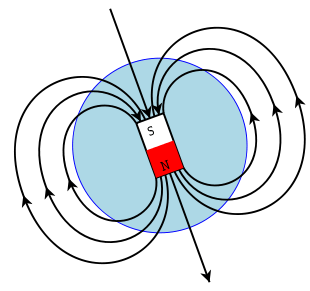
The area of magnetic force around a magnet is known as its _____________.
magnetic field
magnetic declination
magnetic fan lines
magnetic tan lines

Oceanic crust is made of ______
Granite
Basalt
Cookies
Water
Continental crust is made of _______
Flowers and grass
Basalt
Granite
Crust
What is the rising of hot liquid and the sinking of cooled liquid called?
Confection current
Convention current
Convection current
Lava lamp
Movement of the liquid metal of the outer core causes
Volcanic eruptions
Earthquakes
Convection Currents
Earth's magnetic field
What would happen to convection currents if the inner Earth Cooled down
They would continue at the same speed
They would move faster
They would move slower
They would stop
Heat transfer by convection is caused by differences in what two things:
Thickness and material
Weight and electricity
Temperature and density

Convection currents happen inside the Earth. Magma is heated by ______ and rises towards the crust.
the sun
the core
plate tectonics

Convection currents happen inside the Earth. Hot magma from the mantle cools as it touches the ______ and transfers heat. Then it sinks back down again.
crust
core
mantle

A trench is formed when a tectonic plate carrying land meets a tectonic plate carrying ocean. How does density cause the trench to form?
The water the is heavy and forces the plate below the land.
The ocean plate is more dense and sinks under the less dense land plate.
The land plate lifts up and slides upover the ocean plate.
What type of plate boundary creates new sea floor?
Divergent
Convergent
Transform
Subduction

What type of plate boundary is represented in the picture?
Athensphere
Divergent
Transform
Convergent

Which crust subducts because it is denser than other crust?
pizza crust
oceanic crust
continental crust
new crust
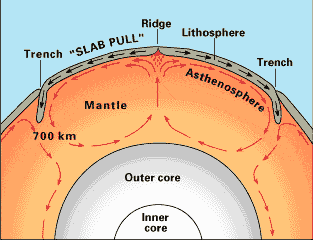
What is the source of energy that drives plate movement?
the subducton of the sea floor
the different densities of the oceanic and crustal plates
convection currents in the asthenosphere
the friction force between the plates that move past each other
What term describes the sinking of the oceanic plate?
subduction
high density
asthenosphere
viscosity
Why does the oceanic plate sink?
high viscosity magma forces it to happen
convection currents in the mantle
oceanic plates are lighter and are pushed under by the continental
oceanic plates are more dense and are forced to sink
What happens in the upper mantle when the oceanic plate has subducted?
The oceanic plate melts due to heat and friction creating high viscosity magma
The oceanic plate melts due to heat and friction creating low viscosity magma
The plate is cycled round to a constructive plate margin.
What happens to the magma when it has been created?
erupts from the volcano
get's stuck in the main vent
Rises through cracks in the continental crust
remains in the mantle, as the mantle is made of magma

What geologic feature/event would you most likely to find at a divergent boundary between two pieces of oceanic crust?
Rift Valley
Mid-Ocean Ridge
Island Arc
Flat land
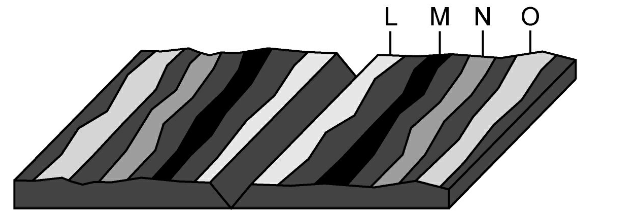
Towards the edges
Youngest seafloor is in the middle of the ocean
Where do most earthquakes and volcanoes take place?
in the oceans
at plate boundaries
on land only
Which statement best explains plate tectonics
The movement of crustal plates over the mantle prevents continental drift
Crustal plates move away from each other at tectonic boundaries
The movement of crustal plates over the mantle often results in earthquakes and volcanic eruptions
Where does the energy from an earthquake originate?
from rocks under stress shifting deep below Earth's surface
weight from rocks pushing down on bedrock
from convection currents
A plate boundary where two plates move away from each other.
Convergent
Divergent
Transform
Normal fault
Oceanic crust sinks beneath a deep-ocean trench and back into the mantle at a convergent plate boundary.
Folding
Subduction
Sea-floor spreading
Mountain formation

