
 Worksheets
Unit 6: Work, Energy and Power Review
Total questions: 124
Worksheet time: 2hrs 3mins
Anika, Hannah, and Aria are having a friendly competition to see who can push a box the farthest. What is the formula they should use to calculate the work done?
work = force + distance
work = force × distance
work = force ÷ distance
work = force - distance
During a science experiment, Daniel, Evelyn, and Maya apply a force of 20 N to move a heavy box a distance of 5 meters. What is the work done by them?
100 J
75 J
50 J
25 J
Scarlett, Abigail, and Aiden are playing a game of tug-of-war. If they all pull with equal force and no displacement occurs, how much work is done?
-1
10
0
1
Sophia, Luna, and Nora are having a debate about the SI unit of work. Can you help them settle the argument?
joule
ampere
newton
watt
Isla, Avery, and Grace are having a friendly competition to see who can come up with the formula to calculate power the fastest. Can you help them out? What is the formula to calculate power?
P = F/d
P = mgh
P = W/t
P = V/I
Anika, Aiden, and Mia are having a friendly competition to see who can guess the power of a machine. The machine does 500 J of work in 10 seconds. Can you help them figure out the power of the machine?
100 W
250 W
1000 W
50 W
Scarlett, Liam, and Anika are having a debate. Scarlett thinks the SI unit of power is ampere, Liam believes it's watt, and Anika argues it's ohm. Who is correct?
Scarlett (ampere)
Liam (watt)
Anika (ohm)
None of them
Lily, Nora, and Arjun are having a heated debate in their physics class. They are trying to figure out the relationship between work and change in kinetic energy according to the work-energy theorem. Can you help them settle this debate?
Work is equal to the change in kinetic energy.
Work is equal to the potential energy.
Work is equal to the initial kinetic energy.
Work is equal to the final kinetic energy.
Imagine Grace, Evelyn, and Kai are having a friendly debate about physics. They're discussing a scenario where the work done on an object is zero. What can you say about its change in kinetic energy in this case?
Grace argues that the change in kinetic energy is negative.
Evelyn believes that the change in kinetic energy is zero.
Kai thinks that the change in kinetic energy is positive.
Or, is the change in kinetic energy unknown?
Imagine this! William and Michael are at a car race. They see a car with a mass of 1000 kg accelerating from rest to a speed of 20 m/s. Ava, who is a physics enthusiast, calculates the work done on the car to be 5000 J. Can you help them figure out the change in the car's kinetic energy?
5000 J
3000 J
2000 J
1000 J

Where is the car moving fastest?
A
B
C
D
Where does the car have the most gravitational PE?
A
B
C
D
The car is not moving at point A -
what type of energy is present at point A?
(Select all that apply)
KE
PE
No Mechanical Energy Present
The car has 200 J of PE at point A and is not moving. What is the total ME at point A?
200 J
150 J
100 J
50 J
0 J
The car has 200 J of KE at point C and is at the lowest point. What is the total ME at point D?
200 J
150 J
100 J
50 J
0 J
A 1000kg car is moving at 5m/s, what is the Kinetic Energy of the car?
6250000 J
25000 J
12500 J
2500 J
A 7.14 kg object has 700 J of stored gravitational potential energy. How high above the ground is the object?
0.9m
7.14m
10m
20m
A 2kg ball rolls with a KE of 36 J - what is the speed of the ball?
6m/s
7.4m/s
18m/s
None of these
KE = 1080 J
KE = 810 J
I do the same amount of work as my friend but it takes me twice as long to finish, who is more powerful
Me
My Friend
Equal Power
Time does not impact power
If 40N of force is applied to Rollo Koster's 10 kg cart over a distance of 50 meters, how much work is done?
8000J
8000N
4000J
2000J
The potential energy of an object increases 50 J. If there is no friction, how much kinetic energy has tranformed?
100 JOULES
50 JOLUES
50 JOULES
200 JOULES
A 50 kg object sits on the roof of a 25 m building. If we neglect friction, at what velocity will it hit the ground if it falls freely?
22.14 m/s
45 km/h
29.56 m/s
None of the above
In which of the following scenarios is work being done, according to the physics definition?
Solving an equation
lifting up a book
holding a barbell above your head
keeping a bike from falling as it rolls along a sidewalk
The "power" of a machine measures...
The work it does
The force it produces
The rate of doing work
Its strength
An object lifted 10m gains 200 J of potential energy. If the same object is lifted 20m, its potential energy gain is...
Half as much
The same
Twice as much
Four times as much
More than 4 times as much
It takes 60 J of work to push a large box 6 m across a floor. Assuming the push is in the same direction as the displacement, what is the magnitude of the force on the box?
6 N
10 N
60 N
360 N
None of these
If you do work on an object in one third of the usual time, your power output is...
One third of the usual power output
The same as the usual power output
Three times the usual power output
Impossible to predict
A 5 kg mass has 100 J of potential energy with respect to the ground. Approximately how high above the ground is the mass?
1 m
2 m
3 m
4 m
None of these
A bow is drawn so that it has 40 J of potential energy. When released, the arrow will theoretically have a kinetic energy that is
less than 40 J
More than 40 J
40 J
Impossible to predict
If you do 200 J of work in 10 seconds, your power output is...
2000 W
200 W
20 W
2 W
An object at rest may also have...
Speed
Velocity
Momentum
Kinetic Energy
Potential Energy
Mrs. Steward carries a 50 N cat 10 m across a room. Her arms exert an upward force on the cat equal to its weight. How much work is Mrs. Steward doing on the cat?
500 N
50 N
5 N
0 N
None of the above
When a car breaks to a stop, all its kinetic energy is converted to...
Stopping Energy
Potential Energy
Chemical Energy
Heat through friction
Nuclear Energy
A ball rolling down an incline plane has its maximum potential energy at...
The top
A quarter of the way down
Half way down
The bottom
Impossible to predict
A car moves 3 times as fast as another car. Compared to the slower car, the faster car has...
3 times the kinetic energy
6 times the kinetic energy
9 times the kinetic energy
12 times the kinetic energy
A shopping cart has a mass of 40 kg is pushed 10 m with a force of 20 N. How much work is done on the cart?
200 J
400 J
800 J
8000 J
A block of ice sliding down an incline has its maximum kinetic energy at...
the top
the bottom
halfway down
impossible to predict
How can you increase the power output of a machine?
Increase the work done
Increase the force with which the work is done
Decrease the time in which the work is done
All of the above
If you push an object a given distance, while applying four times the force, you do...
Twice as much work
Four times as much work
Half as much work
The same amount of work
A 10 kg ball has a height of 2 m, while a 5 kg ball has a height of 5 m. Which ball has more potential energy?
The 5 kg ball
The 10 kg ball
They both have the same potential energy
impossible to predict
Which quantity has the greatest influence on the amount of kinetic energy a large truck has while moving down the highway?
It's mass
It's weight
It's velocity
It's size
None of the above
How much power is required to raise a 30 kg crate a vertical distance of 6 m in a time of 4 seconds?
120 W
52.5 W
450 W
385 W
525 W
A block of mass m is pushed to the left against a spring that is compressed a distance d from its equilibrium length. When the block is released, it reaches a maximum velocity of KE1. Next a block with mass 4m is pushed against an identical spring and compressed the same distance d. What is the maximum kinetic energy of the 4
m block?
a. 1/2 KE1
b. KE1
c. 2 KE1
d. 4 KE1
Which appliance uses the most energy?
Air conditioner has a power rating of 2000 W and use duration of 1 hour
Light bulb has a power rating of 60 W and a usage duration of 18 hours
Dishwasher has a power rating of 2500 W and a usage duration of .5 hours
Clock radio has a power rating of 1 W and a usage duration of 24 hours
a. Dishwasher
b. Air conditioner
c. Light bulb
d. Clock radio
A rock climber carrying a backpack has a total weight of 800 N. How much work is done when she climbs 10 m in 10 sec?
50 J
60 J
800 J
8000 J
An engineering student is gathering data on the motion of a model car traveling down and back up a skate ramp. After several trials the student finds that the car does not travel as high on the other side of the skate ramp as the height it was released at on the other side. Which of the following can best explain this difference?
The car gained a small amount of mass as it moved down the ramp
The student accidentally accelerated the car at the top of the ramp
The measured height of the ramp was less than the actual height
The student did not include the effect of frictional force in the calculations
Workers must move a new refrigerator into a home. This requires taking the refrigerator up steps that are 3 m high. They have two options for ramps to help move the refrigerator up the stairs, a ramp of 20 feet and a ramp of 5 feet. Which of the answers below correctly compares the Force and Work required using each ramp?
The 20 m ramp will require a smaller force and require more Work
The 5 m ramp will require a larger force and require more Work
Both ramps will require the same force and the same Work
The 5 m will require a larger force and require the same Work
A student conducts an experiment in which an object is released from rest above a motion detector. The student collects the data necessary to graph the object’s kinetic energy as a function of time, as shown below. All frictional forces are negligible. Which of the following graphs represents the sum of the Mechanical Energy (K + Ug) of the object-Earth system as a function of time?
A horizontal line indicating constant mechanical energy over time.
A downward curving line, indicating mechanical energy decreasing over time.
An upward curving line, indicating mechanical energy increasing over time.
A line that curves upward more steeply than in graph c, indicating mechanical energy increasing at a faster rate over time.
All carts shown below are identical, 1 kg metal carts. Blocks placed in the carts have a mass of 2.0 kg each. In which arrangement does the cart have the least amount of potential energy when it is at the top of the ramps?
A. A cart and height of 2 m.
B. A cart with two boxes and a height of 2 m.
C. A cart with one box and a height of 1 m.
D. A cart with one box and a height of 2 m.
A block slides across a flat, horizontal surface to the right. For each choice, the arrows represent velocity vectors of the block at successive intervals of time. Which of the following diagrams represents the situation in which the block loses kinetic energy?
a. 4 same length arrows equidistant apart.
b. 4 arrows moving to the right, each one shorter as you move to the right.
c. 4 arrows moving to the right, each one longer as you move to the right.
d. 3 extra long arrows of equal length moving to the right
A 2 kg block is placed at the top of an incline with an unknown angle θ and released from rest a distance H above the ground. The block's velocity while sliding down the incline is shown in the graph. How could a student use the graph to determine the total energy of the block-Earth system? Frictional forces between the block and the incline are negligible.
Use mgy with m=2 kg and y equal to the area between the horizontal axis and the curve.
Use ½ mv² with m=2 kg and v equal to the final velocity of the object that can be found from the graph.
Use Fd with F equal to the normal force exerted on the block and d equal to the area between the horizontal axis and the curve.
The answer cannot be determined without knowing the initial height of the object above the ground.
A 3 kg block is pushed a distance d = 10.0 m up a 30° incline and height of 6 m. What is the approximate change in the gravitational potential energy of the block-Earth system when the block is at rest at the top of the incline, compared to at the bottom of the incline?
0 J
20 J
120 J
180 J
200 J
An object initially at rest falls from a height H until it reaches the ground. Which two charts could represent the mechanical energy of the object-Earth system just before the object is dropped and when the object has fallen halfway to the ground?
a. Ug of 67% and K of 33% at the beginning followed by Ug of 50% and K of 50% at the end.
b. Ug of 100% at the beginning followed by Ug with K of 50% each at the end.
c. Ug of 67% and K of 33% at the beginning followed by Ug of -50% and K of 50% at the end.
d. Ug of 100% at the beginning follwed by Ug with -50% and K of 50% at the end.
The surface of an incline is coated with an experimental substance that is supposed to eliminate the frictional force between a block and the surface of the incline. A 4 kg block is placed at the top of the incline at a height of 2 m. The block is released from rest and slides down the incline. A motion detector at the bottom of the incline measures the block’s speed as 6 m/s. Which of the following claims is correct about the experimental substance?
The experimental substance reduced all the frictional force because all the gravitational potential energy of the Earth-block system at the top of the incline was converted into the kinetic energy at the bottom of the incline.
The experimental substance did not reduce all the frictional force because some of the gravitational potential energy of the Earth-block system at the top of the incline was converted into nonmechanical energy.
The effectiveness of the experimental substance cannot be determined because the speed of the block at the bottom of the inline, as measured by the motion detector, indicates that the block has more energy at this location than the Earth-block system had at the top of the incline.
The effectiveness of the experimental substance cannot be determined without knowing the magnitude of the frictional force between the block and the incline before and after the experimental substance was applied to the incline.

Compare the kinetic energy of the roller coaster at the top of the first hill to its kinetic energy at the top of the second hill. Justify your comparison.
The KE is higher on the first hill.
The KE is higher on the second hill.
The KE is equal on both hills.
The KE cannot be determined based on the information.

When will the roller coaster be moving the slowest (other than at the top of the first hill)? Justify your answer.
At point B because it's lowest.
At point C because it's the next highest.
At point D because its next lowest.
At point E because it's the medium height.
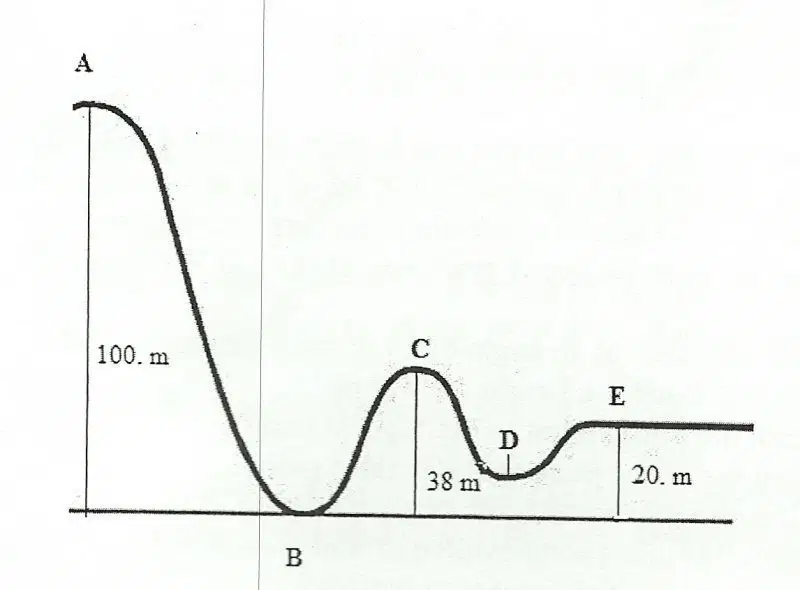
What is the maximum height of the third hill that the roller coaster would successfully make it over? Justify your answer.
At the same height as the first hill because it has that much energy.
At the same height of the second hill because it loses energy.
At the point of the second dip because there is little energy.
To the floor because all energy is exhausted.
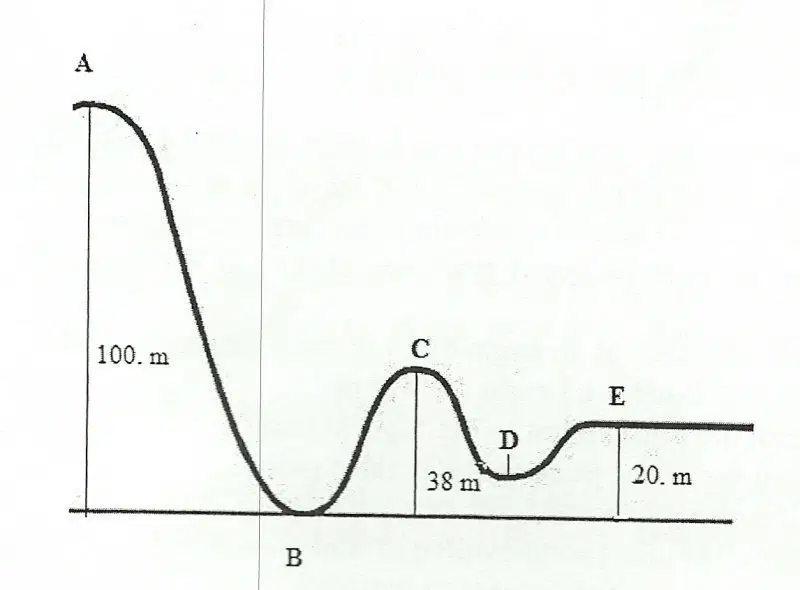
What will the speed of the roller coaster be at the top of the new hill you described in the previous question? Justify your answer.
At 5 m/s because it's slower.
At or near 0 m/s because it will slow down.
At 20 m/s because it's faster.
At 15 m/s because it's a medium speed.
Define Potential Energy.
The energy that an object stores due to its position or state.
Define Kinetic Energy
Define Mechanical Energy
The total amount of potential and kinetic energy in a system
What is the difference between gravitational and elastic potential energy?
Define chemical potential energy.
What is the physics definition of work?
The force exerted on an object causing it to move
What is the physics definition of power?
Work done or energy is transferred over time
Define conservation of energy.
What is the law of conservation of mass?
What is the law of conservation of energy?
What is the law of conservation of momentum?
In what ways can the potential energy of an object be increased
while keeping its height above the ground constant?
By increasing the object's velocity
Calculate the kinetic energy of a 500 g ball moving with a speed of 12 m/s.
If a bicycle with a mass of 20 kg is moving at a speed of 5 m/s, what is its kinetic energy?
What is the kinetic energy of a 75 kg athlete running at a speed of 9 m/s?
Determine the gravitational potential energy of a 1.5 kg object positioned on a ledge that is 8 meters high.
Calculate the gravitational potential energy of a 2 kg book placed on a table that is 2 meters above the floor.
Find the gravitational potential energy of a 700 g box situated on a shelf that is 5 meters above the ground.
Determine the gravitational potential energy of a 600 g book positioned on a bookshelf that is 4 meters high.
If an object possesses a mechanical energy of 6000 J, and its potential energy
at a specific location is 2500 J, what is its kinetic energy at that point?
Given that a system has a total mechanical energy of 800 J, and its kinetic energy at a particular instant is 350 J, what is the potential energy of the system at that moment?
If the mechanical energy of an object is measured to be 12000 J, and its kinetic energy at a certain point is 9000 J, what is the corresponding potential energy at that location?
Calculate the work done when a force of 600 N is applied to push a 25 kg crate a distance of 4.5 m.
112.5 J
133.33 J
15000 J
2700 J
Determine the work done when a 300 N force is used to lift a 50 kg object vertically by 7 meters.
42.86 J
350 J
2100 J
15000 J
How much work is done when you use 425 N of force to move a 15 kg box 2.8 m?
A bicycle is moving at a speed of 10 m/s, and its kinetic energy is measured to be 2000 J. Determine the mass of the bicycle.
If a truck has a kinetic energy of 120,000 J while traveling at a velocity of 30 m/s,
what is the mass of the truck?
510 kg
267kg
2223kg
842kg
Calculate the mass of a skateboard moving at a velocity of 5 m/s if its kinetic energy is found to be 500 J.
A 2 kg object has a gravitational potential energy of 400 J. How high above the ground is the object?
20.39 meters
Determine the height above the ground of a 7 kg object with a gravitational potential energy of 10,500 J.
323 meters
75.4 meters
152.9 meters
1500 meters
If a 3.5 kg object has a gravitational potential energy of 2800 J, what is its elevation above the ground?
A person applies a force of 60 N to push a sled. If 8000 J of work is done during this process,
what is the total distance the sled is pushed?
A car engine exerts a force of 150 N over a certain distance, doing 45000 J of work. Calculate the total distance the car moves.
If a weight lifter lifts a barbell with a force of 200 N and does 2400 J of work, what is the total vertical distance the barbell is lifted?
A machine has a power output of 800 W.
Determine the time it takes for the machine to perform 6000 J of work.
An engine generates 1200 W of power.
Calculate the time required for the engine to complete 24000 J of work.
If a device has a power consumption of 300 W, find the time needed for it to accomplish 9000 J of work.
Units of Force (F)
s
kg
m
N
Units of mass (m)
s
N
kg
kg m/s
Units of momentum (p)
kg m/s
kg
m/s
Ns
Units of velocity (v)
m/s2
m/s
N
kg m/s
Units of acceleration (a)
m/s
kg
m/s2
N
Units of impulse (J or sometimes I)
kg
s
Ns
N
Units of energy (KE, PE, EE)
kg
J
kg m/s
m/s2
Units of work (W)
J
W
kg m/s
m
Unit of displacement (x or d)
m/s2
kg
m
m/s
Units of power (P)
kg
N
m
W

