
 Worksheets
04 | Sensation and Perception
Total questions: 90
Worksheet time: 2hrs 30mins
Why is transduction important to sensation?
It explains our diminishing sensitivity to an unchanging stimulus.
It illustrates how much information processing occurs automatically.
It demonstrates how our experiences and expectations affect whether we perceive stimuli.
It converts physical stimuli, such as light, into neural messages.
The local fire department sounds the 12 o'clock whistle. The process by which your ears convert the sound waves from the siren into neural impulses is an example of
accommodation
transduction
parallel processing
sensory adaptation
When cocaine is consumed, it produces a rush of euphoria by
producing hallucinations.
blocking the reuptake of dopamine.
increasing the occurrence of alpha waves.
triggering a state of dissociation
Many researchers believe that pleasing tastes attracted our ancestors to energy- or protein-rich foods that enabled their survival. Such researchers are most likely
behaviorists.
evolutionary psychologists.
behavior geneticists.
molecular geneticists.
Audiotapes of soothing ocean sounds accompanied by faint and imperceptible verbal messages designed to increase a desire to lose weight best illustrate
Sensory interaction.
parallel processing
synesthesia.
subliminal stimulation.
The simultaneous stimulation of adjacent cold and pressure spots on the skin produces the sensation of
cold.
hot.
wetness.
pressure.
By creating an outline in which specific facts and theories are located within the larger framework of major topics and subtopics, Jasmine can remember much more of what she reads in her textbooks. This best illustrates the benefits of
implicit memory
the serial position effect
hierarchical organization.
the spacing effect.
The horizon moon appears to shrink in size if it is viewed through a narrow tube that eliminates the perception of distance cues. This best illustrates the importance of
the difference threshold.
perceptual adaptation.
relative size.
context effects.
What is the purpose of the eardrum?
Movement of the eardrum directly causes the stirrup to vibrate
Transduction of sound waves into neural messages occurs in the eardrum.
Axons on the eardrum converge to form the auditory nerve, which sends auditory messages to the brain.
To transmit sound from the air to the bones of the middle ear.
The process of receiving and representing stimulus energies through the nervous system is called
priming.
sensation.
accommodation.
synesthesia.
Taste and smell are both what kind of senses?
chemical
kinesthetic
vestibular
energy
According to the Young-Helmholtz theory
color vision depends on pairs of opposing retinal processes.
the retina contains three kinds of color receptors.
the size of the difference threshold is proportional to the intensity of the stimulus.
certain nerve cells in the brain respond to specific features of a stimulus.
As the brain receives information about the lines, angles, and edges of objects in the environment, higher-level cells process and interpret the information to consciously recognize objects. This process best illustrates
sensation.
bottom-up processing.
perception.
selective attention.
The basilar membrane is located in the
cochlea.
semicircular canal.
middle ear.
auditory canal.
Which of the following is a binocular cue for the perception of distance?
relative size
retinal disparity
visual cliff
visual cliff
Sound wave vibrations are transmitted by three tiny bones located in the
semicircular canals.
middle ear.
cochlea.
inner ear.
Epinephrine and norepinephrine are released by the
thyroid gland.
pituitary gland
parathyroids
adrenal glands.
The organization of two-dimensional retinal images into three-dimensional perceptions is called
monocular cues.
perceptual constancy.
retinal disparity.
depth perception.
As your teacher dims the lights to show a movie clip, you still perceive your friend's shirt as red. Which of the following best explains this phenomenon?
perceptual set
color constancy
lightness constancy
context effects
Seven members of a boys' club reported the following individual earnings from their sale of cookies: $2, $9, $8, $10, $4, $9, and $7. In this distribution of individual earnings
the median is greater than the mean and greater than the mode.
the median is less than the mean and less than the mode.
the median is greater than the mean and less than the mode.
the median is less than the mean and greater than the mode.
Patients' negative expectations about the outcome of a surgical procedure can increase their postoperative experience of pain. This best illustrates the importance of
top-down processing.
transduction.
sensory adaptation.
difference thresholds.
Interposition is a cue for depth perception in which closer objects
reflect more light to our eyes than do distant objects.
appear lower in the horizontal plane than do distant objects.
obstruct our view of distant objects.
create larger retinal images than do distant objects.
Which qualities do scientists possess?
Curiosity, skepticism, and confidence
Curiosity, skepticism, and humility
Analytical, skepticism, and confidence
Focus, skepticism, and stubbornness
An integrated understanding of pain control in terms of mental distraction, the release of endorphins, and the presence of empathic caregivers is most clearly provided by
the visual cliff.
opponent-process theory.
perceptual constancy.
a biopsychosocial approach.
Perceiving the color, motion, and form of a bird in flight illustrates
parallel processing.
place theory.
serial processing.
trichromatic theory.
Alexia tickles her sister by stroking adjacent _______ spots on her skin.
cold
pressure
pain
warmth
In writing survey questions, political pollsters who want to gather evidence of people's support for particular viewpoints are especially likely to be aware of
the representativeness heuristic.
fixation.
the framing effect.
the availability heuristic.
If an image falls on the eye's blind spot, you do not detect it. Which of the following best explains this phenomenon?
An image that is not projected on the fovea will not be perceived.
The curvature of the lens must accommodate to the incoming light levels or the image will not be seen.
When the eye stops moving, the sight would vanish
The image is not perceived because without receptor cells, transduction cannot occur.
The ability to detect whether your body is in a horizontal or vertical position depends most directly on
accommodation.
olfactory receptors.
sensory adaptation.
the vestibular sense.
Opponent-process cells have been located in the
cochlea.
spinal cord.
visual cortex.
thalamus.
The tendency to perceive a moving light in the night sky as belonging to an airplane rather than a satellite best illustrates the impact of
perceptual set.
the phi phenomenon.
perceptual constancy.
feature detection.
Tinnitus is a phantom ________ sensation.
somatic
gustation
visual
When informed that a brief imperceptible message would be flashed repeatedly during a popular TV program, many viewers reported feeling strangely hungry or thirsty during the show. Since the imperceptible message had nothing to do with hunger or thirst, viewers' strange reactions best illustrate
a placebo effect.
the volley principle.
sensory adaptation.
the McGurk Effect.
With her eyes closed and her nose plugged, Varsha was unable to taste the difference between an onion and a pear. Her experience best illustrates the importance of
sensory interaction.
accommodation.
sensory transduction.
sensory adaptation.
The impact of experience on perception is most clearly illustrated by
perceptual adaptation.
the phi phenomenon.
retinal disparity.
relative luminance.
For a moment after hearing his dog's high-pitched bark, Mr. Gold has a vivid auditory impression of the dog's yelp. His experience most clearly illustrates ________ memory.
short-term
iconic
implicit
echoic
A subliminal message is one that is presented
with very soft background music.
below one's absolute threshold for awareness.
while an individual is under hypnosis.
in a manner that is unconsciously persuasive.
Which process allows more light to reach the periphery of the retina?
transduction of the blind spot
sensory adaptation of feature detectors
accommodation of the lens
dilation of the pupil
The principle that two stimuli must differ by a constant proportion for their difference to be perceived is known as
sensory interaction.
Weber's law.
the opponent-process theory.
feature detection.
Standing atop a mountain on an utterly dark, clear night, most of us would see a candle flame atop another mountain 30 miles away. This best illustrates:
priming.
the absolute threshold.
a just noticeable difference.
transduction.
Brightness is to intensity as hue is to:
pitch.
amplitude.
color.
wavelength.
Brightness is to intensity as hue is to:
pitch.
amplitude.
color.
wavelength.
The retina is to the eye as the ________ is to the ear.
auditory canal
cochlea
auditory nerve
eardrum
Which theory can best explain why people respond differently to the same stimuli?
signal detection theory
opponent-process theory
frequency theory
the Young-Helmholtz theory
Which receptor cells most directly enable us to distinguish different wavelengths of light?
cones
rods
feature detectors
bipolar cells
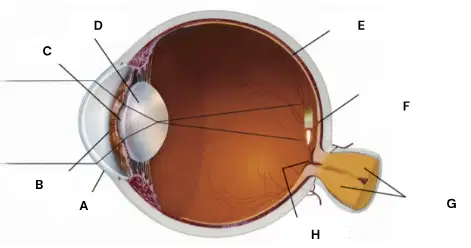
Which part of the eye is the letter G pointing too?
pupil
lens
optic nerve
retina
Which part of the eye is the letter C pointing too?
pupil
lens
optic nerve
retina
When you are expecting an incoming text message, you are much more likely to notice it the second it arrives. This best illustrates
priming.
absolute thresholds.
difference thresholds.
signal detection theory.
Rods are
less light-sensitive and less color-sensitive than are cones.
more light-sensitive and less color-sensitive than are cones.
less light-sensitive and more color-sensitive than are cones
more light-sensitive and more color-sensitive than are cones.
Why do people who have lost all hearing in one ear have difficulty locating sounds?
Sound waves strike one ear sooner and more intensely than the other.
Long sound waves have low frequency, therefore lower pitch.
The ears transform the vibrating air into nerve impulses, which our brain decodes.
Because if the eardrum is punctured, the ear's ability to conduct vibrations diminishes.
The process of encoding refers to
the persistence of learning over time.
the recall of information previously learned.
the motivated forgetting of painful memories.
getting information into memory.
Cones and rods are to vision as ________ are to audition.
hair cells
oval windows
eardrums
If we see a speaker mouthing day while actually hearing someone else saying may, we may perceive a third syllable bay that blends both inputs. This phenomenon is known as
accommodation.
the McGurk Effect.
prosopagnosia.
sensory adaptation.
Kinesthesis refers to the
system for sensing the position and movement of individual body parts.
diminished sensitivity to an unchanging stimulus.
process by which stimulus energies are changed into neural signals.
quivering eye movements that enable the retina to detect continuous stimulation.
The sense of smell is known as
subliminal stimulation.
transduction.
the vestibular sense.
olfaction.
Our sense of taste originally was thought to involve only the following four sensations
sour, bitter, sweet, and starchy.
salty, fatty, bitter, and sweet.
bitter, sweet, sour, and salty.
sweet, salty, starch, and bitter.
The steadily increasing size of the retinal image of an approaching object is especially important for perceiving the object's
weight.
shape.
height.
motion.
Which of the following circumstances is most likely to contribute to conduction hearing loss?
exposure to unpredictable or uncontrollable noise
exposure to very loud rock music
failure to use earplugs while working in a noisy factory
misuse of Q-tips (cotton swabs) in cleaning your ears
We compute motion based on the assumption that shrinking objects are
fixation points
schemas.
retreating.
binocular cues.
Researchers have identified receptors for which of the following skin sensations?
warmth
cold
pressure
pain
While playing tennis you need to know where your limbs are located so you can move them into the right positions to run or swing your racket. Which of the following senses provides this information?
gustation
kinesthesis
vestibular
audition
According to the opponent-process theory, cells that are stimulated by exposure to ________ light are inhibited by exposure to ________ light.
yellow; blue
red; blue
blue; red
blue; green
The convergence of parallel lines provides the distance cue known as
closure.
continuity.
linear perspective.
interposition.
When Ileanna visually displayed three rows of three letters each for only one-twentieth of a second, research participants
recalled only half the letters because they did not have enough time to see all of them.
recalled only about seven of the letters due to storage limitations.
had a momentary photographic memory of all nine letters.
formed a sensory memory of no more than a single letter.
As a door opens, it casts an increasingly trapezoidal shape on our retinas; however, we still perceive it as rectangular. Which of the following best explains this phenomenon?
phi phenomenon
perceptual adaptation
figure and ground
shape constancy
People who demonstrate blindsight have most likely suffered damage to their
visual cortex.
lens.
optic nerve.
fovea.
When visually deprived infant monkeys were first allowed to see, they could not visually distinguish
circles from squares.
between red and green lights.
figures from backgrounds.
between different-colored objects.
The receptor cells that convert light energy into neural signals are called
rods and cones.
bipolar cells.
feature detectors.
ganglion cells.
We tend to perceive more pain when others around us also report feeling pain. This research finding indicates that pain perception is affected by both biological and what other influences?
neural
social-cultural
hormonal
cognitive-behavioral
When given a placebo that is said to relieve pain, we are likely to be soothed by the brain's release of
endorphins.
umami.
nociceptors.
feature detectors.
After losing his left hand in an accident, Jack continued to experience pain in his nonexistent hand. His experience illustrates
bottom-up processing.
the vestibular sense.
phantom limb sensations.
sensory adaptation.
A 3-D movie enhances our sense of depth perception by simulating the effects of
linear perspective.
perceptual constancy.
retinal disparity.
interposition.
According to the gate-control theory, a back massage would most likely reduce your physical aches and pains by causing
activation of nerve fibers in your spinal cord.
deactivation of the pain receptors on the surface of your skin
release of pain-killing endorphins in your muscles.
the release of adrenaline into your bloodstream.
Which part of the eye is the letter F pointing too?
cornea
lens
fovea
retina
Under very dim levels of illumination
the iris expands to allow more light to reach the retina.
foveas react to increase the sensitivity of the optic nerve.
rods are more light-sensitive than cones.
feature detectors in the retina activate.
While a man provided directions to a construction worker, two experimenters rudely interrupted by passing between them carrying a door. The student's failure to notice that the construction worker was replaced by a different person during this interruption illustrates
blind spot.
change blindness.
bottom-up processing.
gate-control theory.
While singing to you on your birthday, your friends leave off the very last word of the song, “Happy birthday to you, Happy birthday to you, Happy birthday dear David, Happy birthday to….” Your tendency to mentally fill in the last word best reflects which of the following Gestalt principles of organization?
closure
continuity
figure and ground
proximity
After a small section of his basilar membrane was damaged, Jason experienced a noticeable loss of hearing for high pitched sounds only. Jason's hearing loss is best explained by the ________ theory.
gate-control
opponent-process
place
frequency
Feature detector
are retinal cells that allow you to see in dim light and are located in the periphery of the eye.
are neurons in the brain's visual cortex that fire in response to specific edges, lines, and angles.
are primarily located in the fovea.
combine to form the optic nerve, which sends visual information to the brain.
The volley principle is most directly relevant to our perception of
pitch.
brightness.
temperature.
pain
According to the opponent-process theory, cells that are stimulated by exposure to
green light are inhibited by exposure to blue light.
green light are inhibited by exposure to red light
red light are inhibited by exposure to blue light.
yellow light are inhibited by exposure to red light
The perception that Bugs Bunny is hopping across a movie screen best illustrates
linear perspective.
retinal disparity.
stroboscopic movement.
opponent-process.
Those who believe in the value of subliminal audiotapes would be wrong to claim that
subliminal stimuli can trigger priming.
imperceptibly brief stimuli can trigger a weak response.
we can sometimes sense stimuli below our absolute threshold.
unconsciously processed information is unusually persuasive.
On a cloudy day, a yellow flower is likely to appear ________ it does on a bright sunny day
equally as yellow as
more yellow than
less yellow than
less colorful than
Mr. Logwood's eyewitness perceptions of a car accident were influenced by his inborn ways of organizing sensory experiences, his learned schemas, and by other eyewitnesses' reactions to the car accident. An integrated understanding of Mr. Logwood's perceptions of the accident is most clearly provided by
a biopsychosocial approach
perceptual constancy
gate-control theory
parapsychology
After listening to your high-volume car stereo for 15 minutes, you fail to realize how loudly the music is blasting. This best illustrates
accommodation.
sensory adaptation.
Weber's law.
the volley principle.
The cochlea is a
fluid-filled tube that provides a sense of upright body position.
fluid-filled tube in which sound waves trigger nerve impulses.
set of three tiny bones that amplify the vibrations of the eardrum
fluid-filled tube that provides a sense of body movement.
Sasha believes that she is a very good driver. Her belief leads her to take unnecessary risks, such as driving too fast and cutting in front of other drivers. Sasha's driving appears to be affected by
hindsight bias.
overconfidence.
intuition.
illusory correlations
Conscious memory of factual information is called ________ memory.
proactive
procedural
explicit
implicit
The sequential occurrence of two highly unusual events is most likely to contribute to
random sampling
the hindsight bias
the placebo effect
an illusory correlation

