
 Worksheets
Brain & Neuron Quiz Prep
Total questions: 90
Worksheet time: 45mins

#1
Frontal Lobe
Parietal Lobe
Temporal Lobe
Occipital Lobe
#2
Frontal Lobe
Parietal Lobe
Temporal Lobe
Occipital Lobe
#3
Cerebellum
Parietal Lobe
Temporal Lobe
Occipital Lobe
#5
Frontal Lobe
Parietal Lobe
Temporal Lobe
Occipital Lobe
#4
Frontal Lobe
Cerebellum
Temporal Lobe
Occipital Lobe
The function of this lobe is decision making, personality & critical thinking
#1
#2
#3
#4
The function of this lobe is processing sensory information
#1
#2
#3
#4
The function of this lobe is visual processing
#5
#2
#3
#4
The function of this lobe is auditory processing & memory formation
#1
#2
#5
#4
The function of this portion of the brain is balance, coordination & posture
#1
#2
#5
#4
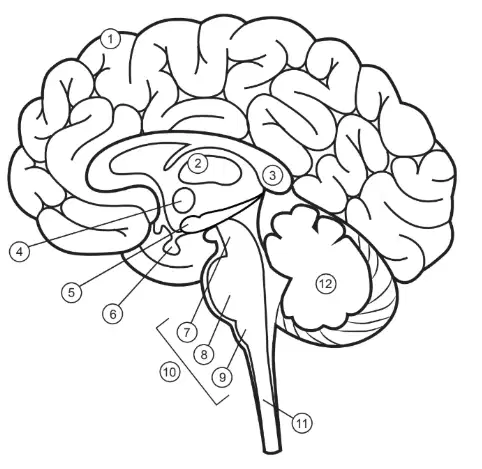
#2
Medulla
Thalamus
Corpus Callosum
Hypothalamus
#3
Amygdala
Cerebellum
Corpus Callosum
Brainstem
#4
Pituitary Gland
Pons
Thalamus
Hypothalamus
#5
Pituitary Gland
Medulla
Hippocampus
Hypothalamus
#6
Pituitary Gland
Medulla
Hippocampus
Hypothalamus
#7
Midbrain
Medulla
Brainstem
Thalamus
#8
Corpus Callosum
Medulla
Brainstem
Pons
#9
Midbrain
Medulla
Hypothalamus
Pons
#10
Hypothalamus
Medulla
Brainstem
Thalamus
#11
Spinal Cord
Medulla
Brainstem
Pons
#12
Corpus Callosum
Cerebellum
Cerebral Cortex
Pons
#1
Outer layer of the brain
Relay station for sensory information
Nerve fibers that connect the left & right hemispheres of the brain
Regulates essential bodily functions such as hunger, thirst, sleep & body temperature & keeps our body in homeostasis
#2
Outer layer of the brain
Relay station for sensory information
Nerve fibers that connect the left & right hemispheres of the brain
Regulates essential bodily functions such as hunger, thirst, sleep & body temperature & keeps our body in homeostasis
#3
Outer layer of the brain
Relay station for sensory information
Nerve fibers that connect the left & right hemispheres of the brain
Regulates essential bodily functions such as hunger, thirst, sleep & body temperature & keeps our body in homeostasis
#4
Outer layer of the brain
Relay station for sensory information
Nerve fibers that connect the left & right hemispheres of the brain
Regulates essential bodily functions such as hunger, thirst, sleep & body temperature & keeps our body in homeostasis
#5
Forming & consolidating memories
Regulates hormone production & helps keep our body in homeostasis
Processes sensory information (mostly visual & auditory)
Regulates waking & relaxation
#6
Forming & consolidating memories
Regulates hormone production & helps keep our body in homeostasis
Processes sensory information (mostly visual & auditory)
Regulates waking & relaxation
#7
Forming & consolidating memories
Regulates hormone production & helps keep our body in homeostasis
Processes sensory information (mostly visual & auditory)
Regulates waking & relaxation
#8
Forming & consolidating memories
Regulates hormone production & helps keep our body in homeostasis
Processes sensory information (mostly visual & auditory)
Regulates waking & relaxation
#9
Regulates crucial bodily functions such as heart beat, blood pressure & breathing
Contains the midbrain, pons & medulla. Involved with breathing, heart rate & sleep/wake cycles
Connects the rest of the body to the brain
Involved with our coordination, posture & balance
#10
Regulates crucial bodily functions such as heart beat, blood pressure & breathing
Contains the midbrain, pons & medulla. Involved with breathing, heart rate & sleep/wake cycles
Connects the rest of the body to the brain
Involved with our coordination, posture & balance
#11
Regulates crucial bodily functions such as heart beat, blood pressure & breathing
Contains the midbrain, pons & medulla. Involved with breathing, heart rate & sleep/wake cycles
Connects the rest of the body to the brain
Involved with our coordination, posture & balance
#12
Regulates crucial bodily functions such as heart beat, blood pressure & breathing
Contains the midbrain, pons & medulla. Involved with breathing, heart rate & sleep/wake cycles
Connects the rest of the body to the brain
Involved with our coordination, posture & balance
The amygdala is responsible for our fear response and is involved in our processing of aggression.
The reticular activation system (RAS) is involved in our alertness & arousal
Our sense of smell is processed in the thalamus
There are 6 different lobes in the brain
The brainstem contains the medulla, amygdala & pons
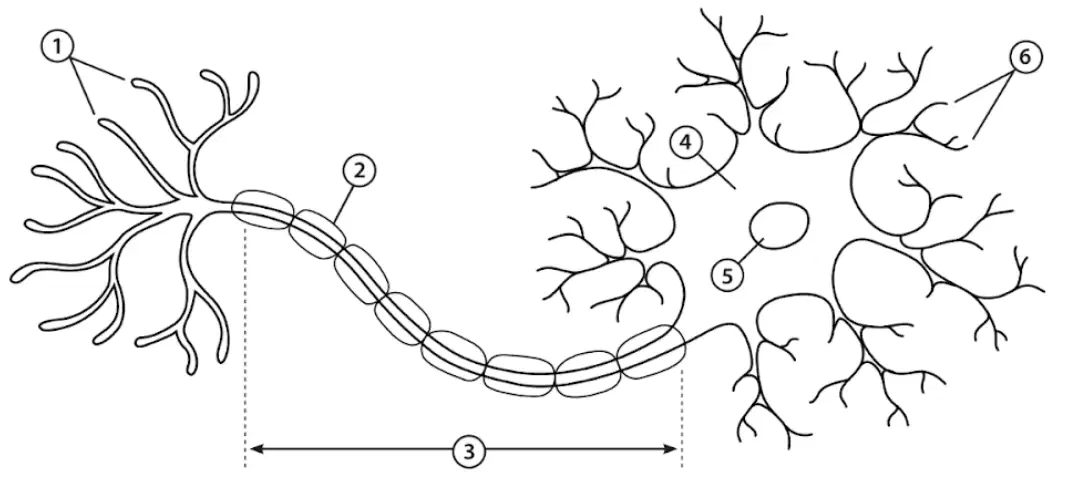
#1
Dendrites
Axon
Axon terminals
Cell body
#2
Myelin Sheath
Axon
Axon terminals
Nucleus
#3
Myelin Sheath
Axon
Axon terminals
Nucleus
#4
Myelin Sheath
Axon
Cell body
Nucleus
#5
Dendrites
Axon
Cell body
Nucleus
#6
Dendrites
Axon
Cell body
Nucleus
#1
Sends messages to receiving cell
Receives messages from the sending cell
Covers the axon & helps speed up the neural impulse
Impulse travels down this structure to the axon terminals
#6
Sends messages to receiving cell
Receives messages from the sending cell
Covers the axon & helps speed up the neural impulse
Impulse travels down this structure to the axon terminals
#2
Sends messages to receiving cell
Receives messages from the sending cell
Covers the axon & helps speed up the neural impulse
Impulse travels down this structure to the axon terminals
#3
Sends messages to receiving cell
Receives messages from the sending cell
Covers the axon & helps speed up the neural impulse
Impulse travels down this structure to the axon terminals
#4
Sends messages to receiving cell
Receives messages from the sending cell
Central part of the neuron that contains the nucleus
The cells "life support"
#5
Sends messages to receiving cell
Receives messages from the sending cell
Central part of the neuron that contains the nucleus
The cells "life support"
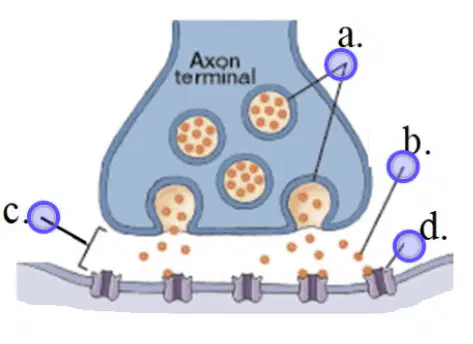
a.)
Vesicles
Neurotransmitters
Synaptic gap
Receptor sites
b.)
Vesicles
Neurotransmitters
Synaptic gap
Receptor sites
c.)
Vesicles
Neurotransmitters
Synaptic gap
Receptor sites
d.)
Vesicles
Neurotransmitters
Synaptic gap
Receptor sites
a.)
Carries the neurotransmitters down the axon terminal to the synaptic gap
Chemical messengers released between neurons
The gap between neurons where neurotransmitters are released
Where neurotransmitters bind to the receiving cell
b.)
Carries the neurotransmitters down the axon terminal to the synaptic gap
Chemical messengers released between neurons
The gap between neurons where neurotransmitters are released
Where neurotransmitters bind to the receiving cell
c.)
Carries the neurotransmitters down the axon terminal to the synaptic gap
Chemical messengers released between neurons
The gap between neurons where neurotransmitters are released
Where neurotransmitters bind to the receiving cell
d.)
Carries the neurotransmitters down the axon terminal to the synaptic gap
Chemical messengers released between neurons
The gap between neurons where neurotransmitters are released
Where neurotransmitters bind to the receiving cell
The thalamus regulates bodily functions such as hunger, thirst, body temperature & sleep cycles
The hippocampus is involved in the forming & consolidating of new memories
Which structure of the brain regulates sleep & relaxation?
Pons
Hippocampus
Thalamus
Cerebellum
Which structure of the brain is a relay station for sensory information (except for smell)?
Pons
Hippocampus
Thalamus
Cerebellum
Which structure of the brain is the nerve fibers that connect the left & right hemispheres?
Brainstem
Cerebral Cortex
Corpus callosum
Cerebellum
Neurotransmitters are the ELECTRICAL communication between cells
Broca's area is responsible for the physical production of speech
Wernicke's area is responsible for the comprehension of speech
Lobe that assists with decision making, personality & problem solving
Frontal Lobe
Parietal Lobe
Temporal Lobe
Occipital Lobe
Lobe that assists with processing senses
Frontal Lobe
Parietal Lobe
Temporal Lobe
Occipital Lobe
Lobe that assists with visual processing
Frontal Lobe
Parietal Lobe
Temporal Lobe
Occipital Lobe
Lobe that assists with auditory processing, memory & language
Frontal Lobe
Parietal Lobe
Temporal Lobe
Occipital Lobe
Involved with coordination, balance & posture (sometimes referred to as the "little brain")
Cerebellum
Brainstem
Cerebral Cortex
Thalamus
Contains the midbrain, pons & medulla
Cerebellum
Brainstem
Cerebral Cortex
Thalamus
Outer layer of the brain. Assists with higher cognitive thinking (such as thinking, perceiving & decision making)
Cerebellum
Brainstem
Cerebral Cortex
Thalamus
Relay system that processes all sensory information except for smell
Cerebellum
Brainstem
Cerebral Cortex
Thalamus
Nerve fibers that connect the left & right hemisphere of the brain
Corpus Callosum
Hypothalamus
Hippocampus
Pituitary Gland
Regulates essential bodily functions (such as body temperature, hunger, thirst & sleep/wake cycles). Helps our body maintain homeostasis
Corpus Callosum
Hypothalamus
Hippocampus
Pituitary Gland
Assists in forming & consolidating memories
Corpus Callosum
Hypothalamus
Hippocampus
Pituitary Gland
Regulates hormone production
Corpus Callosum
Hypothalamus
Hippocampus
Pituitary Gland
Fear & aggression responses happen here
Amygdala
Midbrain
Pons
Medulla
This structure is part of the brainstem. Processes sensory information (mostly auditory & visual)
Amygdala
Midbrain
Pons
Medulla
This structure is part of the brainstem. It regulates the waking and relaxing cycle of sleep.
Amygdala
Midbrain
Pons
Medulla
This structure is part of the brainstem. Its communicates with the heart & lungs by regulating heart rate, blood pressure & breathing
Amygdala
Midbrain
Pons
Medulla
Sends messages to receiving cell
Axon terminals
Dendrites
Myelin Sheath
Axon
Receives messages from the sending cell
Axon terminals
Dendrites
Myelin Sheath
Axon
Covers the axon & helps speed up neural impulse
Axon terminals
Dendrites
Myelin Sheath
Axon
Impulse travels down this structure of the cell. This part of the cell is covered with the myelin sheath
Axon terminals
Dendrites
Myelin Sheath
Axon
Carries the neurotransmitters down the axon terminal of the sending cell
Vesicles
Neurotransmitters
Synaptic Gap
Receptor Site
Chemical messengers that are released between neurons
Vesicles
Neurotransmitters
Synaptic Gap
Receptor Site
The gap between the sending neuron and the receiving neuron
Vesicles
Neurotransmitters
Synaptic Gap
Receptor Site
Where neurotransmitters bind to the receiving cell
Vesicles
Neurotransmitters
Synaptic Gap
Receptor Site

