
 Worksheets
Unit 2 Test
Total questions: 70
Worksheet time: 1hrs 20mins
Emma is studying how certain cells in the human body produce and transport enzymes. She learns that salivary glands produce a large quantity of enzymes that are transported out of the secretory cells. Which of the following organelles would be abundant in these cells?
nuclei
golgi apparatus
smooth ER
lysosomes
Match the following organelles to their descriptions:
Mitochondria
Present in large numbers in cells that have high energy demands, such as muscles
Golgi apparatus
Has a receiving (cis) and shipping (trans) face: packaging and secretion center
Lysosomes
Membrane-bound structure containing hydrolytic enzymes
Smooth ER
An organelle with extensive, folded membranes: abundant in cells that detoxify poisons
Michael is studying how different substances move across cell membranes. Which of the following uses passive transport without the help of proteins to move materials across the plasma membrane?
the depolarization of a muscle cell by transporting ions across the plasma membrane
the uptake of glucose by the microvilli of cells lining the stomach
the movement of large proteins across the plasma membrane
the movement of carbon dioxide across the plasma membrane
In a biology class, Luna is learning about how cells remove waste. She wonders, large molecules are moved out of the cell by which of the following processes?
endocytosis
exocytosis
vesicles
passive diffusion
Emma is conducting an experiment where she needs to move a nutrient into a cell, even though the nutrient is more concentrated inside the cell than outside. Which of the following processes could achieve this?
active transport
osmosis
diffusion
facilitated diffusion
Charlotte is explaining to Aiden that the fluid mosaic model describes the plasma membrane as consisting of a (a) bilayer with embedded (b) .
carbohydrates
nucleic acid

Jackson is observing how sugar dissolves in water. Identify the principal driving movement in this diffusion process.
concentration gradient
membrane surface area
particle size
temperature
Grace is studying how substances move across cell membranes. Which of the following is an example of passive transport?
the movement of H+ into a thylakoid disc during photosynthesis
the uptake of glucose in the intestine
the uptake of mineral ions into root hair cells of plants
the movement of water from the descending loop of a nephron into the interstitium
Priya is conducting an experiment with a semi-permeable membrane and two solutions. She wants to know in which direction water will move via osmosis across the membrane. What should she expect?
from an area with a high concentration of other solutes to a lower one
from an area with a high concentration of water to one of lower concentration
from an area with a low concentration of water to one of higher concentration.
throughout the cytoplasm
Nora is studying the challenges faced by organisms living in freshwater environments. What problem do these organisms encounter?
They will have higher concentrations of body solutes.
Without compensating mechanisms, their bodies tend to take in too much water.
They have no way of controlling their tonicity.
Their bodies tend to lose too much water to their environment.

Lily is studying the fluid mosaic model of the plasma membrane in her biology class. She learns that the membrane is a mosaic of components. Why is it advantageous for the plasma membrane to be fluid in nature?
Fluidity allows greater flexibility to the cell and motion of membrane components required for transport.
Fluidity helps only in transport of some materials, and does not contribute to the flexibility.
Fluidity helps in maintaining the pH of intracellular fluid, and helps in maintaining the physiological pH of the cell.
Fluidity helps in providing mechanical strength to the plasma membrane.

Avery is learning about intravenous solutions in her biology class. She discovers that both normal saline and lactated Ringer’s solution are isotonic, similar to the middle image she sees in her textbook. Why is this important?
Isotonic solutions maintain equilibrium and avoid the exchange of materials to or from the blood.
Isotonic solutions disrupt equilibrium and allow better exchange of materials in the blood.
Isotonic solutions increase the pH of blood and allow better absorption of saline in blood.
Isotonic solutions decrease the pH of the blood and avoid the exchange of materials to or from the blood.

If Maya was injected with what was labeled as an isotonic saline solution, but then she died, and an autopsy revealed that several of her red blood cells had burst, such as in the image on the right, would it be true that the injected solution was really isotonic? Why or why not?
False, the solution was hypertonic.
False, the solution was osmotic.
False, the solution was hypotonic.
True, the solution was isotonic.

Nora set up an experiment to determine the movement of molecules through a dialysis-tubing bag into water. A dialysis-tubing bag containing 5% lactose and 5% fructose was placed in a beaker of distilled water, as illustrated. After four hours, fructose is detected in the distilled water outside of the dialysis-tubing bag, but lactose is not. What conclusions can be made about the movement of molecules in this experiment?
Fructose, being a monosaccharide, diffused through the dialysis bag into the distilled water. However, lactose, being a disaccharide, could not diffuse through the dialysis bag.
Fructose was homogenized by lactose, allowing the fructose to diffuse through the dialysis bag and into the distilled water. Lactose is not homogenized, so it could not pass through the dialysis bag.
Fructose and lactose are oppositely charged and separated out due to the force of repulsion.
Fructose diffused because of the pore specificity of the semipermeable membrane, not because of its concentration gradient.
During a biology class, Anika and Benjamin were discussing the similarities between chloroplasts and mitochondria. Which of the following are common traits of both the chloroplast and mitochondrion?
Both are surrounded by a single membrane
Both have their own DNA
Both are found in animal and plant cells
Both synthesize proteins using ribosomes on the Rough ER
Mia is studying cell membranes in her biology class. She learns about different types of molecules and their ability to pass through a membrane's lipid bilayer. Which of the following is true of small, nonpolar molecules?
They easily pass through a membrane's lipid bilayer
They very slowly pass through a membrane's lipid bilayer
They require transport proteins to pass through a membrane's lipid bilayer
They are actively transported across the cell membrane
During a biology class, Harper and Evelyn were discussing the endosymbiont theory. Which pieces of evidence support this theory? (Select all that apply)
mitochondria have circular DNA like prokaryotes
mitochondria use ATP like prokaryotes
chloroplasts contain ribosomes like prokaryotes
chloroplasts have a contractile vacuole like prokaryotes
Priya is studying how certain cells in the skin protect against UV light. She learns that melanocytes are responsible for producing melanin, a protein that offers this protection. Based on their function, what organelle would be found in high numbers in melanocytes?
ribosomes
chloroplasts
lysosomes
mitochondria
During a biology class, Abigail was asked to explain the two parts of a phospholipid. What are they called?
Hydrophilic Head, Hydrophobic Tail
Hydrophobic Head, Hydrophilic Tail
During a biology class, Olivia learned that ___________ strengthens and stabilizes the cell membrane.
Carbohydrates
Proteins
Phospholipids
Cholesterol
Nora is designing a new aquarium and wants to ensure that only certain types of fish can move between different sections. The barrier she uses is ___________ ____________
when some fish can pass through while others cannot.
Selectively (or Semi) Permeable
Totally Transparent
Liquid Licorice
Heavily Patrolled
Ethan places a raisin in a glass of pure water. What will happen to the raisin?
swell
shrink
stay the same size
impossible to tell

What is D?
cholesterol
channel protein
phospholipid
carbohydrate

Avery is studying cell membranes in biology class. She wants to identify the hydrophobic region of the cell membrane. Which part should she focus on?
E
B
C
A
Maya is trying to move a ball up a hill, from the bottom where there are fewer balls to the top where there are many. What type of transport is this similar to?
Passive Transport
Active Transport
Scarlett is learning about cellular processes in her biology class. She discovers that _______________ requires energy in the form of ATP to move substances across cell membranes.
Osmosis
Active transport
Facilitated diffusion
Passive transport
Olivia is studying how certain molecules move across cell membranes. She learns that in facilitated diffusion, molecules will randomly move through the pores in ______________.
Carrier proteins
Channel proteins
Ion pumps
All of the above
Mia noticed her gums were swollen after eating popcorn. How will rinsing with warm salt water help the swelling?
swollen gums will absorb the salt
salt lowers the temp
salt goes against the concentration gradient
water in the gums will diffuse out of the cells

Scarlett is studying plant cells in her biology class. She looks at a diagram and needs to identify the organelle labeled C. What organelle is it?
Cell Wall
Mitochondria
Large Cell Vacuole
Chloroplast
Zoe is organizing her room and needs a special container to store her water bottles, snacks, and trash. What is the function of this container similar to in a cell?
Sac that stores water, nutrients, and waste products
Sac filled with digestive chemicals
Jelly-like substance within the plasma membrane
stack of membranes that packages chemicals

During a biology class, Isla asked which cell part is NOT found in all cells?
Cell Wall
Cell Membrane
Cytoplasm
Genetic Material

Aiden is studying a complex cell in his biology class. It can be a plant or animal cell and contains membrane-bound organelles.
Eukaryotic Cell
Prokaryotic Cell
Bacteria
Blood cell

Maya is observing a microorganism under the microscope. What does this organism use for movement?
Pseudopod
Cilia
Flagella
legs
During a biology class, Arjun was curious about where ribosomes are produced in the cell. Can you help him find the right answer?
Nucleolus
Endoplasmic reticulum
Golgi body
Vessicle
In a biology class, Grace is learning about the different parts of a cell. She is curious to know which organelle helps with cell digestion. Can you help her identify it?
Lysosomes
Ribosomes
Golgi Complex
ER

Liam is studying a cell diagram in his biology class. He needs to identify the organelle labeled D. What is it?
Endoplasmic Reticulum
Flagella
Rough ER
Smooth ER
In a classroom experiment, Priya is asked to identify the part of a cell that acts like the control center, containing the genetic material and directing all cell activities. What is the function of this part?
Structure that organizes motion of chromosomes.
Structure that contains DNA and directs the cell
Membrane that surrounds and protects the cell
Stack of membranes that packages chemicals

Grace is studying cell biology and wants to know the difference between rough and smooth ER. What should she learn?
There is no difference.
Plants have rough ER, animals have smooth ER.
What type of injuries the Doctors treat.
Rough has ribosomes, smooth does not.

In Harper's biology class, they learned about a cell structure that acts like a protein packaging and shipping machine. What is it?
vacuole
ribosome
endoplasmic reticulum
golgi apparatus
During a biology class, Anika was curious about where lipids are formed in the cell. Can you help her find the answer?
Rough ER
Smooth ER
Nucleus
Ribosomes
Abigail is a doctor. A patient comes in dehydrated. What type of solution would be best to place into their IV?
A hypotonic solution to allow the cells to rehydrate.
A slightly hypertonic solution to allow the cells to rehydrate.
An isotonic solution to increase fluid in the body without causing harm to the cells.
An isotonic solution to decrease fluid in the body without causing harm to the cells.
Nora is studying cystic fibrosis, a genetic condition that is associated with defects in the CFTR protein found in the membrane. After being synthesized, where does this protein go to be modified, packaged, and sorted?
Golgi Bodies
Rough ER
Smooth ER
Lysosome
During a biology class, Priya was asked to identify which of the following is not found in a prokaryotic cell.
ribosomes.
an endoplasmic reticulum.
a cell wall.
DNA.

Elijah is comparing different sizes of sugar cubes to see which one dissolves the fastest in water. Which of the following sugar cubes would have the highest surface area to volume ratio?
1
2
3
they are all the same
In a biology class, Zoe is learning about different cell types and their functions. She discovers that certain cells have large numbers of ribosomes. These cells are specialized in producing which of the following molecules?
lipids
glycogen
proteins
nucleic acids
Abigail is designing a model of a cell for her biology class. She needs to ensure that the cell size is limited by _____ to accurately represent how cells function in real life.
the number of proteins within the plasma membrane
the surface area of mitochondria in the cytoplasm
surface to volume ratios
the size of the endomembrane system

During a biology class, Benjamin is examining a diagram of a cell. What type of cell is shown in the diagram?
prokaryotic
eukaryotic
plant
animal

Sophia is conducting an experiment where she places plant cells in a __________ solution, and she observes them beginning to swell.
Hypertonic
Isotonic
Hypotonic
Equalized
During a biology class, Olivia asked which of the following components helps to strengthen and stabilize the cell membrane?
Carbohydrates
Proteins
Phospholipids
Cholesterol
During a biology class, Nora was asked where photosynthesis takes place in plant cells. What should she answer?
mitochondria
central vacuole
ribosomes
chloroplast
Which portion of the phospholipid does not like water?
Tails
Head
Phosphate
Glycerol

This cell is experiencing which kind of situation?
Hypertonic
Hypotonic
Isotonic
Which are parts of the Cell Theory?
All living things are made of cells
Cells are the basic unit of structure and function
Cells come from pre-existing cells
All Cells have a nucleus
Cells are small and specialized
Select all that are TRUE about the cell membrane
Found in eukaryotes
Found in Prokaryotes
Selectively permeable
Contains DNA
Consists of phospholipids and proteins
Contains a large and a small subunit as well as binding sites for amino acids. May be free floating or bound to the endoplasmic reticulum
Ribosome
Lysosome
Nucleus
Endoplasmic Reticulum

What is the organelle labeled "1"?
Nucleus
Ribosome
Centriole
Nucleolus
What is the organelle labeled "2"?
Nucleus
Ribosome
Lysosome
Nucleolus
What is the organelle labeled "3"?
Cell Wall
Ribosome
Rough ER
Smooth ER
What is the organelle labeled "5"?
Rough ER
Smooth ER
Mitochondria
Golgi Body
What is the organelle labeled "8"?
Rough ER
Cell Wall
Smooth ER
Golgi Body
What is the organelle labeled "9"?
Mitochondria
Centriole
Ribosome
Peroxisome
What is the organelle labeled "11"?
Cytoplasm
Cell Wall
Nuclear Membrane
Ribosome
What is the organelle labeled "14"?
Cytoplasm
Cell Wall
Cell Membrane
Nuclear Plasm

Which side has the higher concentration of glucose?
cell
blood
Locate a Channel protein in the cell membrane.
A researcher is studying the movement of a protein that is secreted from a eukaryotic cell.
Which of the following pathways best represents the movement they could expect
for packaging/processing of the secretory protein?
Nucleus --> Golgi --> Rough ER --> Cytoplasm
Golgi --> Rough ER --> secretory vesicles --> Plasma Membrane
Rough ER --> Golgi --> secretory vesicle --> Plasma Membrane
Secretory vesicle --> Golgi --> Rough ER -- Cytoplasm

Dialysis tubing was filled with a solution that consisted of 95% solvent and 5%
solute. The dialysis tubing was placed in a beaker filled with a solution that consisted
of 98% solvent and 2% solute ( see image to the right ). Using this information, which
statement is correct?
The solutes will diffuse through the membrane but not the solvent
The net flow of solvent is into the dialysis tubing
The dialysis tubing is in a hypertonic solution
The relation of the dialysis tubing to its environment is isotonic
The AQP1 gene in humans codes for the AQP1 protein (aquaporin-1), which allows water to pass through plasma membranes via osmosis. If there were a mutation to this gene that prevented the proper function of AQP1, which option below best predicts the most likely outcome?
Cells would be unable to uptake water due to the non-functional AQP1 protein
The mutation to the gene would cause a change in the amino acid sequence of the protein, which would
ultimately affect the protein’s 3D structure and function. This would allow for more water to be taken up by
cells
Cells would still be able to uptake water, as water can pass through the cell membrane without the assistance of aquaporins. However, it would take up water at a much slower rate because water has a slight charge
A change in shape and function of the protein would prevent ATP from transferring its terminal phosphate
group to the aquaporin, thus preventing water from passing through the channel
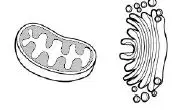
Examine the image of a mitochondria and a Golgi complex to the right. Then identify the statement that best explains why these two organelles are highly efficient in their functions.
Both the mitochondria and the Golgi have double membranes, which allow for
efficient transport of material in and out of the organelles
Both the mitochondria and the Golgi can form vesicles from their membranes
allowing for material to be easily transported in and out of the organelles
Both the mitochondria and the Golgi have compartmentalization, which allows
for an optimal surface area to volume ratio to exchange material through their membranes
Both the mitochondria and the Golgi contain their own ribosomes, which allows for them to produce their
own enzymes to be used in cytoplasmic reactions
If ATP breakdown (hydrolysis) is inhibited, which of the following types of movement across cell membranes is also inhibited?
Movement of oxygen into a cell
Movement of water through aquaporins
Passage of a solute against its concentration gradient
Facilitated diffusion of a permeable substance

