
 Worksheets
Year 9 Chemistry Revision
Total questions: 64
Worksheet time: 3hrs 44mins
Who discovered that the atom had an small, dense, positively charged center?
Ernest Rutherford
J.J Thomson
Robert Millikan
John Dalton
Place the following atomic models in order, from earliest to latest:
A) Rutherford B) Thomson C) Dalton
B, C, A
C, A, B
A, C, B
C, B, A
Which scientist discovered that the atom has parts - which means it can be divided?
Democritus
Dalton
Thomson
Rutherford
Who discovered that atoms are mostly empty space?
Dalton
Thomson
Rutherford
Bohr
Who proposed that electrons move around the nucleus in circular orbits?
Dalton
Thomson
Rutherford
Bohr

Which scientist was the first person responsible for proposing the idea of atoms?
Democritus
John Dalton
Ernest Rutherford
J.J. Thomson
Niels Bohr
True or false: Isotopes have the same number of protons (and electrons), but a different number of neutrons.
True
False
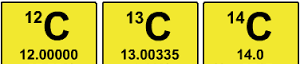
What does the number at the end of isotope names mean? E.g. Carbon-12, Carbon-13, Carbon-14
Mass number
atomic number
number of protons
number of neutrons
Boron-10, Boron-11, and Boron-12 are all isotopes of the same element, with an atomic number of 5. How many neutrons does Boron-12 have?
6
7
2
12
If fluorine has an atomic number of 9, which isotope would have 10 neutrons?
Fluorine-18
Fluorine-19
Fluorine-20
Fluorine-21
A particular isotope of hydrogen has 1 proton and 3 neutrons. What will be the name of this isotope?
Hydrogen-1
Hydrogen-3
Hydrogen-4
Hydrogen-2
One of the isotopes of chlorine has 17 protons and 23 neutrons. What is the name of this isotope?
(a)
An isotope of Aluminium is aluminium-25. If aluminium has an atomic number of 13, how many neutrons does this isotope have?
(a)
Which of these are isotopes of the same element? (select more than one)
magnesium-23
magnesium-31
sodium-24
magnesium-25
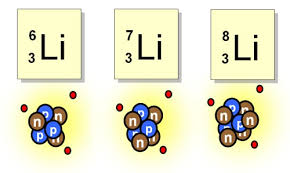
Which atom has 4 neutrons?
Li-6
Li-7
Li-8
they have the same # of neutrons
What is Half-life?
The amount of time it takes for half the nuclei in a sample of the isotope to become radioactive
The amount of time it takes for half the nucleus of the isotope to decay
The amount of time it takes for half the nuclei in a sample of the isotope to decay
the amount of time it takes for half the number of protons in the nucleus to decay
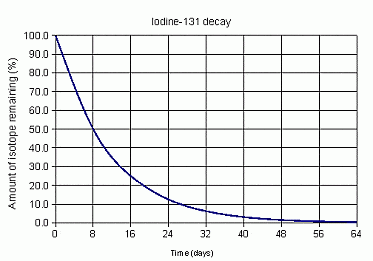

Why do some elements have half-lives?
they radioactively decay
half of their atom gets stolen
They are Twizzlers that break in half
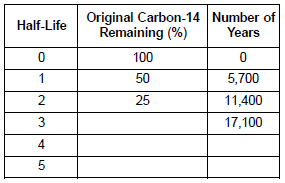
After 22,800 years, approximately what percentage of the original carbon-14 remains?
15%
12.5%
6.25%
3.125%
Why do we use half life of the radioisotope carbon-14?
to determine the age of fossils and ancient materials
to record sea floor spreading
to breakdown the process of decay
to measure the radioactivity of objects
Carbon dating relies on
the fact that all living things contain a small amount of carbon-14
organisms dying
washing your hands
organism remaining constant
What contains carbon-14
Cars
Humans
Trees and other plants
Paper
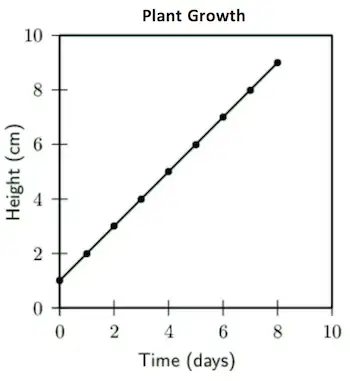
What’s the graph telling you?
The graph shows an increasing trend.
The graph shows a decreasing trend.
The graph shows no significant change.
The graph shows a cyclical pattern.
Which observations prove a chemical change has occurred?
Dissolving and expected color change
Mixing and dissolving
State of matter change and boiling water bubbles
Unexpected color change and temperature change
When mixing milk and vinegar, a white, chunky, solid substance is formed. What has occurred?
Physical change: state of matter
Chemical change: production of a solid
Physical change: freezing
Chemical change: rust
A physical change...
Changes the physical properties of an object, but does not create a new substance.
Creates a new substance and cannot be undone.

Is this an example of a physical or chemical change?
Physical
Chemical

Is this an example of a physical or chemical change?
Physical
Chemical

Is this an example of a physical or chemical change?
Physical
Chemical

Is this an example of a physical or chemical change?
Physical
Chemical
A change in which NEW substances are formed.
Chemical change
Physical change
H2SO4

What are the reactants?

Sodium and chlorine combine to form sodium chloride, or table salt. Sodium and chlorine are:
Producers
Products
Reactionaries
Reactants
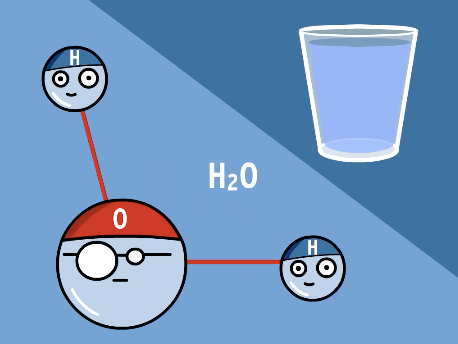
4 grams of hydrogen and 32 grams of oxygen will combine to form:
36 grams of water
28 grams of hydroxide
32 grams of oxygen
36 grams of deuterium
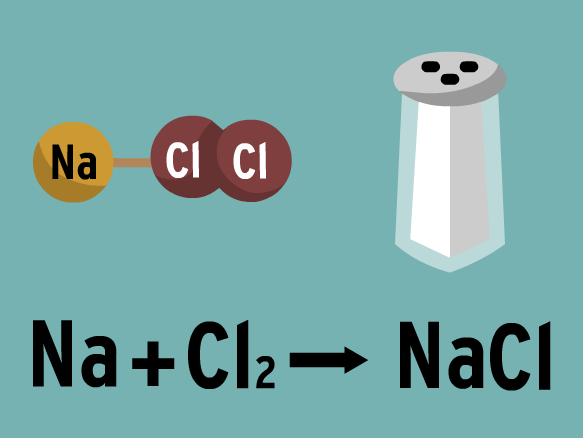
In a chemical reaction, 4 grams of sodium must combine with how many grams of chlorine to produce 10 grams of table salt?
4 grams
6 grams
8 grams
10 grams
Number placed in front of a chemical formula that tells how many molecules are present.
product
coefficient
reactant
subscript
Number written below & to the right of a chemical symbol that tells how many atoms of each element
subscript
reactant
product
coefficient
Al + O2 → 2Al2O3
Mg + __HCl ---> MgCl2 + H2
2C2H2 + 5O2 --> 4CO2 + 2H2O
Balance the following equation:
___ H2+ ___ O2→___ H2O
1, 1, 3
2, 2, 2
1, 2, 1
2,1, 2
Balance the following equation:
___ SeCl6+ ___ O2→___ SeO2+____Cl2
1, 1, 1, 3
2, 1, 2, 1
1, 2, 1, 2
2, 2, 2, 4
Chemical Equation
A representation of a chemical reaction
the starting materials in a chemical reaction
the new substances that are formed in a chemical reaction
tells how many atoms, molecules, or formula units take part in a reaction
Balance this equation
_Al +_HCl --> _H2 +_AlCl3
2,6,3,2
it's already balanced
4,12,3,4
2,1,4,5
The coefficient in 3H2O is
6
5
2
3

