wayground logo

Free Printable Worksheets

Font size

S
M
L
XL
Worksheets

Space Test Revision

Total questions: 156

Worksheet time: 2hrs 9mins

Name
Class
Date
1.

What is Weight?

a)

The force of gravity on an object

b)

The mass of an object

c)

The volume of an object

d)

The density of an object

2.

What did Kepler discover about planetary orbits?

a)

They are circular

b)

They are elliptical

c)

They are square

d)

They are triangular

3.

Which planet is the largest in our solar system?

a)

Earth

b)

Jupiter

c)

Saturn

d)

Neptune

4.

Which planet is known as the Earth's twin because of its similar size and composition?

a)

Mars

b)

Venus

c)

Jupiter

d)

Neptune

5.

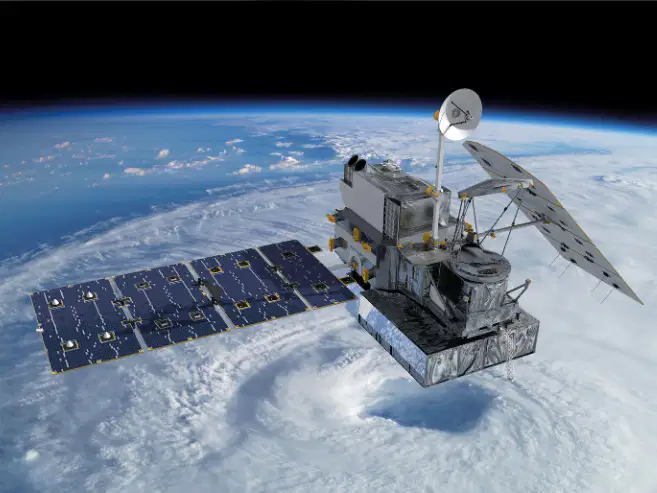
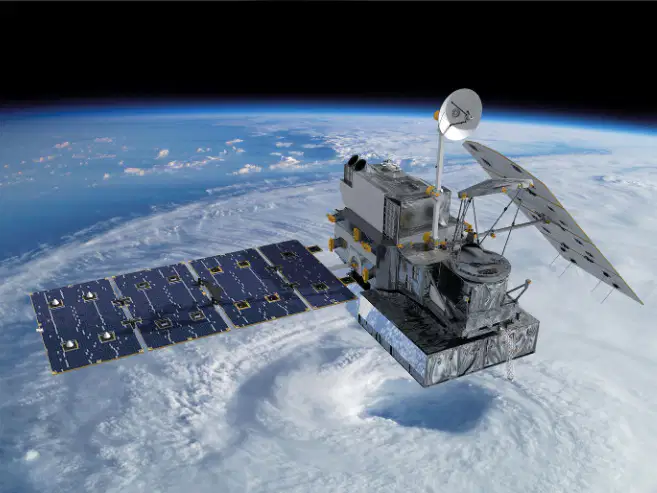
What are the two types of satellites?

a)

Natural and artificial

b)

Large and small

c)

Fast and slow

d)

Bright and dim

6.

Which type of orbit stays in the same position relative to Earth's surface?

a)

Polar orbit

b)

Geostationary orbit

c)

Elliptical orbit

d)

Low Earth orbit

7.

What is a key feature of a geostationary orbit?

a)

It moves with the Earth's rotation

b)

It passes over the poles

c)

It is used for space exploration

d)

It is closer to the Earth's surface

8.

What are polar orbits used for?

a)

Weather forecasting

b)

Deep space exploration

c)

Communication with Mars

d)

Mining asteroids

9.

Polar orbits are primarily used for which type of observation?

a)

Earth observation

b)

Mars observation

c)

Sun observation

d)

Moon observation

10.

Which of the following is NOT an application of artificial satellites?

a)

Communication

b)

Agriculture

c)

Weather Monitoring

d)

Space Science

11.

What type of signals do artificial satellites transmit for communication?

a)

GPS signals

b)

Weather signals

c)

Phone, TV, and internet signals

d)

Space observation signals

12.

In which area do artificial satellites help with mapping and directions?

a)

Communication

b)

Navigation

c)

Weather Monitoring

d)

Space Science

13.

Which of the following is a communication application of artificial satellites?

a)

GPS mapping

b)

Transmitting TV signals

c)

Observing stars

d)

Predicting climate

14.

What is a common use of artificial satellites in urban areas?

a)

Observing stars

b)

Transmitting internet signals

c)

Tracking weather patterns

d)

Providing GPS directions

15.

Satellites in __________ orbit pass over Earth’s poles and can observe the whole planet, making them ideal for __________ and environmental monitoring.

a)

geostationary, communication

b)

polar, weather forecasting

c)

elliptical, exploration

d)

circular, navigation

16.
What is the term for Earth being in the center?
a)
geocentric
b)
heliocentric
c)
sun centered
d)
Galileo
17.
The ancient Greek who proposed a geocentric model of the universe is
a)
Ptolomy
b)
Galileo
c)
Copernicus
d)
Kepler
18.
Which scientist found that planetary orbits were elliptical?
a)
Galileo
b)
Ptolemy
c)
Copernicus
d)
Kepler
19.
Galileo approached questions in a fashion that is now known as what?
a)
scientific theory
b)
scientific method
c)
earth science
d)
scientific law
20.
When Galileo peered into the telescope and saw that Venus went through phases, what did this suggest?
a)
The telescope must possibly be wrong.
b)
Venus had a moon orbiting it.
c)
Venus must be orbiting the Sun.
d)
Venus had moons just like Earth.
21.
Which is not evidence for the geocentric model?
a)
The sun moves across the sky from east to west every day.
b)
The moon moves around the Earth every day.
c)
The stars move across the sky every night.
d)
The planets display retrograde movement in the sky. 
22.
Whose heliocentric model is seen as the first step in the development of the modern models of the solar system?
a)
Galileo
b)
Copernicus
c)
Ptolemy
d)
Kepler
23.
A model of the solar system in which Earth and the other planets revolve around the SUN.
a)
Heliocentric
b)
Geocentric
24.
A model of the universe in which Earth is at the center of the revolving planets and stars. This includes the sun revolving around the Earth. This model is no longer supported.
a)
Geocentric
b)
Heliocentric
25.
The Word "Helio" Refers To?
a)
Earth
b)
Mars
c)
Sun
d)
Juputer
26.
The Word "Geo" Means?
a)
Sun
b)
Earth
c)
Milky way
d)
Back
27.
Mercury, Venus, Earth, and Mars are called.....?
a)
Jovian Planets
b)
Awesome Sauce Planets
c)
Gas Giants
d)
Inner Planets
28.
What do we call Jupiter, Saturn, Uranus and Neptune?
a)
Outer Planets
b)
Terrestrial Planets
c)
Inner Planets
d)
Oort Cloud
29.
What is the only planet known to contain life?
a)
Mars
b)
Earth
c)
Neptune
d)
Uranus
30.
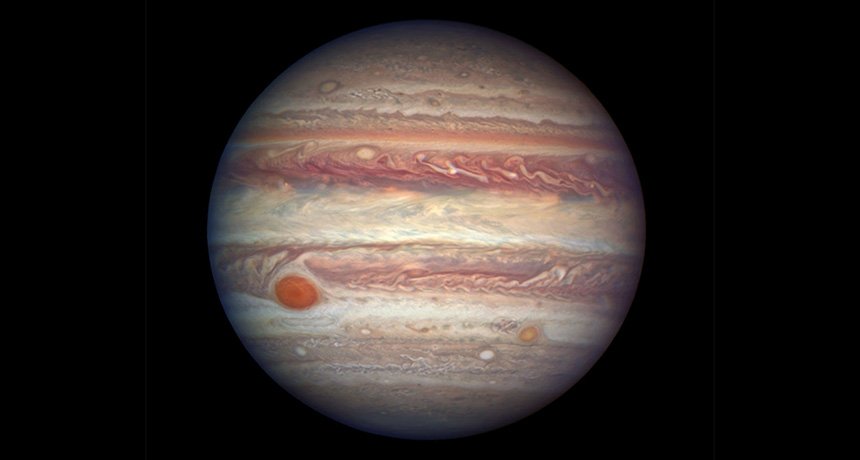
What characteristic is Jupiter known for?
a)
Rings of ice and dust
b)
Great Red Spot
c)
Olympus Mons
d)
Fire
31.
Which planet is now characterized as a dwarf planet?
a)
Neptune
b)
Pluto
c)
Miss Best
d)
Coca-cola
32.
What is one factor that makes life on Earth possible?
a)
Water
b)
High gravity
c)
Elliptical Orbit
d)
Hydrogen
33.
Which is the largest object in our solar system?
a)
Sun
b)
Jupiter
c)
Earth
d)
Pluto
34.
Which planet is closest to the sun?
a)
Uranus
b)
Mercury
c)
Neptune
d)
Earth
35.
Which is the second closest planet to the sun?
a)
Earth
b)
Saturn
c)
Venus
d)
Mercury
36.
Which planet is third from the sun?
a)
Mars
b)
Pluto
c)
Venus
d)
Earth
37.
Which is the fourth planet from the sun?
a)
Mars
b)
Saturn
c)
Earth
d)
Jupiter
38.
Which planet is fifth from the sun?
a)
Saturn
b)
Jupiter
c)
Mars
d)
Earth
39.
Which is the sixth planet from the sun?
a)
Earth
b)
Uranus
c)
Saturn
d)
Neptune
40.
Which planet is seventh from the sun?
a)
Saturn
b)
Earth
c)
Venus
d)
Uranus
41.

These are the 4 planets (Mercury, Venus, Earth, Mars) are known as

a)

terrestrial planets

b)

gas giants

c)

dwarf planets

d)

solar planets

42.

These are the four planets the Sun; Jupiter, Saturn, Uranus, and Neptune are classified as

a)

terrestrial planets

b)

gas giants

c)

solar planets

d)

the best planets

43.

Where is the Asteroid Belt located in the Solar System?

a)

near Neptune

b)

between Mercury and Venus

c)

between Mars and Jupiter

d)

around the Sun

44.
What is similar about all of the Outer Planets?
a)
small
b)
large
c)
few moons
d)
takes a short amount of time to go around the sun
45.
What is a planet?
a)
a group of stars that forms a pattern in the sky
b)
a large ball of hot gases that gives off heat and light
c)
a large ball or rock or gas that moves around the sun
d)
a toy aliens play with
46.
The sun goes around the Earth.
a)
True
b)
False
47.

How long does it take for the Earth to orbit the Sun?

a)

24 hours

b)

29 days

c)

360 days

d)

365.25 days

48.

Why do we get day and night?

a)

Because the Sun moves round the Earth.

b)

Because the Earth moves round the Sun.

c)

Because the Earth spins around its own axis.

d)

Because the Earth’s axis is tilted.

49.

Which statement is INCORRECT?

a)

During summer in the UK the North Pole it tilted towards the Sun.

b)

During summer the Earth is closer to the Sun

c)

The Sun’s rays are more concentrated in the summer.

d)

In winter the nights are longer.

50.

How long does it take the earth to orbit the sun?

(a)  

51.

Circle the southern hemisphere

52.

Circle the northern hemisphere:

53.

At what degree, does the earth's axis spin at?

(a)  

54.

When does a lunar eclipse happen?

a)

When the earth passes between the sun and the moon

b)

When pigs fly

c)

When the cosine of the earth's axis is coherent to that of Pythagorus' theorem

d)

When the moon passes between the earth and the moon

55.
Mercury, Venus, Earth, and Mars are called.....?
a)
Jovian Planets
b)

Solar Planets

c)
Gas Giants
d)
Inner Planets
56.
Which planet is now characterized as a dwarf planet?
a)
Neptune
b)
Pluto
c)

Goofy

d)

Mercury

57.
Which is the second closest planet to the sun?
a)
Earth
b)
Saturn
c)
Venus
d)
Mercury
58.
Asteroids are composed mostly of _________.
a)
ice
b)
dirt
c)
rock
d)
gas
59.
What is the name of our galaxy?
a)
Snickers
b)
Andromeda
c)
Local Group
d)
Milky Way
60.
At position A, which hemisphere would have summer?
a)
Northern hemisphere
b)
Southern hemisphere
61.
How does the tilt of the Earth’s axis affect the angle of the Sun’s rays hitting the Earth?
a)
Angle is greater in summer / lesser in winter
b)
Angle is the same in summer / fall
c)
Angle is greater in winter / lesser in summer
d)
Greater in summer/lesser in winter/same in summer and fall
62.
Why is the Equator warmest?
a)
Because it is closest to the sun.
b)
Because it receives the most direct sunlight
c)
Because no clouds form here.
d)
Because it is far from the sun
63.
About how long does it take the moon to make one complete cycle around the earth?
a)

24 days

b)

27.3 days

c)

29.5 days

d)
28 days
64.

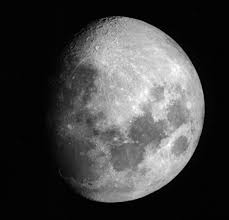
Name this moon phase which occurs just after 1st Quarter
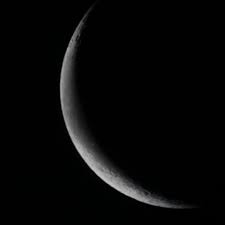
a)
waning crescent
b)
waxing crescent
c)
waning gibbous
d)
waxing gibbous
65.

Name this moon phase which occurs just before New Moon
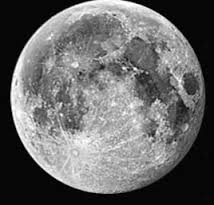
a)
waning crescent
b)
waxing crescent
c)
waning gibbous
d)
waxing gibbous
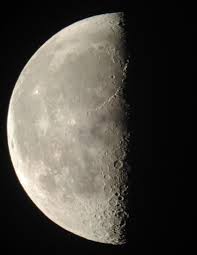
66.
Name the moon phase
a)
First Quarter
b)
Last Quarter
c)
New Moon
d)
Full Moon
67.
Name the moon phase
a)

First Half

b)

Full Crescent

c)
New Moon
d)

Half Moon

e)

Last Quarter

68.

This model is showing us a...

a)

lunar eclipse

b)

solar eclipse

c)

phases of the moon

d)

earth eclipse

69.
What event occurs because of the rotation of Earth?  
a)
tides
b)
four seasons
c)
day and night
d)
change in weather
70.
Which term describes the path the Moon travels around Earth?  
a)
rotation
b)
orbit
c)
phase
d)
day
71.
Which of these cycles takes 24 hours?  
a)
Earth rotating on its axis  
b)
Earth revolving around the Sun  
c)
the Moon rotating on its axis  
d)
the Moon revolving around Earth
72.
The phases of the Moon are caused by the
a)
tilt of the Earth
b)
tilt of the Moon
c)
revolution of the Earth around the Sun
d)
revolution of the Moon around the Earth
73.
The Moon revolves around Earth about once every
a)
day
b)
week
c)
month
d)
year
74.
Andrea is making a computer animation to model the motions of the Sun, Earth, and Moon. Which orbit should happen most often in her model?
a)
the Sun orbiting Earth
b)
the Sun orbiting the Moon
c)
the Moon orbiting Earth  
d)
the Moon orbiting the Sun  
75.
Look at the pictures in order from left to right.
Which best explains what happens at Point X as Earth rotates?
a)
Night becomes day
b)
Fall becomes winter.
c)
A full moon appears.
d)
A solar eclipse occurs.
76.
Which number most likely shows the position of the Sun at noon? The picture shows an event that happens every day.
a)
1
b)
2
c)
3
d)
4
77.
Which season is taking place in the Northern Hemisphere in Position 3?
a)
Winter
b)
Spring
c)
Summer
d)
Fall
78.
What season is it in the northern hemisphere?
a)
It is summer.
b)
It is spring.
c)
It is winter.
d)
It is fall.
79.
Why do we experience the changing of the season on the earth?
a)
distance from the sun
b)
rotation of the earth
c)
change in solar output
d)
tilt of the earth's axix
80.
The right side of this illustration represents...
a)
day
b)
night
81.

The half of Earth located below the equator

a)

Northern Hemisphere

b)

Southern Hemisphere

82.

An imaginary line that runs through the poles of a planet

a)

Axis

b)

Equator

c)

Revolution

d)

Rotation

83.

Marked by the longest or shortest day of the year

a)

Equinox

b)

Rotation

c)

Revolution

d)

Solstice

84.

An imaginary line drawn around Earth that divides it into two halves

a)

Axis

b)

Equator

c)

Latitude

d)

Longitude

85.

The process of turning or spinning on an axis

a)

Rotation

b)

Revolution

86.

What does the earth's tilt cause?

a)

The seasons

b)

Day and Night

c)

Tsunamis

d)

Earthquakes

87.

What is the shape of the earth's orbit around the sun?

a)

Circular

b)

Elliptical (slightly oval)

c)

Square to rectangular

d)

Variable and changes with the seasons (no particular shape)

88.

Why does the area around the equator stay the same temperature all year?

a)

The equator rotates slower than the poles.

b)

The equator remains the same distance from the sun.

c)

The equator always receives direct sunlight.

d)

The equator has 18 hour days.

89.

What causes day and night?

a)

The sun goes around the Earth

b)

The Earth orbits the sun

c)

The moon rising causes night time

d)

The Earth rotating on its axis

90.

Which of the following is true about winter in the Northern Hemisphere?

a)

The Earth is farthest from the Sun

b)

The South Pole is dark 24 hours per day

c)

Day and night are the same length

d)

The Sun is low in the sky

91.

What would happen if Earth's axis was straight up and down instead of tilted?

a)

Life on Earth would not be possible

b)

There would be no night or day

c)

There would be no seasons

d)

Earth would be covered with ice

92.

Mass is the amount of ____ in an object.

a)

density

b)

gravity

c)

matter

d)

volume

93.

Mass is measured in ____.

a)

Newtons

b)

litres

c)

centimetres

d)

kilograms

94.

Weight is a ____ caused by an object's mass in a ____ field.

a)

temperature, thermal

b)

pressure, electric

c)

volume, magnetic

d)

force, gravitational

95.

Weight is measured in ____ ____.

a)

newton meters

b)

pascals

c)

kilograms

d)

Newtons

96.

On the Moon, Sam's mass is ____ and her weight is ____.

a)

the same, more

b)

more, the same

c)

less, the same

d)

the same, less

97.

The ____ field affects an object's weight.

a)

magnetic

b)

electric

c)

gravitational

d)

thermal

98.

All forces are measured in ____.

a)

grams

b)

Newtons

c)

litres

d)

joules

99.

The gravitational field strength on Earth is approximately ____ N/kg.

a)

10

b)

25

c)

8.9

d)

11.2

100.

What is the name of the instrument use to measure forces?

a)

Electronic balance

b)

scales

c)

metre stick

d)

Newton balance

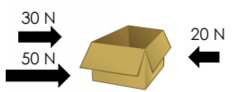
101.
What is the net force?
a)
20 N 
b)
0 N 
c)
400 N 
d)
40 N 
102.

What is the unit to MEASURE force?

a)

Kilogram

b)

Meter

c)

Pounds

d)

Newton

103.
What is the net force?
a)
10 N
b)
0 N
c)
25 N
d)
1 N
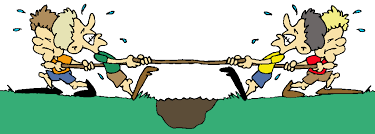
104.
If these teams are pulling with the same amount of force what will happen?
a)
The boy in blue will win.
b)
They will not move at all.
c)
The boy in red will win.
d)
Both will fall down.
105.
Balanced or unbalanced?
a)
balanced
b)
unbalanced
106.

Forces that have a net force of zero Newtons

a)

Balanced force

b)

Unbalanced force

107.
What will cause an object to move?
a)
Applied forces
b)
Balanced forces
c)
Unbalanced forces
108.
A push or pull that causes a change in motion
a)
Friction
b)
Gravity
c)
Force
d)
Mass
109.
Calculate the Net Force. 
a)
60N, Left 
b)
40N, Right 
c)
0N
d)
60N, Right
110.
You and your dad are moving the couch from one side to another. Your dad pushes with a force of 35 N to the right and you push with a force of 25 N right. What is the net force on the couch?
a)
60 N right
b)
10 N left
c)
60 n right
d)
50 N left
111.
What force holds the planets in motion around the sun?
a)
Magnetic
b)
Electrical
c)
Gravitational
d)
Air Resistance
112.
What force brings the pencil down?
a)
Applied
b)
Magnetic
c)
Normal
d)
Gravitational
113.
What force ultimately slows the roller coaster to a stop?
a)
Applied
b)
Normal
c)
Friction
d)
Magnetic
114.
Jupiter has about 317 times more mass than Earth. What can you infer from this fact? 
a)
That Jupiter’s gravitational force is much weaker than on Earth’s gravitational force.
b)
That Jupiter’s gravitational force is much stronger than Earth’s gravitational force.
c)
That Jupiter’s and Earth’s gravitational forces are equal.
d)
Mass has no effect on the gravitational force between two objects
115.
This type of force resist motion between two surfaces that are pressed together
a)
contact
b)
gravity
c)
friction
116.
What is it called when the force of gravity is acting on an object?
a)
Weight
b)
Sliding Friction
c)
Momentum
d)
Projectile Motion
117.

Which two of these forces act on parachutes?

a)

Air Resistance

b)

Gravity

c)

Thrust

d)

Kinetic Energy

118.

Another name for air resistance is...

a)

Buoyancy

b)

Streamline

c)

Gravity

d)

Drag

119.

What causes an object to fall faster?

a)

Smaller surface area

b)

Larger surface area

c)

If it has a parachute

d)

If it is softer

120.

The larger the surface area of the moving object, the ___________ air resistance there is.

a)

Less

b)

More

c)

Longer

d)

Quicker

121.

The larger the parachute the ____________

a)

Less air resistance

b)

More surface tension

c)

Less drag

d)

More drag

122.

The more streamlined an object is, the...

a)

More air resistance

b)

Less air resistance

c)

Slower air resistance

d)

Faster air resistance

123.

When dropped from the same distance, which will fall to the floor faster?

a)
b)
124.

What is a parachute designed to maximize?

a)

Gravity

b)

Air Pressure

c)

Air Resistance

d)

Thrust

125.

Complete the sentence.

It is not the difference in gravity that causes objects to fall at different speeds, it’s the difference in the amount of__________________.

a)

Gravity

b)

Mass

c)

Air resistance

126.

What are the two main forces acting on a falling object?

a)

Electric force and weight

b)

Weight and air resistance

c)

Gravity and friction

d)

Magnetism and air resistance

127.

What is terminal velocity?

a)

The speed at which air resistance is zero

b)

The maximum speed of a falling object when forces are balanced

c)

The speed at which an object stops moving

d)

The speed at which an object starts falling

128.

What happens to air resistance as an object falls faster?

a)

It disappears

b)

It decreases

c)

It remains constant

d)

It increases

129.

What is the effect of a larger surface area on terminal velocity?

a)

It has no effect

b)

It increases terminal velocity

c)

It decreases air resistance

d)

It decreases terminal velocity

130.

What happens when a skydiver opens their parachute?

a)

Their terminal velocity increases

b)

Their air resistance decreases

c)

Their surface area decreases

d)

Their terminal velocity decreases

131.

What happens to the forces on an object at terminal velocity?

a)

They decrease

b)

They are balanced

c)

They are unbalanced

d)

They increase

132.

What is the role of air resistance in free fall?

a)

It slows down the object

b)

It speeds up the object

c)

It acts in the same direction as motion

d)

It has no effect

133.

Which factor does NOT affect terminal velocity?

a)

Surface area of the object

b)

Color of the object

c)

Shape of the object

d)

Mass of the object

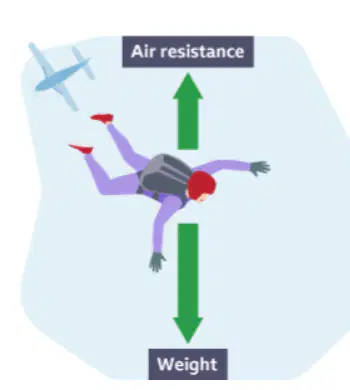
134.

When a skydiver just jumps out of the plane

a)

There is no air resistance

b)

Air resistance is very small (compared to weight)

c)

Air resistance is similar to weight

d)

Air resistance is bigger than weight

135.

When a skydiver has been falling for a small time (but has not reached terminal velocity)

a)

There is no air resistance

b)

Air resistance is very small (compared to weight) and has not changed since the start of the fall

c)

Air resistance is smaller than weight but has gotten closer in size compared to weight

d)

Air resistance is equal to weight

136.

When a skydiver has reached terminal velocity

a)

There is no air resistance

b)

Air resistance is very small (compared to weight) and has not changed since the start of the fall

c)

Air resistance is smaller than weight but has gotten closer in size compared to weight

d)

Air resistance is equal to weight

137.

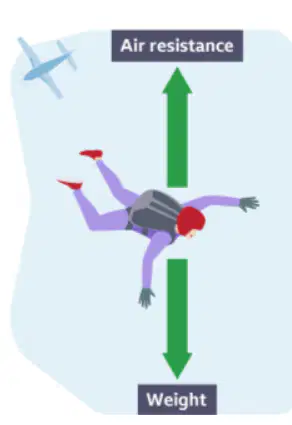
What would happen here

a)

Constant speed

b)

Slow down

c)

Acclerate downwards

d)

Stationary

138.

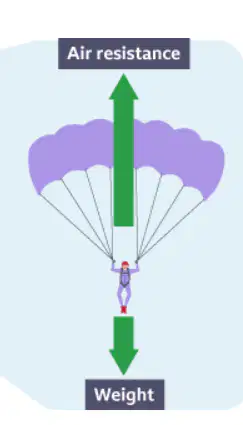
What would happen here to this skydiver as they are falling

a)

Constant speed

b)

Slow down

c)

Acclerate downwards

d)

Stationary

139.

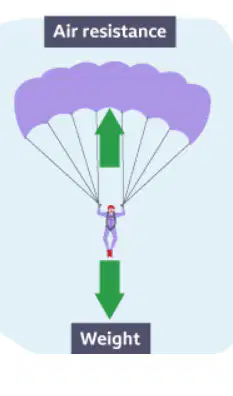
What would happen here to this skydiver as they are falling

a)

Constant speed

b)

Slow down

c)

Acclerate downwards

d)

Stationary

140.

What would happen here to this skydiver as they are falling

a)

Constant speed

b)

Slow down

c)

Acclerate downwards

d)

Stationary

141.
An organism that produces its own energy
a)
Producer
b)
Consumer
c)
Decomposer
d)
Predator
142.
A diagram that shows how energy is transferred from one organism to another
a)
Carrying Capacity
b)
Producer
c)
Food Chain
d)
Balance of Nature
143.
A diagram that shows how food chains are connected
a)
Producer
b)
Limiting Factor
c)
Consumer
d)
Food Web
144.
Organism that eats other organisms to get energy
a)
Producer
b)
Consumer
c)
Plant
d)
Food chain
145.
A parrot eats fruit, seeds, and insects.  Which of the following terms best describes a parrot?
a)
Herbivore
b)
Carnivore
c)
Producer
d)
Omnivore
146.
A field mouse eats grass and grass seeds.  Which of the following terms best describes a field mouse?
a)
Herbivore
b)
Producer
c)
Carnivore
d)
Decomposer
147.
An alligator eats fish, turtles, ducks, and small mammals on the bank.  Which of the following terms best describes the alligator?
a)
Herbivore
b)
Carnivore
c)
Omnivore
d)
Producer
148.
In the arctic, polar bears hunt seals.  which of the following terms best describes the polar bear?
a)
Producer
b)
Predator
c)
Prey
d)
Host
149.
A snake hunts lizards and frogs.  Which terms best describes lizards and frogs?
a)
Predator
b)
Microoganism
c)
Prey
d)
Producer
150.

Where does the energy start in this food chain?

a)

Plant

b)

Sun

c)

Deer

d)

Wolf

151.

Which of these is an organism that does not depend on another living thing for food?

a)

the Sun

b)

an insect

c)

a plant

d)

an animal

152.

Which of these completes the food chain correctly?

a)

a rock

b)

a fox

c)

a plant

d)

an egg

153.

What does the arrow point to in a food chain?

a)

only the plants in a food chain

b)

only the animals in a food chain

c)

the organism that gets the energy

d)

the organism that lives the longest

154.

Which of these is a possible food chain for this environment?

a)

Sun → grass → fly → frog

b)

frog → fly → grass → Sun

c)

Sun ← grass ← fly ← frog

d)

Sun → fly → frog → snake

155.
Which of the following best describes the deer's role in the ecosystem?
a)
herbivore
b)
omnivore
c)
carnivore
d)
decomposer
156.
Which of the following best describes the wolf's role in this ecosystem?
a)
herbivore
b)
omnivore
c)
carnivore
d)
decomposer