
 Worksheets
Chemistry Midterm Review Questions
Total questions: 68
Worksheet time: 34mins
Use the conversion factor 10 mm = 1 cm to convert 4.00 x 103 mm to cm.
4.00 x 103 mm x 10 mm1 cm =
4.00 x 102 cm
4.00 x 103 mm x 10 mm1 cm =
2.65 cm
4.00 x 103 mm x 1 cm10 mm =
4.00 x 104 cm
Use the conversion factor 1 kL = 1,000 L to convert 0.5 kL to L.
0.5 kL x 1,000 L1 kL = 0.0005 kL
0.5 kL x 1 kL1,000 L = 500 L
0.5 kL x 1,000 L1 kL = 0.005 kL

Use the % error formula on the back of the periodic table. The mass of a sample is 50 g. A balance measures the mass of this sample as 40 g. What is the percent error of the balance?
2%
20%
-20%
2 Be(OH)2
What's the coefficient?
1
2
0
2 Be(OH)2
How many Be atoms are present?
1
2
0
Be(OH)2
How many oxygen atoms are present?
1
2
3
2 Be(OH)2
How many hydrogen atoms are present?
2
4
6
3 Fe(NO3)3
How many oxygen atoms are present?
3
9
27
When a substance melts, its shape changes but what it's composed of does not change. How do chemists describe this change?
physical change
chemical change
Choose the correct statement.
Boiling water is a chemical change.
Crushing a rock is an irreversible physical change.
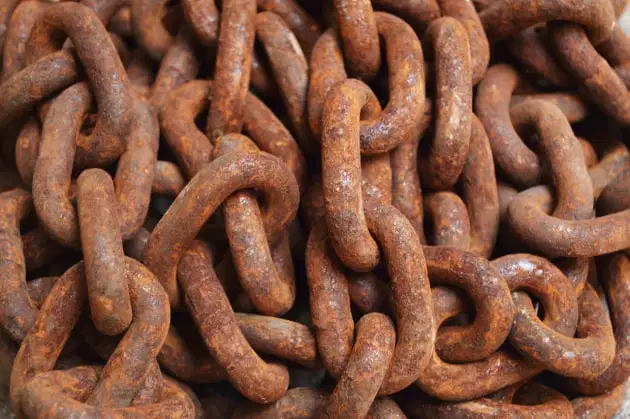
Why is rusting a chemical change?
It is reversible.
It creates a new substance.
It doesn't change the composition of the substance.
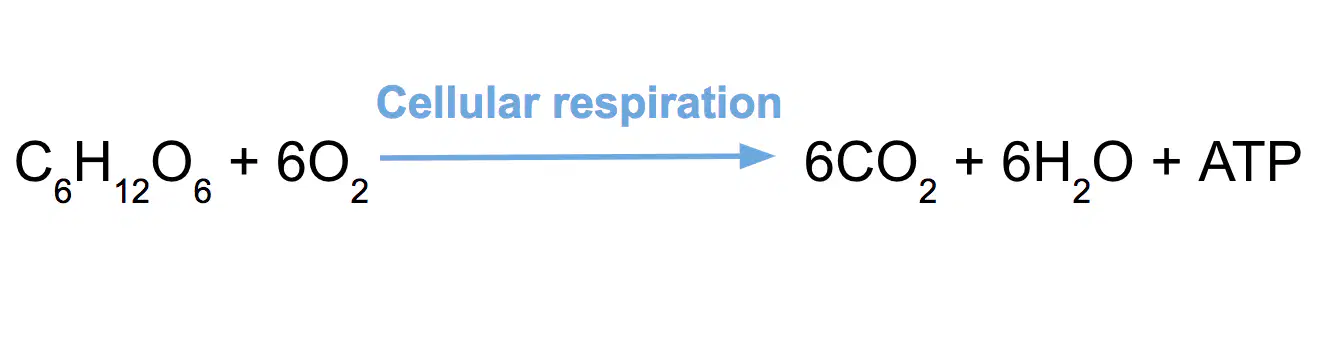
What are the reactants for cellular respiration?
6CO₂ and 6H₂O and ATP
C₆H₁₂O₆ and 6O₂
What are the products for cellular respiration?
6CO₂ and 6H₂O and ATP
C₆H₁₂O₆ and 6O₂
What signs indicate that a chemical change is occurring?
Dissolving
Melting
Gas bubbles
If two liquid solutions are mixed together and a solid formed, what do chemists call the solid?
magic
precipitate
production of a gas
Which statement is true?
Electrons are negatively charged particles.
Neutrons are negatively charged particles.
Protons are negatively charged particles.
Electrons are in the nucleus of atoms.
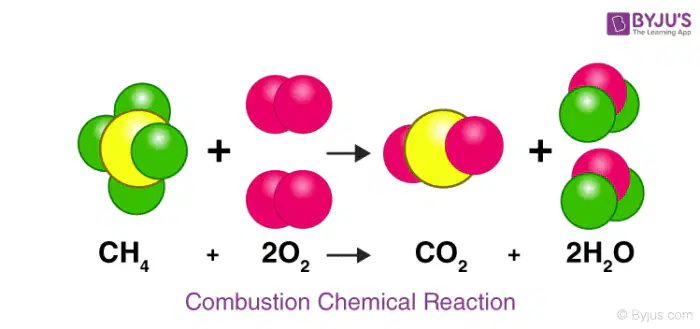
How many C atoms are in the reactants?
1
2
3
4
How many O atoms are in the products?
1
2
3
4
How many molecules of water are produced?
1
2
3
4
If a reaction starts with 10 grams of reactants, how many grams of product will be produced?
5
10
20
Choose the chemical symbol that is incorrect.
O
NE
Mg
Mn
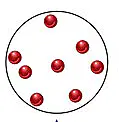
What does this represent?
Element
Compound
Mixture
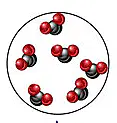
What does this represent?
Element
Compound
Mixture
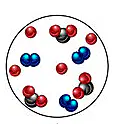
What does this represent?
Element
Compound
Mixture
What is the subscript for hydrogen in H2O?
1
3
2
Choose the description of electrons in the lowest energy state.
Excited state
Ground state
Orbital
Bohr model
What happens when an electron gains energy?
Jumps aways from the nucleus to an outer shell, becoming excited
Falls from an outer shell towards the nucleus, becoming grounded
What happens when an electron loses energy?
Jumps aways from the nucleus to an outer shell, becoming excited
Falls from an outer shell towards the nucleus, becoming grounded
In order to move from the ground state to an excited state, an electron must
release energy.
gain energy.
What is the correct designation of the electron configuration of silicon?
1s² 1p⁶ 2s² 2p¹
1s² 2s² 2p⁶ 2d³
1s² 2s² 2p⁶ 3s² 3p2
What is the electron configuration for carbon?
1s² 2s² 2p2
1s² 2s³ 2p²
1s² 2s² 2p² 3s¹
The element with electron configuration 1s² 2s² 2p⁶ 3s² 3p1 is
Mg
B
Si
Al
Electrons are found in specific orbits around the nucleus
True
False
Electrons can be located between orbits
True
False
When energy is added, electrons move to lower-energy orbits
True
False
Orbits are assigned principle energy levels, like 2p
True
False
When is light emitted (given off)?
When electrons jump from ground to excited state
When electrons fall from an excited state back to their ground state
What does the cloud represent in the electron cloud model of atoms?
The probability of the electron location.
The average distance between the electron and the nucleus.
The minimum distance between the electron and the nucleus.
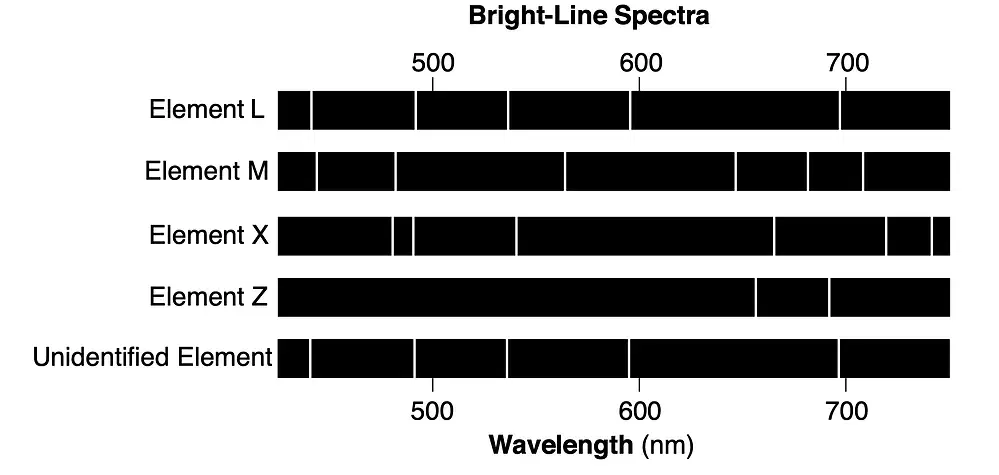
The image shown is a bright line spectra, showing the wavelengths of electrons in various elements. What is the unidentified element?
Element L
Element M
Element X
Element Z
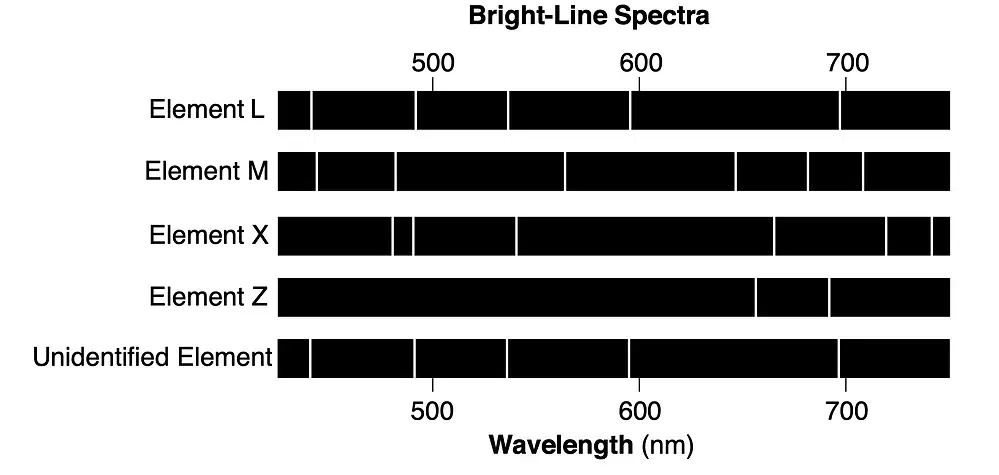
What subatomic particle causes the lines seen in emission spectra diagrams?
Protons
Neutrons
Electrons
Quarks
What is the net charge on any ionic compound?
3-
0
3+
1.5
What does the formula for sodium phosphate look like?
NaPO4
Na3P
Na3PO4
What is the correct formula for lead(IV) phosphide?
PbP
Pb3P4
P4Pb3
How many electrons in total are transferred from calcium atoms to nitrogen atoms to make the ionic compound calcium nitride, Ca3N2?
2
4
6
8
Ionic compounds consist of
Cations (+) and anions (-)
Cations (+) and cations (+)
Antions (-) and anions (-)
How many fluoride ions, F⁻, are needed to form an ionic compound with sulfate, SO4²⁻?
1
2
3
0
How many potassium ions, K⁺, are needed to form an ionic compound with nitride, N³⁻?
1
2
3
0
What is the term for the small numbers to the lower right of symbols in chemical formulas?
superscript
subscript
What is the term for electrons in the outermost energy level?
outer electron
anion
valence electron
vernal electron
In the ionic compound cobalt(III) phosphite, how many cobalt(III) ions are needed to form an ionic compound with phosphite?
1
2
3
0
When group 3A elements become charged ions they will
lose protons
lose electrons
lose neutrons
What is the formula for calcium cyanide, which is made up of the ions Ca²⁺ and CN⁻?
CaCN2
Ca(CN)2
Ca2CN
The electron configuration of a sulfide ion is:
1s²2s²2p³3s²3p4
1s²2s²2p³3s²3p
1s²2s²2p⁶3s³
1s²2s²2p⁶3s²3p⁶
When magnesium becomes an ion, what will its charge and subsequent electron configuration be?
+2, 2s2
+2, 2p6
-2, 2p6
Choose the correct statement about single covalent bonds.
One atom completely loses two electrons to the other atom in the bond.
Two atoms share two pairs (4 total) of electrons.
Two atoms share two electrons.
Two atoms share one electron.
What is the purpose of sharing electrons in covalent bonds?
to become ions and attract each other
to attain a noble-gas electron configuration for stability
to become more polar
to increase their atomic numbers
Carbon tetrachloride is a(n)
monatomic ion.
polyatomic ion.
binary compound.
polyatomic compound.
Covalent molecular compounds are made of
two or more transition elements.
positive and negative ions.
two or more nonmetallic elements.
What is the ending for the names of all binary compounds?
-ide
-ite
-ade
-ate
Choose the binary covalent molecular compound.
NaOH
CO2
HgO
Choose the covalent molecule.
MgO
Ne
PCl5
BeI₂
Select the correct formula for nitrogen pentoxide.
NO₆
NO₃
NO4
NO5
Which of the following is the correct name for C2O4?
carbon oxide
dicarbon tetraoxide
carbon tetraoxide
Classify NaOH.
Polyatomic covalent compound
Polyatomic ionic compound
Binary molecular compound
Why do elements form chemical bonds?
to obtain lower energy states
to mimic the noble gases
to become more stable
all answers are correct
How do ionic bonds differ from covalent bonds?
Ionic bonds share electrons between atoms.
Ionic bonds transfer electrons between atoms.
Ionic bonds only contain metals.
Ionic bonds only contain nonmetals.
Choose the correct statement.
Cobalt's mass number is 27, so it has 27 electrons.
Cobalt's atomic number is 27, so it has 27 protons.
Cobalt's atomic number is 27, so it has 27 neutrons.
Choose the correct statement.
Potassium has 19 protons and 19 electrons in a neutral atom.
Potassium has 19 protons and 19 neutrons in a neutral atom.
Potassium has 19 neutrons and 19 electrons in a neutral atom.

