
 Worksheets
PETE 2031 Chapter 5b and 6
Total questions: 107
Worksheet time: 2hrs 40mins
the preference of a solid to be in contact with one fluid over another in a system of two or more immiscible fluids
(a)
water wet
(a)
oil-wet
(a)
tend to have a preference to be in contact with either oil or water
(a)
Knowing the wettability is very important in understanding the flow behavior when (a)
happens between water and gas or between solid and a fluid (liquid or gas)
(a)
happens between two liquids, and the lower the IFT is the closer the fluids are to become miscible
(a)
the ability of two fluids to mix
(a)
energy per unit area or the force per unit length in [N/m] or [dynes/cm]
(a)
IFT is a function of
fluid pairs
temperature
pressure
σ of air/mercury
σ of gas/oil
σ of gas/brine
σ of oil/brine
(a)
are forces of attractions between similar molecules
(a)
are forces of attractions between different molecules
(a)
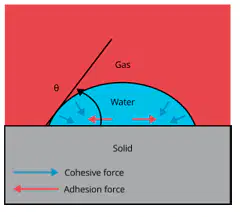
What happens?
(a)
σ so
(a)
σ sw
(a)
Θ
(a)
categories of wettability
water-wet
intermediate wet
oil wet
mixed wet
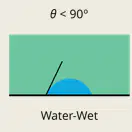
surface likes water, so water will be absorbed (surface will be coated with water), Θ < 90 (rock has high affinity to water, therefore, water will spread on the surface)
(a)
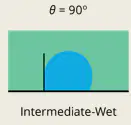
surface likes both (equal tendency), so it will either like oil or water, Θ = 90 (rock has equal affinity to both and water)
(a)
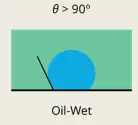
surface likes oil, so oil will be absorbed (surface will be coated with oil), Θ > 90
(a)
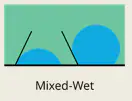
part of the rock prefer to be coated with oil and part with water
(a)
the decrease of the wetting phase (decrease in its saturation); in a water - wet reservoir, when the oil migrates from the source rock to the reservoir, what is Θ?
(a)
the increase of the wetting phase (increase in its saturation); in a water - wet reservoir, when water is injected to displace oil, what is Θ?
(a)
When there is no flow happening, Θ is called what?
(a)
the contact angle value will vary depending on the flow sequence being drainage or imbibition
(a)
Wettability can be measured _______________ or __________________.
(a)
Direct measurements of wettability
(a)
Types of method for measuring wettability
Use of uncontaminated crude oil and brine from the reservoir and the dominant mineral present in the reservoir for experimentation.
Use of displacement data on reservoir cores that have been obtained under conditions designed to maintain the original wettability.
Use of contaminated crude oil and brine from the reservoir and the dominant mineral present in the reservoir for experimentation.
Use of displacement data on reservoir cores that have been obtained under no conditions designed to maintain the original wettability.
Wettability is inferred from (a) after the uncontaminated reservoir crude oil and uncontaminated natural or simulated reservoir brine are exposed to the dominant mineral.
___________________ are required for equilibrium to be reached. The contact angle measured on a smooth polished crystal ____________ reflect the effect of surface roughness.
(a)
These long-standing problems with contact angle measurements of long ageing times, poor reproducibility and relevance (of smooth surface measurement to rough rock surface in reality) have been (a) used for measurements, methods that did not satisfy some key definitions.
The fact that wettability relates to adhesion and advancing contact angle while the water-receding contact angle relates well to the (a) .
measured water-receding angles and hence could not quantify wettability.
(a)
resolves the wettability measurement issue and has consistently yielded highly reproducible measurements for several reservoir cases so far
(a)
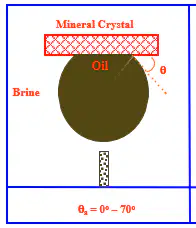
Concerns in Single Crystal Contact Angle Technique
Water-receding angle is measured while wettability relates to water-advancing angle
Poor reproducibility due to uncertainty of contact line movement within the oil-exposed area of the solid surface
Effect of interfacial adhesion resulting in strong dependence of contact angle on drop volume
Poor reproducibility due to certainty of contact line movement within the oil-exposed area of the solid surface
Effect of interfacial adhesion resulting in strong independence of contact angle on drop volume
(a)

(a)

(a)

(a)
(a)
(a)
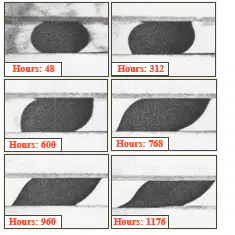
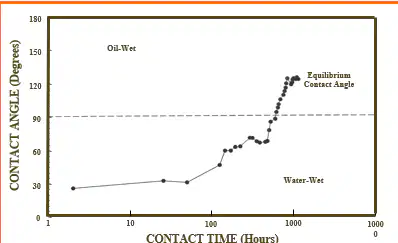
Different rates of approach to equilibrium on the two surfaces; Uncertainty of TPCL movement with the previously oil occupied area; Doubt whether the definition of WACA is met; No opportunity to check for reproducibility; Long test duration (49 days)
(a)
Similar approach to equilibrium on both surfaces; Concrete evidence for TPCL movements; Definition of WACA is satisfied; Reproducibility check is easily made – variation of one degree in both systems; Relatively short test duration (2-4 days) – with significant cost reduction
(a)
water - wet on distribution reservoir wettability
0 to 75 degrees; 13 silicate reservoirs; 2 carbonate reservoirs; 15 total reservoirs (27%)
75 to 105 degrees; 2 silicate reservoirs; 1 carbonate reservoirs; 3 total reservoirs (5%)
105 to 180 degrees; 15 silicate reservoirs; 25 carbonate reservoirs; 37 total reservoirs (55%)
intermediate - wet on distribution reservoir wettability
0 to 75 degrees; 13 silicate reservoirs; 2 carbonate reservoirs; 15 total reservoirs (27%)
75 to 105 degrees; 2 silicate reservoirs; 1 carbonate reservoirs; 3 total reservoirs (5%)
105 to 180 degrees; 15 silicate reservoirs; 25 carbonate reservoirs; 37 total reservoirs (55%)
oil - wet on distribution reservoir wettability
0 to 75 degrees; 13 silicate reservoirs; 2 carbonate reservoirs; 15 total reservoirs (27%)
75 to 105 degrees; 2 silicate reservoirs; 1 carbonate reservoirs; 3 total reservoirs (5%)
105 to 180 degrees; 15 silicate reservoirs; 25 carbonate reservoirs; 37 total reservoirs (55%)
oil - wet on carbonate reservoir wettability
0 to 80 degrees; 8% of reservoirs
80 to 100 degrees; 12% of reservoirs
100 to 160 degrees; 65% of reservoirs
160 to 180 degrees; 15% of reservoirs
intermediate - wet on carbonate reservoir wettability
0 to 80 degrees; 8% of reservoirs
80 to 100 degrees; 12% of reservoirs
100 to 160 degrees; 65% of reservoirs
160 to 180 degrees; 15% of reservoirs
water - wet on carbonate reservoir wettability
0 to 80 degrees; 8% of reservoirs
80 to 100 degrees; 12% of reservoirs
100 to 160 degrees; 65% of reservoirs
160 to 180 degrees; 15% of reservoirs
strongly oil - wet on carbonate reservoir wettability
0 to 80 degrees; 8% of reservoirs
80 to 100 degrees; 12% of reservoirs
100 to 160 degrees; 65% of reservoirs
160 to 180 degrees; 15% of reservoirs
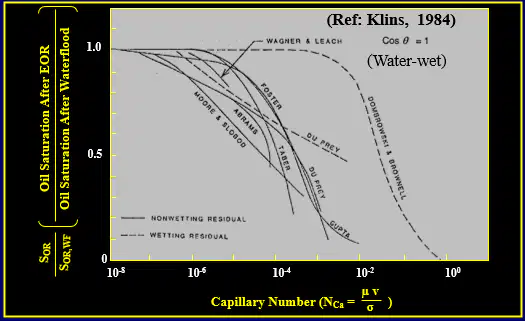
Maximize ED and EV:
(a)
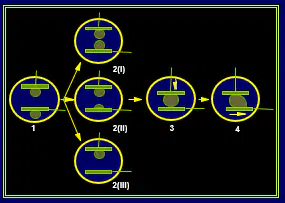
1. Starts with ____ drops on ____ crystals - both aging under the influence of buoyancy
2. When lower crystal is turned over - _ possibilities as shown in step 2
3. ___ drops are then mingled in step (3) - now it resembles Modified Sessile Drop Technique - except for the oil-exposed area on lower surface
4. When lower surface is shifted sideways, water advances over previously oil-exposed area, yielding _______________!
(a)
(a)
DDDC Technique Highlights:
Both _______________ possess similar history of exposure to crude oil
Enables unambiguous _____________ of solid/oil/water 3-phase contact line (TPCL) movements
Measured angles do __________ their true definitions
(a)
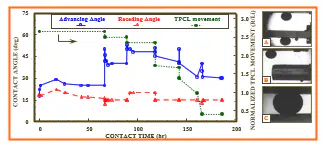
Intermediate-wet Case of Gilwood Live Oil on Quartz under Reservoir Conditions of 17.8 MPa, 60oC and a Brine pH of 7.0
Water-wet Case of Beaverhill Lake Live Oil on Quartz under Reservoir Conditions of 25 MPa, 96oC and a Brine pH of 7.0
Oil-wet Case of Beaverhill Lake Live Oil on Calcite under Reservoir Conditions of 25 MPa, 96oC and a Brine pH of 7.0
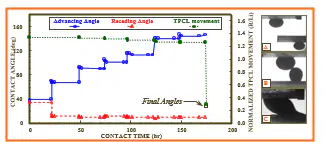
Intermediate-wet Case of Gilwood Live Oil on Quartz under Reservoir Conditions of 17.8 MPa, 60oC and a Brine pH of 7.0
Water-wet Case of Beaverhill Lake Live Oil on Quartz under Reservoir Conditions of 25 MPa, 96oC and a Brine pH of 7.0
Oil-wet Case of Beaverhill Lake Live Oil on Calcite under Reservoir Conditions of 25 MPa, 96oC and a Brine pH of 7.0
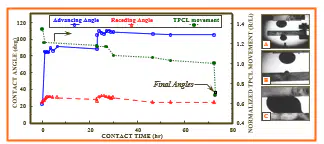
Intermediate-wet Case of Gilwood Live Oil on Quartz under Reservoir Conditions of 17.8 MPa, 60oC and a Brine pH of 7.0
Water-wet Case of Beaverhill Lake Live Oil on Quartz under Reservoir Conditions of 25 MPa, 96oC and a Brine pH of 7.0
Oil-wet Case of Beaverhill Lake Live Oil on Calcite under Reservoir Conditions of 25 MPa, 96oC and a Brine pH of 7.0

(a)

(a)

(a)

Measure the interfacial tension between live oil and injection gas at reservoir temperature as a function of pressure or gas enrichment; Plot interfacial tension against pressure or enrichment; Extrapolate the data to ‘zero’ interfacial tension to obtain MMP or MME
(a)
compares the recovered amount of oil by spontaneous imbibition to the amount recovered by forced water injection to give the Amott water index (Iw)
(a)
initial water saturation in the core
(a)
water saturation after spontaneous water imbibition
(a)
water saturation after forced water injection
(a)
oil saturation after forced water injection
(a)
oil saturation after spontaneous oil imbibition
(a)
oil saturation after forced oil injection
(a)
the difference between the water and the oil indices; Ia = Iw - Io
(a)
Amott index for water - wet
(a)
Amott index for intermediate - wet
(a)
Amott index for oil - wet
(a)
will have different saturation distributions at the pore-scale.
(a)
water will imbibe the smallest pores because the surface likes water and will displace the oil
(the opposite happens in an oil-wet system).
(a)
The amount of oil recovered by water injection is mainly dictated by the (a) .

(a)
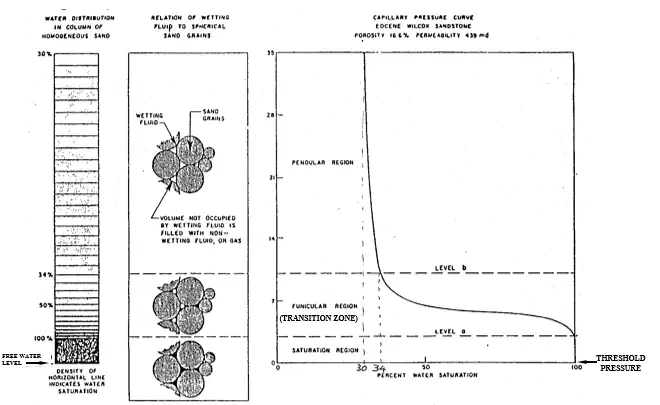
(a)
Techniques used for Capillary Pressure
Porous Diaphragm
Mercury Injection
Centrifuge
Dynamic 2-Phase Flow
Both the centrifuge and dynamic methods have shown (a) agreement with the diaphragm method.

(a)
Because of the difficulty in making contact angle measurements at reservoir conditions, the (a) term is ignored in the second method!
(a) can vary from -1 to +1, making a major impact on capillary pressure and its conversion - hence it CANNOT be ignored!
The need to measure IFT and CA at reservoir conditions of pressure, temperature and fluids compositions is (a) .
to determine IFT at reservoir conditions
(a)
repeatable measurement of water-advancing and water-receding contact angles
(a)
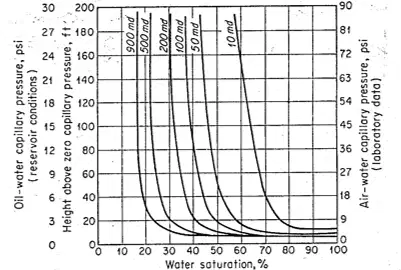
lab capillary pressure
reservoir capillary pressure
height above free-water level
Lab Measurements of Capillary Pressure
Porous plate technique
Mercury injection capillary pressure
Centrifuge
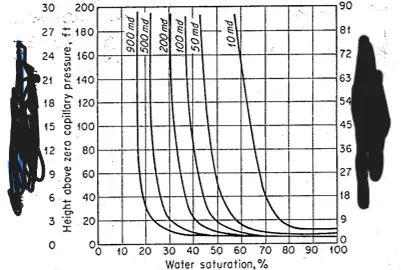
Left ordinate corresponds what?
(a)
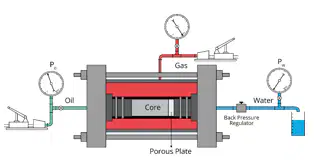
a low permeability water-wet ceramic disc is used as a porous plate; is used to keep the oil in the core and let only the water pass through it
(a)
The inlet and outlet pressures will be the ______ (non-wetting phase) and the _______ (wetting phase) pressures, since the core is ____________.
(a)
Start with low capillary pressure and wait until you reach the equilibrium; calculate the water saturation by weighing or by using volumetric balance; increase the capillary pressure in steps until the irreducible water saturation is reached; time consuming; gives accurate measurements
(a)
a core is placed inside a pressure chamber and mercury is injected; the mercury is the non-wetting phase and the air is the wetting one; the volume of the injected mercury and the pressure are calculated; the fastest method to measure capillary pressure experimentally
(a)
The volume of the mercury injected can be converted to a ____________ phase saturation (Snw), then the saturation of the ____________ phase (Sw) is Sw = 1 - Sw
(a)
does not use reservoir fluids; usually used to characterize the rock sample by obtaining the throat radius distribution; can saturate 100% of the core sample without obtaining a representative irreducible saturation as in reservoirs
(a)
damages the core, so it can not be used for further analysis
(a)
in this method, both the drainage and the waterflood capillary pressure curves are measured; accuracy is not as high as in the porous plate method; rotation speed is converted to pressure using specific equations
(a)
Centrifuge: For drainage, the sample filled with the __________ phase is placed in a cell surrounded by the _______________ phase. We _______________ the cell at several speeds and measure the amount of displaced fluid at each speed until there is no further production at high speeds.
(a)
Centrifuge: For waterflood capillary pressure curve, the cell is ____________ as the _____ phase is usually less dense than _________
(a)
In MICP, a (a) is needed to make the curve more representative of the reservoir condition
can also be used to characterize the rock as it can measure several capillary pressure data points in a short time.
(a)
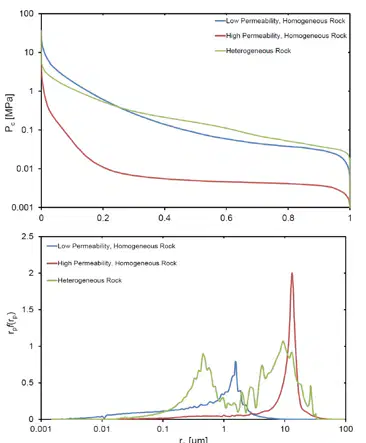
These capillary points can be converted to throat radii if the interfacial tension and the contact angle are known by what?
(a)
The throat radii are listed, and the frequency of each throat radius is found, then a plot of the throat radius as a function of the frequency is generated
(a)
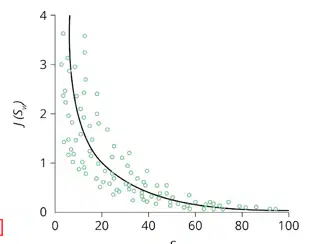
capillary pressure can be expressed in dimensionless form, used to convert capillary pressure data that may be performed with different rock or fluid properties than the field data
(a)
The J - Function can be used to what
calculate the average capillary pressure across
find the J using the rock data found in lab
use the given equation arrangement with the average rock properties found from different samples
are used to find the fluid saturation above the free water level; can be used after finding the actual depth of the FOL/FWL from the RFT data or by finding the gas/oil contact (GOC) and the oil/water contact (OWC) from Wireline logging; once a depth is identified the capillary pressure can be calibrated to find the fluid saturation at specific depth; can be used to identify the depth of the transition zone and the clean oil zone
(a)
tells us about the flow of oil when water is introduced to the system, however, they are not frequently used because they are difficult to be measured in the lab as the spontaneous imbibition process is rapid and hard to be measured accurately, and there are easier ways to use
(a)

