wayground logo

Free Printable Worksheets

Font size

S
M
L
XL
Worksheets

Revision on L( 1,2and 3)

Total questions: 100

Worksheet time: 2hrs 10mins

Name
Class
Date
1.
Which characteristic would most likely be inherited by a baby?
a)
brown hair
b)
crying a lot
c)
ability to jump high
d)
his ability to talk
2.

The process where characteristics are transmitted from parent to offsprings is called:

a)

variation

b)

heridity

c)

gene

d)

allele

3.

the copying of Information from DNA to mRNA takes place in

a)

cytoplasm

b)

mitochondria

c)

nucleus

d)

ribosomes

4.

the 3 base pair letter on mRNA is known as

a)

Codon

b)

anti codon

c)

purines

d)

pyrimidines

5.

Who is the father of genetics

a)

Swan

b)

Mendel

c)

Aristotle

d)

Lamark

6.

hereditary means

a)

Passing of traits from offspring to parents

b)

Passing of traits from parents to offspring

c)

Supporting results with data

d)

Supporting results with common knowledge

7.

The brown eye trait is dominant over blue eyes. Which of the following genotypes best represents the phenotype for blue eyes?

a)

BB

b)

Bb

c)

bb

d)

bB

8.

The young of an organism

a)

Instincts

b)

Learned Behaviors

c)

Life Cycle

d)

Offspring

9.

An organism that has two different alleles for a trait.

a)

Genotype

b)

Phenotype

c)

Homozygous

d)

Hybrid

10.

A chart or a family tree that shows the presence or absence of a trait according to the relationships within a family across several generations.

a)

Punnett square

b)

Pedigree

c)

Heredity

d)

Purebred

11.

An organism that has two identical alleles for a trait.

a)

Twins

b)

Heterozygous

c)

Phenotype

d)

Homozygous

12.

What is the study of heredity?

a)

Genetics

b)

Mendel

c)

Pea plants

d)

Genes

13.

Genes are inherited in pairs, one from each parent.

a)

True

b)

False

14.

HH is

a)

homozygous dominant

b)

homozygous recessive

c)

heterozygous

d)

neither dominant nor recessive

15.

How a trait appears is a

a)

phenotype

b)

genotype

c)

gene

d)

dominant

16.

Hybrid is another way of saying

a)

heterozygous

b)

purebred

c)

dominant

d)

recessive

17.

What is the probability of Aa?

a)

50%

b)

100%

c)

25%

d)

0%

18.

If brown (B) is dominant to blue (b), what are the possible phenotype(s) of this cross?

a)

Brown and blue

b)

Bb and bb

c)

Brown

d)

Bb

19.

RNA replaces uracil with ______ from DNA.

a)

Thiamine

b)

adenine

c)

cytosine

d)

guanine

20.
If a father is AA and a mother is AB, what is the probability for a child with AB blood? 
a)
0%
b)
25%
c)
50%
d)
75%
21.
If two parents have type AB blood, what is the probability that their child will have type O blood?
a)
0%
b)
25%
c)
50%
d)
100%
22.

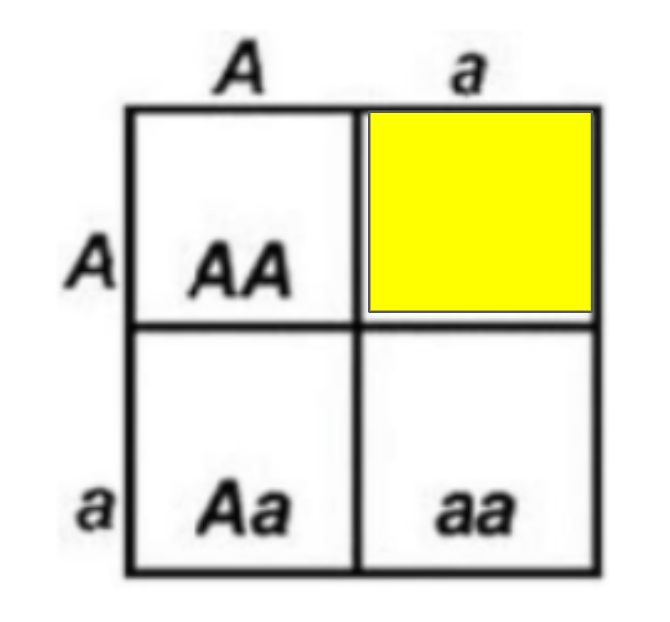
Fill in the Yellow Box

a)

AA

b)

Aa

c)

aa

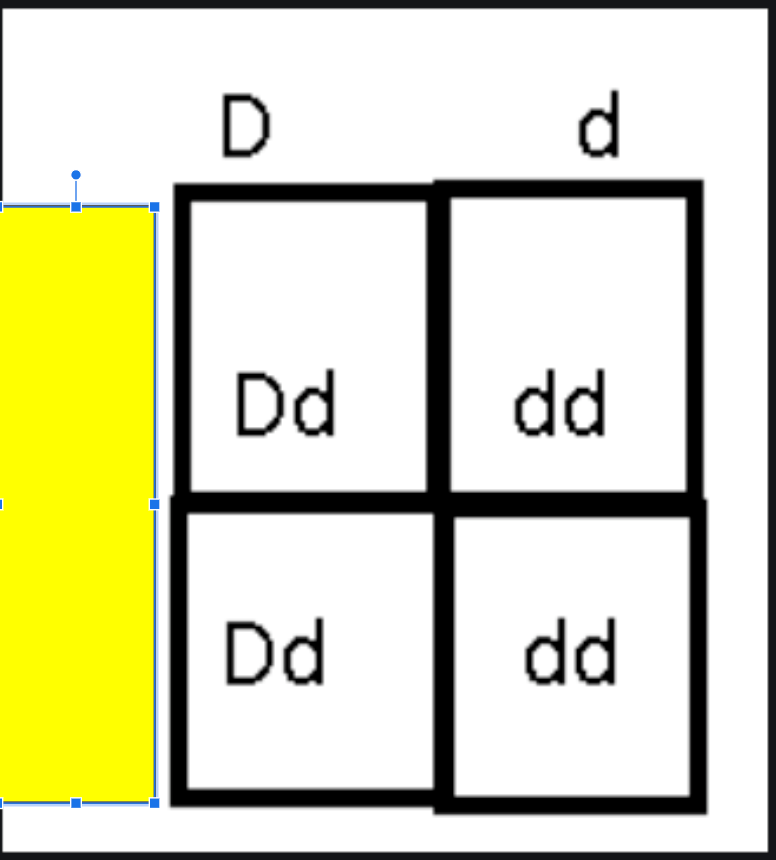
23.

What is the mother's genotype?

a)

DD

b)

Dd

c)

dd

24.
Guanine bonds with ______________.
a)
Adenine
b)
Guanine
c)
Cytosine
d)
Thymine
25.
Which 2 molecules form the sides (backbone) of the DNA ladder?
a)
deoxyribose sugar and adenine
b)
deoxyribose sugar and a hydrogen bond
c)
deoxyribose sugar and the nucleus
d)
deoxyribose sugar and phosphate
26.
What are the three components of a nucleotide?
a)
sugar, hydrogen, nitrogen base
b)
sugar, oxygen, nitrogen base
c)
sugar, phosphate, nitrogen base
d)
sugar, phosphate, protein
27.
A process in which DNA has the unique ability to make an exact copy of itself.
a)
Replication
b)
Translation
c)
Transcription
28.
Which sequence of DNA bases would pair with this partial strand
ATG TGA CAG
a)
ATG TGA CAG
b)
TAC ACT GTC
c)
GTA AGT GAC
d)
CAT TCA CTG
29.
Which of the following best describes a DNA molecule?
a)
double helix
b)
contains ribose
c)
made of amino acids
d)
contains Uracil
30.
Guanine bonds with ______________.
a)
Adenine
b)
Guanine
c)
Cytosine
d)
Thymine
31.
Which 2 molecules form the sides (backbone) of the DNA ladder?
a)
deoxyribose sugar and adenine
b)
deoxyribose sugar and a hydrogen bond
c)
deoxyribose sugar and the nucleus
d)
deoxyribose sugar and phosphate
32.
What are the three components of a nucleotide?
a)
sugar, hydrogen, nitrogen base
b)
sugar, oxygen, nitrogen base
c)
sugar, phosphate, nitrogen base
d)
sugar, phosphate, protein
33.
A process in which DNA has the unique ability to make an exact copy of itself.
a)
Replication
b)
Translation
c)
Transcription
34.
Adenine bonds with ______________.
a)
Guanine
b)
Thymine
c)
Cytosine
d)
Adenine
35.
RNA contains the sugar
a)
ribose
b)
deoxyribose
c)
glucose
d)
lactose
36.
Which of the following statements is true?
a)
DNA is single-stranded
b)
RNA is single-stranded
c)
DNA contains uracil
d)
RNA contains deoxyribose
37.
What is the difference between DNA and RNA in terms of bases?
a)
RNA contains uracil in place of thymine
b)
RNA contains uracil in place of adenine
c)
RNA contains uracil in place of guanine
d)
RNA contains uracil in place of  cytosine
38.
I travel outside of the nucleus.
a)
DNA
b)
RNA
39.
How many nucleotides make a codon?
a)
1
b)
2
c)
3
d)
6
40.

Which organelle is the location where protein is made?

a)

Ribosome

b)

Nucleus

c)

Cytoplasm

d)

Nucleotide

41.

When these bond together, they form a protein

a)

Amino Acids

b)

Peptide Bonds

c)

Ribose

d)

Nucleotides

42.

If a DNA strand is 35 % Cytosine, what else must be true?

a)

It is 35% Thymine

b)

It is 35% Guanine

c)

It is 25% Cytosine

d)

It is 25% Adenine

43.
Why does DNA replicate?
a)
To create another copy for the new cell
b)
To create a duplicate copy in case the original gets damaged
c)
To create a new copy to replace the damaged original
44.
What does a filled in square represent?
a)
Not affected Female
b)
Not affected Male
c)
Affected Male
d)
Affected Female
45.
How many generations are shown in this pedigree?
a)
1
b)
2
c)
3
d)
4
46.
What do half colored symbols represent?
a)
The individual is a carrier (heterozygous).
b)
The individual expresses the trait.
c)
The individual has both recessive alleles.
d)
The individual has both dominant alleles.
47.
Which individual in the first generation is a carrier?
a)
The male
b)
The female
c)
individual 1
d)
None of the above
48.
Which generation connects these two pedigrees? 
a)
1
b)
2
c)
3
49.

In a pedigree, individuals that are carriers are represented as shapes that are

a)

Not shaded

b)

Fully shaded

c)

Half shaded

50.

How many females show the trait?

a)

1

b)

2

c)

3

d)

4

51.

Nucleic acid that carries the code for making proteins from the nucleus to the cytoplasm

a)

DNA

b)

Amino Acid

c)

RNA

d)

Ribosome

52.

TRUE or FALSE

the combination of a nitrogen base, a sugar, and a phosphate is called a gene

a)

TRUE

b)

FALSE

53.

TRUE or FALSE

The production of proteins take place in the ribosomes

a)

TRUE

b)

FALSE

54.

What are the three types of RNA?

a)

mRNA, tRNA, rRNA

b)

mRNA, tRNA, oRNA

c)

tRNA, rRNA, pRNA

55.

RNA and DNA are composed of different sugars. Which of the following statements are true?

a)

RNA uses ribose and DNA uses deoxyribose.

b)

RNA uses deoxyribose and DNA uses ribose.

c)

DNA and RNA both use ribose sugars.

d)

DNA and RNA both use deoxyribose sugars.

56.
Which of these bases does not exist in RNA?
a)
C
b)
T
c)
U
d)
A
57.
True or false:  RNA is double-stranded.
a)
true
b)
false
c)
it depends on the type
58.

The nitrogen base pairs for RNA are

a)

A-T C-G

b)

A-U C-G

c)

A-C T-G

d)

T -U G-C

59.

How many sets of division (PMAT) happen in Meiosis?

a)

1

b)

2

c)

3

d)

4

60.

How many daughter cells does each Meiosis (I & II) create?

a)

1,2

b)

2,4

c)

2,2

61.

Pairs of chromosomes that contain the same genes, but may have different versions are called

a)

chromatids

b)

sister chromatids

c)

homologous pairs

62.

Name the phase pictured

a)

Metaphase I

b)

Metaphase II

c)

Anaphase I

d)

Anaphase II

63.

In mitosis, the two resulting cells are

a)

different from the starting cell and identical to each other.

b)

different from the starting cell and different from each other.

c)

identical to the starting cell and different from each other.

d)

identical to the starting cell and identical to each other.

64.

Before cells can divide, what must be copied?

a)

mitochondria

b)

cytoplasm

c)

DNA

d)

cell wall

65.
In mitosis, the two resulting cells are
a)
different from the starting cell and identical to each other.
b)
different from the starting cell and different from each other.
c)
identical to the starting cell and different from each other.
d)
identical to the starting cell and identical to each other.
66.
How many cells are made in the process of MITOSIS?
a)
one
b)
two
c)
four
d)
eight
67.
How many chromosomes do humans have?
a)
46
b)
21
c)
10
68.
The structure shown in the diagram is a _____________?
a)
chromatid
b)
chromosome
c)
centromere
d)
DNA
69.
Most of the cells in the human body are produced by
a)
mitosis
b)
meiosis
70.
DNA is inside your cells. What part of the cell is the DNA inside of?
a)
cell membrane
b)
cytoplasm
c)
nucleus
71.

All organisms get ___________ of their chromosomes from each of their parents.

a)

12\frac{1}{2}

b)

11\frac{1}{1}

c)

13\frac{1}{3}

72.

_________________ is the genetic makeup or combination of alleles in an organism.

a)

The phenotype

b)

The genotype

73.

Humans have 22 chromosomes in all. They inherit 11 from one parent and 11 from the other.

a)

true

b)

false

74.

DNA is passed from

a)

offspring to parents

b)

Parents to offspring

c)

Offspring to offspring

d)

Parent to parent

75.
Guanine bonds with ______________.
a)
Adenine
b)
Guanine
c)
Cytosine
d)
Thymine
76.

TRUE or FALSE

The DNA is shaped like a twisted ladder, a triple helix

a)

TRUE

b)

FALSE

77.

Which RNA takes genetic information out of the nucleus and into the cytoplasm?

a)

tRNA

b)

mRNA

c)

rRNA

d)

pRNA

78.

Which RNA is in charge of bringing amino acids from the cytoplasm into the ribosomes?

a)

rRNA

b)

mRNA

c)

tRNA

79.

What is the purpose of meiosis?

a)

The purpose of meiosis is to produce somatic cells.

b)

The purpose of meiosis is to produce identical offspring.

c)

The purpose of meiosis is to produce gametes with half the number of chromosomes.

d)

The purpose of meiosis is to increase the number of chromosomes.

80.

What does the image demonstrate

a)

Punnet squares

b)

Crossing over

c)

Metaphase

d)

Dna replication

81.

What organism did Mendel study?

a)

pea plants

b)

onions

c)

mice

d)

cats

82.
Dominant alleles are represented by a:
a)
Male gene
b)
lowercase letter
c)
recessive trait
d)
capital letter
83.
___________________________ is the field of science that studies of how traits are passed on, or inherited.
a)
dominant traits
b)
ratio
c)
phenotype
d)
genetics
84.
What is a gene?
a)
An entire chromosome that  codes for a trait
b)
a piece of clothing
c)
a piece of a DNA on chromosome that codes for a trait
d)
Chemical messengers in your brain that code for a trait
85.
Who is considered the "father" of modern genetics?
a)
Einstein
b)
Mendel
c)
Disney
d)
Trump
86.
An organism that has two different alleles for a trait.
a)
Purebred
b)
Hybrid
c)
Dominant
d)
Recessive
87.
Aa, DD, bB, yy are all examples of
a)
genotypes
b)
phenotypes
88.
Which of the following genotypes is heterozygous?
a)
Bb
b)
BB
c)
bb
d)
B
89.

Which of the following genotypes is homozygous recessive?

a)

Tt

b)

tt

c)

TT

d)

tT

90.

In a flowering plant species, red flower color (R) is dominant over white flower color (r). What is the genotype of any white-flowering plant resulting from this species?

a)

rr

b)

rR

c)

RR

d)

Rr

91.
aa always shows up as
a)
dominant
b)
recessive
92.

What is the structure shown in the middle of the pink box?

a)

tRNA

b)

Amino Acid

c)

Anticodon

d)

Codon

93.
Amino acids are joined together in order to form
a)
DNA
b)
ribosomes
c)
proteins 
d)
RNA
94.
How many amino acids are coded for by this sequence of nucleotides:
ATG GGA  ACT
a)
4
b)
3
c)
6
d)
2
95.

Which molecule uses DNA as a template to carry instructions out of the cell?

a)

tRNA

b)

mRNA

c)

rRNA

d)

DNA Polymerase

96.
the process of making a copy of DNA
a)
transcription
b)
double helix
c)
DNA replication
d)
replication fork
97.

TRANSCRIBE this DNA sequence: TACGTTACT

a)

AUGCAAUGA

b)

ATGCAATGA

c)

AUGGATUGA

d)

TACGTTACT

98.
What will be the resulting mRNA from this DNA sequence:
GAT-TAC-AGA-TTA-CAT?
a)
CTA-ATG-TCT-AAT-GTA
b)
GAU-UAG-UGA-UUA-GUT
c)
CUA-AUG-UCU-AAU-GUA
d)
CAT-ACA-TAC-ATA-TAG
99.
Which 2 molecules form the sides (backbone) of the DNA ladder?
a)
deoxyribose sugar and adenine
b)
deoxyribose sugar and a hydrogen bond
c)
deoxyribose sugar and the nucleus
d)
deoxyribose sugar and phosphate
100.

Which of the following represents what is occurring during DNA replication?

a)

DNA --> DNA

b)

DNA --> mRNA

c)

mRNA --> amino acid chain (protein)

d)

DNA --> protein