wayground logo

Free Printable Worksheets

Font size

S
M
L
XL
Worksheets

Chemistry Review

Total questions: 100

Worksheet time: 8hrs 20mins

Name
Class
Date
1.
The particles with no charge in an atom are the _______.
a)
electrons
b)
neutrons
c)
protons
d)
protons and neutrons
2.
The positively charged particles of an atom are the ________.
a)
electrons
b)
protons
c)
neutrons
d)
protons & neutrons
3.
The negatively charged particles of an atom are the ______.
a)
electrons
b)
protons
c)
neutrons
d)
protons & neutrons
4.
What is the atomic number?
a)
number of protons
b)
number of neutrons
5.
What is the mass number?
a)
the number of protons
b)
the sum of the number of protons and the number of neutrons in the nucleus of an atom 
c)
the number of electrons
d)
the number of neutrons
6.
Which element has 31 protons ?
a)
Gallium 
b)
Germanium
c)
Gadolinium
d)
Polonium
7.
What does the nucleus of an atom contain?
a)
Electrons and neutrons
b)
Protons and neutrons
c)
Neutrinos and positrons
d)
DNA and RN
8.
In an atom, what is the number of protons equal to?
a)
The number of electrons.
b)
The number of neutrons.
c)
The number of molecules.
d)
The number of nuclei.
9.
What is at the center of every atom?
a)
An electron
b)
A compound
c)
A molecule
d)
A nucleus
10.
A particle that moves around the nucleus is a(n)...
a)
Proton
b)
Neutron
c)
Electron
d)
Quark
11.
Oxygen’s atomic number is 8. This means that an oxygen atom must have
a)
8 electrons
b)
8 protons
c)
8 neutrons
d)
a mass number of 8
12.
What number indicates an electron?
a)
1
b)
2
c)
3
d)
4
13.
 What is the mass number of this element?
a)
5
b)
27
c)
32
d)
59
14.
What number indicates the nucleus?
a)
1
b)
2
c)
3
d)
4
15.
What is the name of this element?
a)
Helium
b)
Hydrogen
c)
Argon
d)
Silver
16.
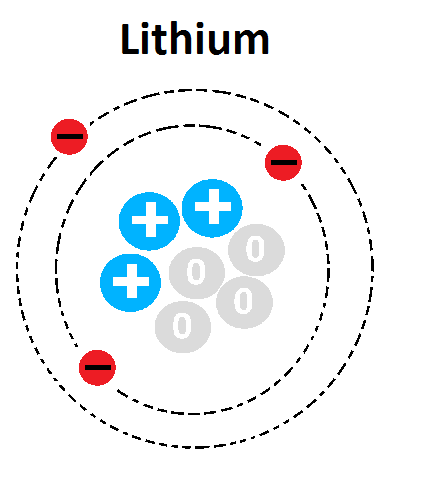
What is the name of this element?
a)
Lithium
b)
Boron
c)
Carbon
d)
Neon
17.
What is the mass number of this atom?
a)
1
b)
3
c)
4
d)
7
18.
What is the atomic number of this atom?
a)
2
b)
4
c)
6
d)
none of the above
19.

On the periodic table, Groups are

a)

Horizontal rows

b)

Vertical columns

20.

On the periodic table, Periods are

a)

Horizontal rows

b)

Vertical columns

21.

The innermost energy level has a maximum of how many electrons?

a)

1

b)

2

c)

6

d)

8

22.

What element is this?

a)

Na

b)

P

c)

N

d)

S

23.

Which Bohr model represents Be?

a)
b)
c)
d)
24.

What is the mass of this element?

a)

0

b)

1

c)

2

d)

3

25.

What is the formula we use to calculate the number of protons, neutrons, and electrons in an atom?

a)

APE MAN

b)

A=P=E M-A=N

c)

A=P=E M=A=N

26.
How many atoms of aluminum are on each side of the following equation: 4Al + 3O--> 2AlO3
a)
2
b)
6
c)
1
d)
4
27.
How many phosphorus atoms are in PO4?
a)
1
b)
2
c)
3
d)
4
28.
The substances listed on the left side of a chemical equation are the
a)
Products
b)
Coefficients
c)
Precipitates
d)
Reactants
29.

In chemical reactions, what does the principle of conservation of matter mean?

a)

Matter is not created or destroyed.

b)

The total mass of the reactants is greater than the total mass of the products.

c)

The total mass of the reactants is less than the total mass of the products.

d)

Matter is not changed.

30.
How many Hydrogen (H) atoms are in NH3O5
a)
3
b)
4
c)
5
d)
1
31.
Name the part in red:

H2 + O2 -> H2O
a)
Coefficient
b)
Product
c)
Yield
d)
Subscript
32.

Name the part in red:


2H2 + O2 -> 2H2O

a)

Coefficient

b)

Product

c)

Yield

d)

Subscript

33.
Name the part in red:

H+ O2 -> H2O
a)
Coefficient
b)
Product
c)
Reactant
d)
Subscript
34.
Name the part in red:

H+ O-> H2O
a)
Coefficient
b)
Product
c)
Reactant
d)
Subscript
35.
Is the following equation balanced or unbalanced ? 
Al + O2 --> Al2O3
a)
Balanced
b)
Unbalanced
36.
Is the following equation balanced or unbalanced ? 
N2 +3 H2 --> 2NH3
a)
Balanced
b)
Unbalanced
37.
Read the following chemical formula: C6H12O6. How many hydrogen atoms are in the formula?
a)
12
b)
6
c)
4
38.
Is this balanced?
Al + O2 → 2Al2O3
a)
Yes
b)
No
39.

How many Oxygen atoms are in 3Ca(NO3)2

a)

18

b)

3

c)

6

d)

9

40.

How many hydrogens are in 4H2O?

a)

6

b)

8

c)

2

d)

4

41.
Which two groups on the Periodic Table are the MOST reactive?
a)
Group 1 and Group 17
b)
Group 2 and Group 16
c)
Group 13 and Group 15
d)
Group 17 and Group 18
42.
How many valence electrons are elements trying to reach in their outer shells?
a)
1
b)
2
c)
5
d)
8
43.
What determines the reactivity of an element?
a)
Size of its nucleus
b)
Number of total electrons
c)
Number of valence electrons
d)
Number of shells
44.
How do you determine the number of valence electrons an element has?
a)
Look at its period
b)
Look at its group
c)
Look at its atomic number
d)
Look at its atomic mass
45.
a)
2
b)
8
c)
3
d)
13
46.
a)
12
b)
7
c)
8
d)
14
47.

Which elements have the most similar chemical properties?

a)

boron and carbon

b)

oxygen and sulfur

c)

aluminum and bromine

d)

argon and silicon

48.
Describe this element.
a)
Highly reactive metal
b)
Highly reactive nonmetal
c)
Stable
d)
Less stable non metal
49.

Vertical columns on the periodic table are called ___?

a)

groups

b)

periods

c)

rows

d)

families

50.

Horizontal rows on the periodic table are called ___?

a)

groups

b)

periods

c)

rows

d)

families

51.

Evidence of Chemical Change.

a)

New substance with different properties

b)

Size change

c)

State change

d)

Mixture

52.
Water boiling is a _______ change. 
a)
Physical Change 
b)
Chemical Change 
53.
One of the signs of a chemical reaction taking place is:
a)
Bubbles are produced 
b)
Reactants are not combining
c)
Products are not forming
d)
Color is not changing
54.
Which of the following describes a precipitate?
a)
a liquid forms when a block of metal is heated
b)
a solid forms when one liquid is poured into another
c)
a gas forms when a solid is placed in a liquid
d)
bubbles form when an acid is poured on a rock
55.
Which is NOT an indication of a chemical change?
a)
temperature change
b)
formation of a precipitate
c)
shape change
d)
production of light
56.
Which of the following is an example that includes evidence of a chemical reaction?
a)
A sample of zinc is placed in water and it settles to the bottom
b)
A solid block of ice is heated and it completely melts into a liquid. 
c)
Sugar that is burned gives off an odor and turns brown and then black.
d)
A tomato is placed into a blender and chopped up into smaller pieces.
57.

The three subatomic particles are

a)

proton, neutron, electron

b)

proton, nucleus, electron

c)

protein, neutron, electricity

d)

proton, neutral, electives

58.

99.9% of the atom's mass is found where?

a)

nucleus

b)

protons

c)

electron cloud

d)

neutrons

59.

A certain atom has 26 protons, 26 electrons, and 30 neutrons. What is its mass number?

a)

26

b)

30

c)

52

d)

56

60.
What is the atomic number of the atom pictured? 
a)
11
b)
12
c)
22
d)
23
61.
Is melting butter for popcorn a chemical or physical change?
a)
chemical
b)
physical
62.
A solid piece of chocolate is melted and changed to liquid form. Which property of the piece of chocolate will remain the same?
a)
Texture
b)
Temperature
c)
Shape
d)
 Mass
63.
Which of the following is NOT an example of a physical change?
a)
crumpled paper
b)
pencil sharpening
c)
shrunken clothing
d)
rust
64.
Freezing Juice?
a)
Physical Change
b)
Chemical Change
65.
A change where one or more new substances are created.
a)
Physical Change 
b)
Chemical Change 
66.
Change in density is a physical change.
a)
True
b)
False
67.
Fizzing, foaming, and burning are all examples of
a)
Chemical change
b)
Physical change
68.
Rust on an iron bar is an example of chemical change.
a)
True 
b)
False
69.
What kind of properties can only be observed when a substance changes into a different substance?
a)
physical properties
b)
chemical properties
70.
When you break a cracker into pieces it is a...
a)
Chemical change
b)
Physical change
71.
A mixture is the result of a physical change because...
a)
The parts can be separated
b)
A new substance is made
c)
There is a chemical reaction
d)
One part of the mixture disappears
72.
Which of these is a result of a chemical change?
a)
A mixture
b)
A solution
c)
A new substance
d)
Melting or freezing
73.
Which of these does NOT happen during a chemical change?
a)
Atomic bonds are formed or break apart
b)
New substance(s) are formed with different chemical properties
c)
The number of atoms in the reaction stays the same
d)
The chemical properties of the beginning substance(s) are the same as those of the end product(s)
74.
Which of the following is a sign that a chemical reaction has occurred?
a)
change in shape
b)
melting
c)
formation of a gas
d)
dissolving
75.

On the periodic table, Groups are

a)

Horizontal rows

b)

Vertical columns

76.
Which of these grouping of elements could have the characteristic of luster (shiny)?
a)
Metal
b)
Nonmetal
c)
metalloids
d)
Both metals and metalloids
77.
Which of these is a property of metals?
a)
It's malleable
b)
It can't conduct electricity
c)
They are used in food
d)
It's very brittle
78.
Which element is a metalloid?
a)
Titanium
b)
Selenium
c)
Potassium
d)
Polonium
79.
All of the following would classify an element as a metal except?
a)
Dull
b)
Luster
c)
Malleable
d)
Hard
80.
Iron is a good conductor, malleable and magnetic. What type of element is Iron? 
a)
Metal
b)
Nonmetal
c)
Metalloid
d)
Pretty
81.
A student is given a sample of an unknown substance. He is asked to determine if it is classified as a metal, a metalloid, or a nonmetal. He discovered that the unknown element conducted some heat and electricity, had a shiny luster, and broke easily. This element is most likely a 
a)
metal
b)
nonmetal
c)
metalloid
d)
cannot be determined
82.
Which table below correctly lists the properties of metals and nonmetals? *
a)
A
b)
B
c)
C
d)
D
83.
Which of the following is a property of a non-metal?
a)
Conducts electricity and heats well
b)
Can be hammered into thin sheets
c)
Is brittle and breaks easily
d)
Has a shiny, metallic luster
84.
All of the following are properties used to classify elements as metals, non-metals, and metalloids EXCEPT —
a)
texture
b)
conductivity
c)
luster
d)
malleability
85.
A student tested the conductivity of four elements using an incomplete electrical circuit. When the element is placed in the circuit, the bulb lights up brightly, lights up dimly, or does not light up at all based on the element’s ability to conduct electricity. The table below shows the results of her investigation. Based on the results of the conductivity test, which element is classified as a metal? 
a)
Hydrogen
b)
Arsenic
c)
Krypton
d)
Copper
86.
Which of the following correctly lists the three main groups of elements from greatest conductivity to least conductivity?
a)
Nonmetals -metalloids-metals
b)
metals-nonmetals-metalloids
c)
metalloids-metals-nonmetals
d)
metals-metalloids-nonmetals
87.
The word “luster” refers to which property of matter?
a)
The ability to conduct electrical or thermal energy
b)
Capable of being drawn out into thin wires
c)
The way a surface appears when it reflects light
d)
Suitable for being shaped by beating or rolling
88.
The table shows the properties of four elements. Which element in the table is classified as a metal?
a)
Manganese
b)
Sulfur
c)
Silicon
d)
Neon
89.
Silicon is a semiconductor and has properties of both metals and nonmetals. What type of element is Silicon? 
a)
Metal
b)
Nonmetal
c)
Metalloid
d)
Pretty
90.
John was observing the physical properties of elements in order to classify them as either a metal, nonmetal, or metalloid. The first element was dull, brittle, and did not conduct heat. What would its classification be? 
a)
metal 
b)
nonmetal 
c)
metalloid
91.
´Elizabeth was examining elements and their physical properties. She described an element is her science journal as having no shine, an insulator, and  very brittle. What would this element be a metal, nonmetal, or metalloid?
a)
metal 
b)
nonmetal 
c)
metalloid
92.
If a material can easily be drawn into the shape of a wire, it is
a)
Ductile
b)
Magnetic
c)
Malleable
d)
Reactive
93.

Which of the following correctly lists elements that are present in the molecule K2CO3 ?

a)

Krypton, Calcium, Oxygen

b)

Potassium, Carbon, Oxygen

c)

Krypton, Carbon, Oxygen

d)

Potassium, Calcium, Oxygen

94.

An element in Group 1 has ____ valence electron(s) and is HIGHLY reactive:

a)

1

b)

2

c)

10

d)

11

95.

How many protons are contained in the nucleus of an neon atom?

a)

1

b)

10

c)

20

d)

30

96.

A scientist combined three different liquids - one liquid settled at the bottom, one settled in the middle, and one settled at the top. Is this a physical or chemical change?

a)

Physical

b)

Chemical

97.

Which chemical reaction involves the fewest oxygen atoms?

a)
b)
c)
d)
98.

As part of an investigation, students combined substances in a beaker to observe chemical reactions. They performed two procedures. They measured the mass of each substance before and after each reaction. The table shows their observations.

Assuming the students did not make any careless errors, what likely explains these changes in mass?

a)

Procedure 1: One of the products was a gas that escaped into the air. Procedure 2: A gas from the air reacted with one of the other reactants.

b)

Procedure 1: The reactants were liquids with different densities. Procedure 2: The reactants were combined into only one product.

c)

Procedure 1: One of the reactants was converted to thermal energy. Procedure 2: All the products were liquids.

d)

Procedure 1: All the reactants were liquids that evaporated. Procedure 2: A gas was formed as one product, and it escaped into the air.

99.

Four students were asked to complete a table for a science assignment. Each student selected one chemical element from each of four groups in the periodic table and then classified each element as a metal, a nonmetal, or a metalloid. Which table was completed correctly?

a)
b)
c)
d)
100.

The table lists some compounds found in foods and their formulas.

Based on this information, which of these statements is NOT true?

a)

A molecule of sorbitol contains three more oxygen atoms than a molecule of glutamine does.

b)

A molecule of lactose contains twice as many atoms as a molecule of fructose does.

c)

A molecule of fructose contains four more atoms than a molecule of glutamine does.

d)

A molecule of lactose contains twice as many carbon atoms as a molecule of sorbitol does.