
 Worksheets
Kadumalands Cell Exam
Total questions: 103
Worksheet time: 3hrs 35mins
What common traits would models of different unicellular organisms share?
They would all be made of many cells with cell walls.
They would all have chloroplasts to trap sunlight and create their own food.
They would all have one cell with smaller parts that do different jobs within the cell.
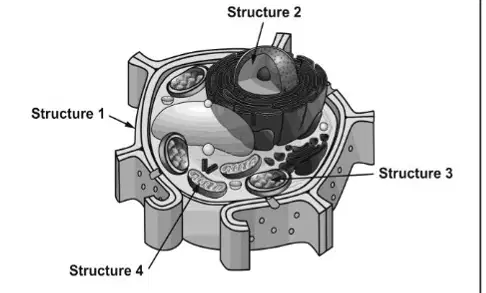
This plant cell contains multiple structures that help it survive. Some of these structures are different than an animal cell. Based on the diagram, which structures distinguish it as a plant cell and not an animal cell?
Structures 1 and 3
Structures 2 and 3
Structures 3 and 4
Some students are comparing the parts of the body to parts of the cell. Which body part best represents the cell membrane and why?
The brain because it controls your body
The stomach because it breaks down food
The skin because it surrounds and protects your organs
Which of these statements explains a key difference between unicellular and multicellular organisms?
Only multicellular organisms can photosynthesize.
The cells of unicellular organisms are much smaller than the cells of multicellular organisms.
Multicellular organisms have cells, not just organelles, that carry out specific functions.
What question can a biologist ask to determine if an object is living?
Does the object move?
Does the object breathe?
Is the object made up of cells?
A student is studying cells and uses a school as a model to represent the cell. Which part of the school represents the nucleus?
Outside fence - where students enter and leave the school
Cafeteria - where food is eaten and provides students with energy
Principal’s office - where the principal controls the activities and functions of the school
Gymnasium - where students exercise
Which statement applies to both unicellular and multicellular organisms?
Living
Made of a single cell
Contain parts made of specialized cells
Cell division helps the organism with growth and repair
Which characteristic is common to both prokaryotic and eukaryotic cells?
Nucleus
Cytoplasm
Genetic material
Membrane-bound organelles
A cell has many parts, each with its own function. Which structure makes proteins?
cell wall
ribosome
cell membrane
nuclear membrane
Which structure protects the plant cell?
cell wall
ribosome
cell membrane
nuclear membrane
Which structure protects genetic information?
cell wall
ribosome
cell membrane
nuclear membrane
Which structure separates the inside of the cell from the outside?
cell wall
ribosome
cell membrane
nuclear membrane
Which organelle captures light energy to produce sugars?
Chloroplast
Mitochondria
Ribosome
Nucleus
Which organelle breaks down sugars to produce energy for the cell?
Chloroplast
Mitochondria
Golgi apparatus
Vacuole
Which organelle packages proteins for delivery to other parts of the cell?
Ribosome
Golgi apparatus
Mitochondria
Chloroplast
Which organelle is the place where proteins are assembled?
Ribosome
Golgi apparatus
Mitochondria
Vacuole
Which organelle stores water inside the cell?
Nucleus
Vacuole
Ribosome
Golgi apparatus
What is the function of the cell membrane?
It produces energy for the cell.
It separates the cell from its environment.
It stores nutrients for the cell.
It helps the cell to move.
What tool did the researcher use to examine the green slime from the pond?
Telescope
Microscope
Binoculars
Magnifying glass
What is the main difference observed between human skin under a compound microscope and an electron microscope?
The compound microscope shows more detail than the electron microscope.
The electron microscope shows more detail than the compound microscope.
Both microscopes show the same level of detail.
Neither microscope shows any detail.
The class found many nonliving things in the sample of pond water. Which of these is a way that the students can tell the difference between living and nonliving things?
Living things are made up of cells while nonliving things are not.
Living things grow larger with time while nonliving things do not.
Living things can move from place to place while nonliving things cannot.
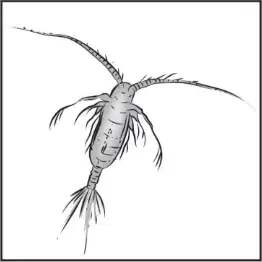
A group of students observed this organism under a microscope. They classified it as a multicellular organism. Which observation, if true, would be most supportive of this conclusion?
The organism was visible without a microscope.
The organism contained multiple membrane-bound cells.
The organism fed on other organisms found in pond water.
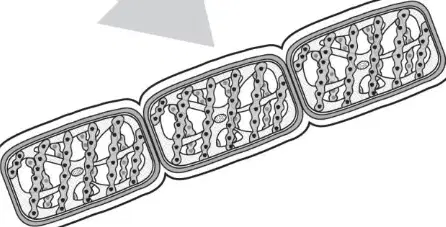
The students notice that this organism appeared to be green under the microscope. Upon closer inspection, they notice small green parts in the cell that appear to be chloroplasts. If this organism were photosynthetic, which statement would likely be true?
The organism would die if placed in the dark.
The organism does not have nuclear material.
The organism does not have structures that allow it to move.
The organism can survive without water.


Ethan, Mason, and Arjun are discussing their biology homework. They are trying to determine if humans, like themselves, are unicellular or multicellular. What should they conclude?
Unicellular
Multicellular
Which organisms are capable of surviving as a single cell?
bacteria
humans
plants
What type of organisms contain ONLY one cell?
Sponges
Multicellular
Unicellular
No living thing has only one cell
Organisms that are made up of only 1 cell are called:
Multicellular
Bacteria
Unicellular
Eukaryotic
Give an example of a unicellular organism.
Amoeba
Mushroom

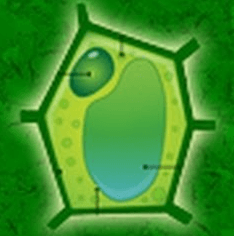
Prokaryotic cells do not have…….
membrane bound organelles
cell membrane
DNA or RNA
life
Prokaryotic cells are
cells lack organized nucleus and membrane-bound organelles
Cells that have a nucleus with cell wall and membrane
Cells that are free of ribosomes and DNA
Cells that do not have a membrane or flagellum
What are prokaryotic?
- bacteria
- no nucleus
- no membrane
- bound organlles
- nucleus
- membrane
- organelles
- multicellular
- fungi
- animal
- plants

Euglena are unicelled organisms that live in pond water. They move around using a flagella and can perform photosynthesis when needed. They contain many organelles . What type of cells are they?
Animal Cell
Prokaryotic Cell
Eukaryotic Cell
Plant Cell

Prokaryotic cells are usually _______ and do not contain a ______
Multicellular, Nucleus
Unicellular, Nucleus

F
G
H
J

F
G
H
J
What term describes the smallest unit that can perform all of the functions necessary for life?
a single cell
a cell nucleus
a cell membrane
a multicellular organism
Which structure captures and stores the sun’s energy in plant cells?
chloroplast
mitochondria
Golgi apparatus
endoplasmic reticulum
Which structure captures and stores the sun’s energy in plant cells?
chloroplast
mitochondria
Golgi apparatus
endoplasmic reticulum
What type of cell has membrane-bound organelles?
eukaryotic cells
prokaryotic cells
both prokaryotic and eukaryotic cells
neither prokaryotic nor eukaryotic cells
Which of these describes the structure of the endoplasmic reticulum?
a system of folded membranes
a tiny organelle that has no membrane
a rigid, protective layer found outside the cell membrane
an organelle surrounded by a double membrane and containing DNA
Which of the following is an accurate sentence?
Plants are unicellular organisms that have specialized functions.
All organisms are multicellular and carry out similar functions of life.
The single cell of a unicellular organism carries out all functions of life.
The single cell of a unicellular organism can have specialized functions.
What is the name of the process that allows plants to produce their own food?
glucose
chlorophyll
chloroplasts
photosynthesis
In biology class Zach observes cells. Each cell has a structure that separates the inside of the cell from the environment. Which structure is Zach observing?
the nucleus
the cytoskeleton
the cell membrane
the genetic material
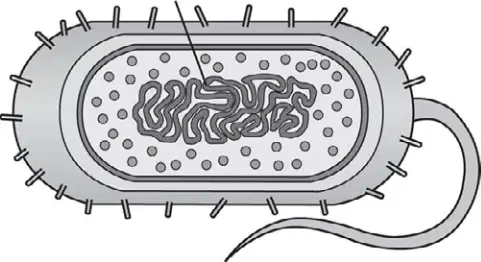
How does the part of the cell labeled A help Alice know that she is looking at a prokaryotic cell?
A is cytoplasm, which is only found in prokaryotic cells.
A is the cell membrane, which is only found in prokaryotic cells.
A is the nucleus, which is only found in prokaryotic cells.
A is DNA, which is not enclosed in a nucleus, as in prokaryotic cells.
What is the basic unit of life?
Atom
Cell
Tissue
Organ
Which organelle is known as the powerhouse of the cell?
Nucleus
Mitochondria
Ribosome
Golgi apparatus
How do plant cells differ from animal cells in terms of organelles?
Plant cells have mitochondria, animal cells do not
Plant cells have chloroplasts, animal cells do not
Plant cells have a nucleus, animal cells do not
Plant cells have ribosomes, animal cells do not
Explain why eukaryotic cells can be larger and more complex than prokaryotic cells.
Eukaryotic cells have a cell wall that provides structure
Eukaryotic cells have organelles that compartmentalize functions
Eukaryotic cells have a simpler structure
Eukaryotic cells have a smaller surface area
Describe how a light microscope is used to view a cell.
By using electron beams to magnify the cell
By using light and lenses to magnify the cell
By using sound waves to detect the cell
By using magnetic fields to visualize the cell
What is the primary function of the cell wall in plant cells?
To store nutrients
To provide structural support
To conduct photosynthesis
To transport proteins
Why is the cell membrane described as selectively permeable?
It allows all substances to pass through
It allows only water to pass through
It allows certain substances to pass while blocking others
It blocks all substances from passing through
Which organelle is responsible for breaking down and recycling cellular waste?
Ribosome
Lysosome
Mitochondria
Endoplasmic reticulum
Which of the following best describes the function of vacuoles in plant cells?
They produce energy for the cell
They store water, nutrients, and waste products
They conduct photosynthesis
They synthesize proteins

I make proteins for the cell. What am I?
ribosome
cell membrane
nucleus
chloroplast

What is this structure?
Mitochondria
Nucleus
Chloroplast
Vacuole


Which organelle is responsible for breaking down waste materials in the cell?
Chloroplast
Cell wall
Lysosome
Ribosome
What structure controls what enters and leaves both plant and animal cells?
Vacuole
Cell membrane
Nucleus
Cell wall
Which statement best describes a function of the mitochondria?
It stores genetic information.
It synthesizes proteins.
It provides structural support.
It produces energy for the cell.
Which organelle is responsible for controlling most activities in a cell?
Cell membrane
Vacuole
Chloroplast
Nucleus
What is the main function of the cell wall in plant cells?
To protect and support the cell
To transport proteins
To store genetic material
To produce energy
Which type of cell does NOT have a nucleus?
Plant cell
Prokaryotic cell
Animal cell
Eukaryotic cell
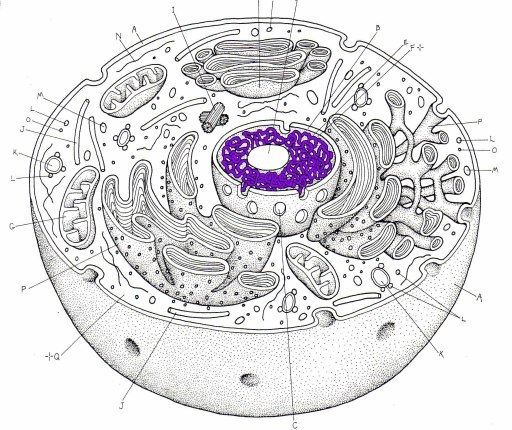


What type of cell is being shown in the image?
plant
animal


What organelle is represented by this image?
rough endoplasmic reticulum
smooth endoplasmic reticulum
ribosome
nucleus

What does letter h point to
mitochondria
nucleus
vacuole
cytoplasm
To focus a specimen, it is best to start with which objective?
high power
low power
scanning
ocular
When using the high power objective, you should not adjust the
coarse focus
fine focus
diaphragm
stage clips

What letter indicates the microscope's stage?
A
G
H
I

What letter indicates the microscope's objective?
F
G
H
I

What letter indicates the microscope's fine adjustment knob?
B
C
D
G

What letter indicates the microscope's base?
D
E
H
I

What letter indicates the microscope's stage clip?
B
C
G
H

What letter indicates the microscope's arm?
B
D
E
F

What letter indicates the microscope's eyepiece?
G
H
I
A


Which objective should be used to first find an image?
Low power
Medium power
High power
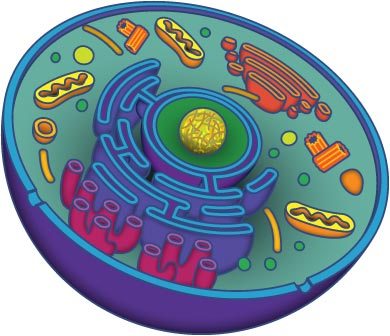

There are three parts to the cell theory. Which is NOT one of those parts?
All organisms are composed of one or more cells.
The cell is the basic unit of structure and organization in organisms.
Cells spontaneously arise from carbon and nutrients carried in the bloodstream.
All cells come from pre-existing cells.
Plants and animal cells are examples of ___ cells
prokaryotic cells
eukaryotic cells
both eukaryotic and prokaryotic
neither
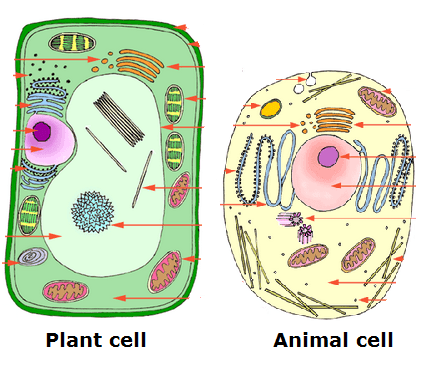
What distinguishes a plant cell from an animal cell? (How do you tell them apart) Hint: There's 3 ways (Check all 3)
Central Vacuole
Mitochondria
Cell Wall
Ribosomes
Chloroplasts

The 3 parts of the Cell Theory are...?
All living things are composed of cells
Cells are the basic units of structure and function in living things
All cells are produced from other cells
All living things are composed of cells
Cells are the basic units of dance and vibes in living things
All cells are destroyed from other aliens
All living things are composed of Jell-O
Cells are the basic units of structure and function in living things
All cells are produced from factories in Canada
All living things are composed of cells
Cells do karate and practice eating whole pies in their free time
All cells are produced from other cells

Cellular Respiration occurs within me and I am in BOTH plant and animal cells. I am a....
Nucleus
Golgi Body
Cytoskeleton
Mitochondria

Photosynthesis takes place within me. I am a...
Mitochondria
Cell Wall
Chlorine
Chloroplast

