
 Worksheets
G9 Review EASE 2
Total questions: 100
Worksheet time: 5hrs 4mins
There is a current of 3.0A in a resistor for time t.
During time t, a charge of 120C flows through the resistor.
What is time t ?
0.025 minutes
0.025 s
40 minutes
40 s
0.05 C
5.0 C
20 C
2.0 C
A charge of 48 C flows for 6s. What is the current?
8 A
288 A
8 V
288 V
The device used for measuring electric current is known as
Ammeter
Galvanometer
Voltmeter
Potentiometer
What is the current in a circuit with 6 ohms of resistance and a battery containing 24 Volts?
1/4 A
144 A
4 A
0.4 A
What is the resistance of a lightbulb that experiences 9 Volts and 3 amps of current?
1/3 ohms
3 ohms
27 ohms
9 ohms
What would happen if in a circuit the voltage is increase?
The time would increase
The current would increase
The current would decrease
The current would stay the same
If there is a current of 2A and a resistance of 24 ohms, what voltage will there be?
26 V
48 V
12 V
22 V

An alarm clock draws 0.5 A of current when connected to a 120 volt circuit. Calculate its resistance.
60Ω
120Ω
180Ω
240Ω
What is the energy given off by a 20V bulb which has 10C passing through it?
200J
2J
0.5J
250J
A 12 V battery does 1200 J of work transferring charge. How much charge is transferred?
14400C
100C
0.01C
1212C
There is a current of 3.0A in a resistor for time t.
During time t, a charge of 120C flows through the resistor.
What is time t ?
0.025 minutes
0.025 s
40 minutes
40 s
0.05 C
5.0 C
20 C
2.0 C
A charge of 48 C flows for 6s. What is the current?
8 A
288 A
8 V
288 V
Quantity of charge can be measured in
time (s)
Ampere (A)
coulombs (C)
Joule (J)
The device used for measuring electric current is known as
Ammeter
Galvanometer
Voltmeter
Potentiometer
What is the current in a circuit with 6 ohms of resistance and a battery containing 24 Volts?
1/4 A
144 A
4 A
0.4 A
What is the resistance of a lightbulb that experiences 9 Volts and 3 amps of current?
1/3 ohms
3 ohms
27 ohms
9 ohms
What would happen if in a circuit the voltage is increase?
The time would increase
The current would increase
The current would decrease
The current would stay the same
If there is a current of 2A and a resistance of 24 ohms, what voltage will there be?
26 V
48 V
12 V
22 V
If the voltage is increased and the resistance stays the same, what will current do?
An alarm clock draws 0.5 A of current when connected to a 120 volt circuit. Calculate its resistance.
60Ω
120Ω
180Ω
240Ω
How must a voltmeter be connected?
In series
In parallel
To a power supply
What is 1 volt equivalent to?
1J/C
1C/J
1A/s
1J/V

Which of these is not another name for voltage
Potential Difference
Electromotive Force
Flow of charge
What is the energy given off by a 20V bulb which has 10C passing through it?
200J
2J
0.5J
250J
When lighting happen,25 C charge is transferred from could to the ground and 1.25x10¹⁰ J energy is produced. Calculate the potential difference within cloud and the ground in unit Volt
4.00 x 10⁸
2.00 x 10⁸
3.00 x 10⁸
5.00 x 10⁸
Calculate the potential difference if the work done by 10 coulombs of charge is 50 joules
500 V
5 V
0.5 V
What is the correct equation?
potential difference = charge / time taken
potential difference = work done / charge
potential difference = work done / time taken
potential difference = time taken / charge
How much work is done in moving a charge of 3C across two points having a potential difference of 12 V.
4J
38 J
30 J
36 J
On connecting 5 electric cells, the e. m. f. of each one is 2.5volt in parallel the total e. m. f. of the new battery equal..... Volt
2.5
5
7.5
12.5

The batteries in the photo are
connected in series
connected in parallel
open
arranged together
How much work is done to transfer 0.15 C of charge through an electric potential difference of 9.0 V?
0.016V
1.35J
60J
1.35V
A 12 V battery does 1200 J of work transferring charge. How much charge is transferred?
14400C
100C
0.01C
1212C
A circuit consists of two 1.5 V cells in series. How much energy does 2 C
of charge gain on going through the cells?
0.75 J
6 J
3 J
0.67 J
A 3.0 Ω resistor and a 6.0 Ω resistor are connected in parallel.What is their combined resistance?
0.50Ω
2.0Ω
4.5Ω
9.0Ω

The circuit diagram shows a 4.0 Ω resistor and an 8.0 Ω resistor connected to a 6.0V battery. What is the current in the battery?
0.50A
0.75A
1.50A
2.00A

The circuit diagram shows a 4.0 Ω resistor and an 8.0 Ω resistor connected to a 6.0V battery.What is the current in the 8.0 Ωresistor?
0 A
0.50A
0.75A
1.0A
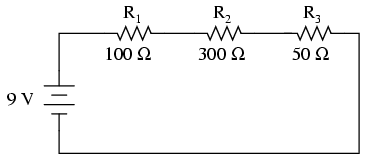

What is the effective resistance of this combination?
2 kΩ
1 kΩ
5 kΩ
500 Ω

What is the total resistance in this circuit?
501 Ω
501 kΩ
1.5 kΩ
1500 kΩ
A 9.0 Ω resistor and another 9.0 Ω resistor are connected in parallel. What is their combined resistance?
0.5 Ω
2.0 Ω
4.5 Ω
9.0 Ω
Which one of the following resistors connected in parallel with a 24 Ω would give a total resistance of 8 Ω
16 Ω
12 Ω
8 Ω
6 Ω

What is the equivalent or total resistance (Re) across this circuit?
3 kΩ
10 kΩ
13 kΩ
18 kΩ
Three resistors, with values of 2.0, 4.0 and 8.0 ohms, respectively, are connected in series. What is the overall resistance of this combination?
0.58 ohms
1.1 ohms
7.0 ohms
14.0 ohms
If a circuit has two resistors in series both are 4Ω, what is the total resistance of the circuit?
1Ω
2Ω
4Ω
8Ω
What is the unit of resistance
Ohm
Home
Amp
Camp

A strong electromagnet is used to attract pins.
What happens when the current in the coil is halved?
No pins are attracted.
Some pins are attracted, but not as many.
The same number of pins is attracted.
More pins are attracted.

The diagram shows a flat, rectangular coil placed between the poles of a magnet. THere is a current in the coil that makes it turn in the direction shown in the diagram. Which change would make the coil turn in the opposite direction?
decreasing the current in the coil
increasing the number of turns of the coil
reversing both the direction of the current in the coil and the poles of the magnet
reversing only the direction of the current in the coil

A
B
C
D

Using the right hand rule, B represents the direction of the
current
magnetic field
Using the right hand grip rule, A represents the direction of the
current
magnetic field


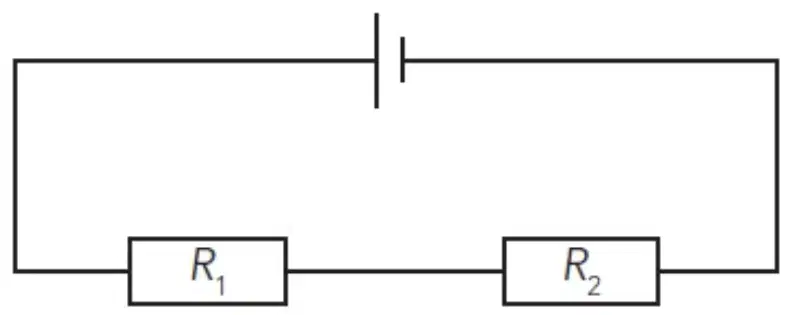
Two resistors R1 and R2 are connected in series. Resistor R1 has double the resistance of resistor R2. Four possible statements about this circuit are listed below. Which pair of statements is correct?
1. The voltage across R1 is twice that across R2.
2. The voltage across R2 is twice that across R1.
3. The current is the same in both resistors.
4. The current in R1 is twice the current in R2.
1 and 4
2 and 3
1 and 3
2 and 4
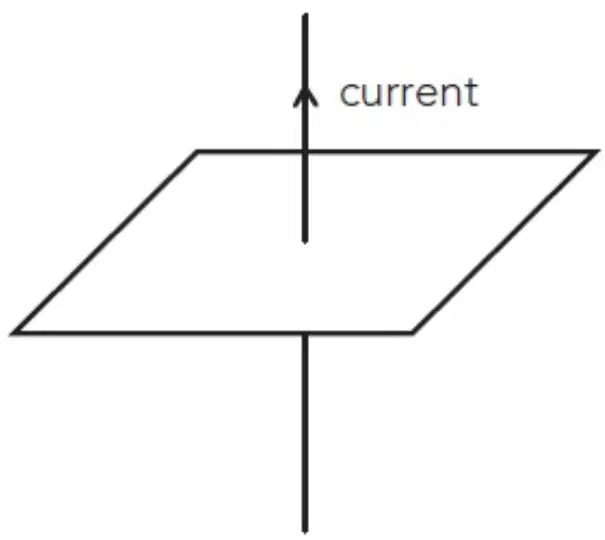
Current flows up a wire as shown in the diagram. What will the magnetic field look like?
straight lines from left to right
straight lines from right to left
clockwise circles
anticlockwise circles
Which of the following pairs of changes will both increase the strength of an electric motor?
Reversing the magnetic field and increasing the number of turns on the coil
Increasing the number of turns on the coil and reversing the direction of the current
Reversing the direction of the current and reversing the magnetic field
Using a more powerful magnet and increasing the number of turns on the coil


This is the symbol for a...
Light Dependent Resistor
Light Emitting Diode
Thermistor
Cell

This is the symbol for a...
Fuse
Wire
Light Emitting Diode
Heater

This is the symbol for a...
Fixed Resistor
Variable Resistor
Light Dependent Resistor
Fuse

