
Font size
S
M
L
XL
 Worksheets
CHEMISTRY-PART 1
Total questions: 55
Worksheet time: 41mins
Name
Class
Date
1.
The energy of movement is ___.
a)
Potential Energy
b)
Kinetic Energy
c)
Mechanical Energy
2.
The more energy that particles have, the ___ they move.
a)
slower
b)
faster
3.
The force of attraction between molecules is ___.
a)
intermolecular forces
b)
bridge forces
c)
chemical bonds
4.

These properties describe a ___.
a)
solid
b)
liquid
c)
gas
d)
plasma
5.
Collisions in which particles transfer all their kinetic energy to other particles are called ___.
a)
elastic
b)
inelastic
6.
Which one of these is NOT an Ideal Gas Assumption?
a)
Gas particles are hard, round spheres.
b)
Gas particles are strongly attracted to one another.
c)
Gas particles do not take up space.
d)
Gas particles collide perfectly elastically.
7.
The particles of ___ generally have the least amount of energy.
a)
solid
b)
liquid
c)
gas
d)
plasma
8.
Gas pressure is caused by ____.
a)
gas molecules colliding with surfaces
b)
gas molecules condensing to a liquid
c)
gas molecules hitting other gas molecule
d)
barometers
9.
A hypothetical gas that perfectly fits all the assumptions of the kinetic molecular theory is known as ____.
a)
real gas
b)
ideal gas
c)
perfect gas
d)
imaginary
10.
Which of the following is an assumption of the kinetic-molecular theory of gases?
a)
Collisions between gas particles are inelastic.
b)
Gases consist of closely spaced particles.
c)
Gas particles move around in an orderly manner.
d)
The temperature of a gas depends on the average kinetic energy of the gas particles.
11.
Which of the following is the equation needed to calculate the kinetic energy, KE, of a moving particle?
a)
KE = 1/2 mv2
b)
KE = 2mv
c)
KE = mv
d)
KE = 1/2 m2v
12.
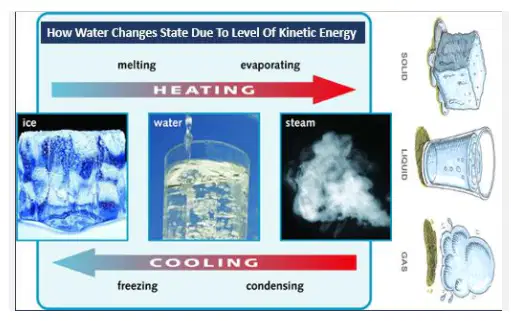
If you add heat, energy ____________, so atoms move faster.
a)
decreases
b)
increases
c)
stays the same
13.
What is the formula for Boyle's Law?
a)
P1V1=P2V2
b)
P1V1/P2V2
c)
P1V2=P2V1
d)
P1/V1=P2/V2
14.
When Pressure increases then the Volume must ____.
a)
increase
b)
decrease
15.
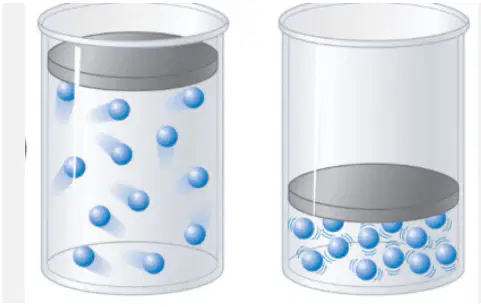
Which container will have a lower pressure?
a)
left
b)
right
c)
they both have the same pressure
d)
I don't know
16.
The relationship of which two variables are compared in Boyle's Law?
a)
pressure & volume
b)
volume & temperature
c)
temperature & pressure
d)
volume & moles (amount of gas)
17.

What causes pressure?
a)
The walls of the container
b)
The vacuum in the container
c)
The collisions of the particles
d)
Atmospheric pressure acting on the outside walls
18.
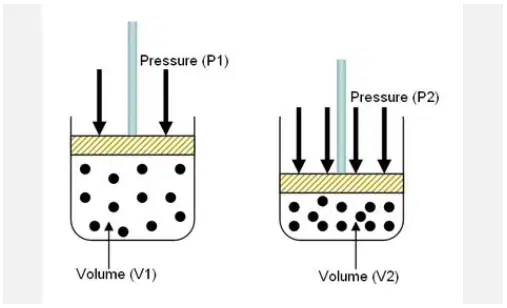
What happened to the volume between the two steps?
a)
volume increased
b)
volume decreased
c)
volume stayed the same
19.
Which two variables must be held constant for Boyle’s Law to apply?
a)
pressure & volume
b)
volume & temperature
c)
temperature & moles (amount of gas)
d)
volume & moles (amount of gas)
20.
What is the formula Charles' Law?
a)
V = T
b)
VT = VT
c)
T1 / V1 = T2 / V2
d)
V1 / T1 = V2 / T2
21.
Which measurement measures the amount of energy in a substance?
a)
Temperature
b)
Volume
c)
Pressure
d)
Mass
22.
Which measurement measures the amount of space a substance takes up?
a)
Temperature
b)
Volume
c)
Pressure
d)
Mass
23.
Which measurement can be identified by the unit K (Kelvin)?
a)
Temperature
b)
Volume
c)
Pressure
d)
Mass
24.
When the temperature of matter increases the particles...
a)
speed up and move closer
b)
speed up and move farther apart
c)
slow down and move closer together
d)
slow down and move farther apart
25.
According to Charles Law, the relationship between Temperature and Volume can best be described as....
a)
Direct Relationship
b)
Inverse Relationship
c)
Direct Square Relationship
d)
Inverse Square Relationship
26.
Charles's Law states that the Volume (V) of a gas is directly proportional to the temperature (T) provided the pressure (p) is kept _____.
a)
constant
b)
varied
c)
in motion
d)
rotational
27.
The following are real-life application of Charles Law except
a)
hot air balloon
b)
Tire
c)
Baking
d)
Running
28.
If the temperature of a gas is cut in half from 200K to 100K, what happens to the volume of the gas?
a)
Cuts in half
b)
Doubles
c)
Triples
d)
Stays the Same
29.
If the temperature of a gas is tripled from 100K to 300K, what happens to the volume of the gas?
a)
Cuts in half
b)
Doubles
c)
Triples
d)
Stays the Same
30.
According to Boyle's law, as the pressure exerted on a gas is increased, the volume will _______.
a)
increase
b)
decrease
c)
remains the same
d)
be doubled
31.
For a given sample of a gas, what must remain constant if Boyle's law is to be applied?
a)
pressure and volume
b)
temperature and amount of gas
c)
volume and amount of gas
d)
pressure and temperature
32.
Application of Charles’ Law can be seen as one flies in a hot air balloon, when heated, causes the air to expand; thus, becomes lighter and so it rises. Which of the following is another application of Charles’ Law?
a)
A flat tire takes up less volume than an inflated tire.
b)
An inflated balloon shrinks when placed inside the refrigerator.
c)
A helium-filled balloon weights much less than an identical balloon filled with air.
d)
A syringe plunger being pressed down to draw out the fluid causes the volume inside the syringe to decrease while increasing pressure inside.
33.
If the temperature remains constant while the volume of a given amount of gas is tripled, the pressure will be ______.
a)
9 times the original pressure
b)
3 times the original pressure
c)
6 times the original pressure
d)
1/3 of the original pressure
34.
Assuming that the temperature remains constant. Following Boyle's Law, how can you increase the pressure of a gas?
a)
Decrease the container volume
b)
Add more molecules of the gas
c)
Increases the container volume
d)
Heat the container
35.
To apply Charles' Law, which of the following needs to remain constant?
a)
pressure and volume
b)
temperature and the number amount of a gas
c)
temperature and volume
d)
pressure and the number of amount of a gas
36.
Which of the following statements correctly defines Boyle’s Law?
a)
As the temperature increases, volume decreases at constant pressure.
b)
As the pressure increases, volume decrease at constant temperature.
c)
As the temperature increases, volume increases at constant pressure.
d)
As the pressure increases, volume increases at constant temperature.
37.
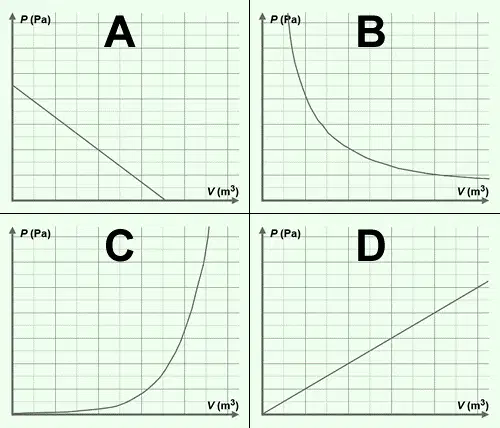
Which of the following graphs correctly represents the relationship between the pressure and the volume of an ideal gas that is held at constant temperature?
a)
Graph A
b)
Graph B
c)
Graph C
d)
Graph D
38.
A 120 mL of gas is measured at 650 Kelvin. If the pressure remains constant, what will be the volume of the gas at 1300 K?
a)
60 mL
b)
120 mL
c)
240 mL
d)
530 mL
39.
Which of the following phenomena best illustrates Charles’ Law?
a)
carbon dioxide being dissolved in water
b)
breathing apparatus being used by a patient
c)
leavening agent causing the fluffiness of cake products
d)
expansion of the balloon as it is being submerged in hot water
40.
A substance which speeds up a reaction without being used up in the decomposition of an aqueous solution of hydrogen peroxide (H2O2).
a)
catalyst
b)
heat
c)
manganese
d)
water
41.
A decomposition chemical reaction can be compared to ______.
a)
two dancing couples switching partners.
b)
a dancing couple breaking up.
c)
eight couples doing a square dance.
d)
two single people joining for dance.
42.

The reaction below is an example of
Mg(s) + 2HCl(aq) --> H2(g) + MgCl2(aq)
a)
combination reaction
b)
decomposition reaction
c)
single-replacement reaction.
d)
double replacement reaction.
43.

The reaction of
2KClO3(s) --> 2KCl(s) + 3O2(g) is a(n) _____.
a)
synthesis reaction.
b)
combustion reaction.
c)
decomposition reaction.
d)
combination reaction
44.

What are the products in the equation below
Zn + CuSO4-----> ZnSO4+ Cu
a)
Zn and Cu
b)
Zn and CuSO4
c)
ZnSO4 and Cu
d)
Zn only
45.
Gab wants to have a portable oxygen tank. A 6.00 liter oxygen gas exerts a pressure of 1.00 atmosphere. How much pressure is needed for this gas to be compressed in a 2.00 liter cylinder, provided there is no temperature change?
a)
1.5 atm
b)
2.0 atm
c)
2.5 atm
d)
3.0 atm
46.
The temperature of a fixed mass of gas in a rigid container is decreased from 400 K to 300 K. The initial pressure was 1000. mmHg. Which is closest to the new pressure, in mmHg, after cooling?
a)
250
b)
500
c)
750
d)
900
e)
1330
47.
Which of the following is the correct balanced reaction?
a)
Option 1
b)
Option 2
c)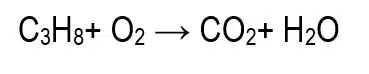
Option 3
d)
Option 4
48.
Quicklime ( CaO ) is used as a drying agent. When water is added to this, slaked lime Ca(OH)2 is formed. What type of reaction is this?
a)
combination
b)
decomposition
c)
single displacement
d)
double displacement
49.
In a reaction with hydrochloric acid, why does powdered magnesium reacts faster than the same mass of magnesium ribbon?
a)
The powdered magnesium is hotter than the magnesium ribbon.
b)
The powdered magnesium contains more atoms than the magnesium ribbon.
c)
The powdered magnesium has a bigger surface area than the magnesium ribbon
d)
The powdered magnesium has a smaller surface area than the magnesium ribbon.
50.
How do you balanced chemical equation?
a)
changing subscripts
b)
adding coefficient
c)
erasing elements as necessary
d)
adding elements as necessary
51.
The rate of reaction increases as the temperature increases. Which of the following statement provides the best explanation for this?
a)
At lower temperatures the particles do not collide with each other.
b)
At higher temperatures the particles have more energy, move faster, and collide more often.
c)
Higher temperature has higher activation energy.
d)
Increasing the temperature increases the number of particles, so they collide more often.
52.
Which of the following statements about collisions is correct?
a)
Reaction will occur even without collision of molecules.
b)
All colliding particles have the same amount of energy.
c)
Only fast-moving particles collide with each other.
d)
Reactions can happen if the colliding particles have enough energy.
53.

Analyze the diagram, what evidence shows that the reaction’s product is a gas?
a)
the gas is not soluble in water
b)
bubbles are forming and collected
c)
acids always produce gases when they react with a solid
d)
there is no filter funnel and paper to remove unreacted solid.
54.

Balance the equation
a)
3,1,2,1
b)
2,1,2,1
c)
1,2,3,4
d)
1,2,1,2
55.
A substance which speeds up a reaction without being used up in the decomposition of an aqueous solution of hydrogen peroxide (H2O2).
a)
catalyst
b)
heat
c)
manganese
d)
water
Reset

