
 Worksheets
Electrical Fault Finding 9
Total questions: 42
Worksheet time: 25mins
Which of the following correct regarding safe isolation and investigating an electrical fault?
Begin investigation, verify circuit is dead, isolate and lock off, re-check voltage device
Obtain permission, check voltage device, verify circuit is dead, isolate and lock off, re-check voltage device, begin investigation
Begin work, lock off, verify circuit is dead, re-check voltage device, begin investigation
Obtain permission, isolate and lock off, check voltage device, verify circuit is dead, re-check voltage device, begin investigation
The very first action involved in carrying out safe isolation to:
Test the circuit
Shut off, lock off then assess all hazards
Assess all hazards through a risk assessment
Carry out a full functional test.
When applying safe isolation protocols you:
Can work on live circuits
Can use the circuit identification as found
Need to correctly identification the circuit
Can use the mains to check test equipment.
The HSE recommends which of the following in order to embrace safety?
Approved volt stick
Equipment listed and endorsed by BS 7671
Equipment listed and endorsed by GS38
Approved neon screwdriver.
The legislation that prohibits live working except in exceptional circumstances is:
Provision and Use of Work Equipment Regulations (1992)
Personal Protective Equipment Regulations (1992)
BS 7671 Requirements for Electrical Installations
Electricity at Work Regulations (1989).
Whilst carrying out fault diagnosis, a serious issue had come to light. Your actions should be to:
Leave the circuit as it is and go and inform the client in a clear and courteous manner
Ensure the circuit is safe then go and inform the client in a clear and courteous manner
Complete the investigation and then inform the client in a clear and courteous manner
Carry on with the investigation and then inform the client when you see them next.
Keeping the customer abreast of development and any correction work in a clear, courteous and accurate manner:
Makes good business sense
Ensures that safety is maintained
Can boost your earnings
Justifies any extra expense.
Which of the following will physically reduce the possibility of interference from unauthorised personnel?
Barriers
Polite notices
Secure locked devices
Multiple number of keys
Notices can only be effective if:
They are well positioned
They inform management only
They are clear and accurate
They are popular.
When fault finding, which of the following apply to customer relations?
The electrician needs to be flexible and sensitive regarding when supply can be isolated
The electrician needs to be discourteous if they encounter a customer
The electrician does not have to worry about the impact of noise
The electrician does not have to worry about any damage incurred.
If an electrician informs a client of the need to isolate the supply:
There is no need for any more control measures
There is no further health and safety obligation required
It will remind the client of the importance of turning the supply back on
The implication and timing when supply is turned off can be discussed.
Which of the following has priority?
Establish the events that led up to the problem
Check if supply is present
Check if any protective devices have operated
Check rating of protective devices.
Isolating a power supply includes:
Switching off secondary supplies only
Switching off primary supplies only
Discharging only stored energy
Isolating and discharging all forms of energy.
The symptom of a high resistance joint could include:
Burning smell
Protective device operating
Collection of moisture
Corrosion.
High resistance joints (terminations) are associated with:
Unsheathed cables
Loose connection
Over-tightened connection
Damaged conductor.
Typical symptoms of excessive circuit current include:
An undersized conductor
Protective device operating
Melting of conductor insulation
An oversized conductor.
If the solenoid contacts of a relay become open circuit, what would happen when power was applied?
The relay would operate as advertised and pull in, but very quickly get hot
The relay would fail to operate
The relay would chatter
The relay would get hot.
If the contacts of relay were to be short circuited, what would happen when power was applied?
The relay would fail to operate
The relay would chatter
The relay would get hot
The relay would operate without being energized
Symptoms associated with a high resistance termination and excessive volt drop are:
Light appearing dim
Tripping of protective devices
Motors slow to operate
Cables becoming hot
Which of the following apply to IT equipment?
Static sensitive devices
Clean earths
Uninterruptable supply
Sensitivity regarding IR testing
Discovering moisture within an enclosure is symptomatic of issues in relation to:
Insulation resistance
Fault protection
Index protection
Basic protection
Discovering copper cable that has been terminated with an aluminium crimp will require the cable to be re-terminated or replaced. This is because of:
Dissimilar metal corrosion
Protective device will operate
Volt drop issues
Termination contact resistance will be low
One of the dangers of electricity in relation to testing and fault finding is that:
The supply may need to be dead
The supply may need to be live
Manufacturing may be affected
Heavy fines are possible
When conducting voltage measurements, which of the following will more likely stop inadvertent tripping of RCDs?
Equipment with a valid calibration
Approved equipment listed within GS38
Expensive equipment
Extremely sensitive equipment
When diagnosing faults, which of the following can aid diagnosis?
Questioning customers
Maintenance records
Previous test results
Manufacturer’s warranty.
Following replacement of a faulty piece of equipment, completion of this particular task would include:
Full functional test
Completion of job sheet
Replace any protective devices that operated
Full set of dead tests.
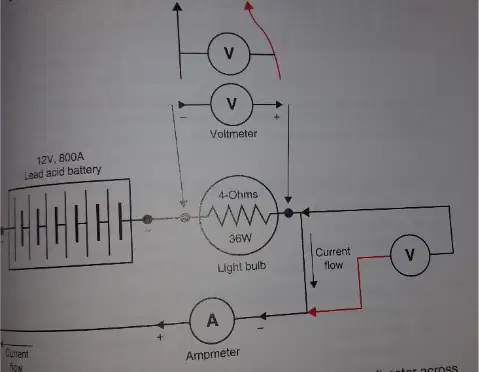
Looking at the circuit diagram below, if the voltmeter across the load measures 12V, what should the other voltmeters read?
0 V
12 V
36 V
6 V.
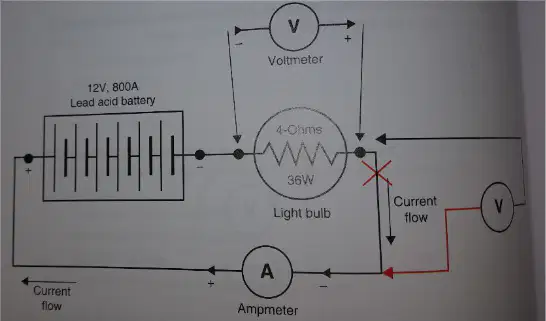
With an open circuit as shown in the diagram below, if the voltmeter across the load measures 12 V, what should the other voltmeters read?
0 V
12 V
36 V
6 V
A circuit breaker tripping is symptomatic of:
An open circuit
A short circuit
A high resistance
A faulty circuit breaker
Lights appearing dim is symptomatic of:
Excessive length of cable
A short circuit
A high resistance
Volt Drop Issues
Melting insulation is symptomatic of:
Excessive length of cable
A short circuit
High resistance
Undersized conductor
Excessive volt drop means that the voltage at the supply end:
Is less than voltage at the consumer load
Is more than the voltage at the consumer load
Is the same as the voltage at the consumer load
Is double the voltage at the consumer load
A burnt out relay is symptomatic of:
Excessive circuit volt drop
Excessive circuit resistance
Excessive circuit current
Incorrect rating
An electrical termination should:
Be accessible
Be mechanically sound
Be electrically sound
Be undersized if possible
If the circuit supplying the solenoid element of a heavy duty contactor becomes open circuit, which of the following would correctly match the symptom?
The contactor would energize but instantly drop out
The contactor would fail to energize
The contactor would energize but start to chatter
The contactor would work as normal but would soon overheat
If the normally open switch that supplies the solenoid element of a heavy duty contactor is shorted out, which of the following would correctly match the symptom?
The contactor would energize but instantly drop out
The contactor would fail to energize
The contactor would energize but start to chatter
The contactor would work as normal but would soon overheat
Which of the following tests can ascertain the serviceability of a solenoid?
Insulation resistance
Resistance measurement
Power rating measurement
Power factor measurement
Increased circuit resistance could be symptomatic of:
Undersized conductor
Oversized conductor
Corrosion
Stripped or damaged conductor strands
Which of the following would influence the decision if a replacement part is repaired or replaced?
Cost
Effect on production
Availability of replacement parts
Access
Which of the following is a major consideration of making good?
Colour
Cost
Non-flammable material
Soundproof
The correct procedure for disposing of fluorescent tubes is:
In black plastic bags having smashed them to bits
In cardboard boxes to protect against the glass shards
Through landfill
Using a hazardous waste management company
Keeping relevant people informed during fault correction work will:
Speed up fault correction
Keep everyone happy
Keep everyone safe
Bring about agreement on the best possible solution

