
 Worksheets
CIA#2 Practice
Total questions: 71
Worksheet time: 1hrs 15mins
The pH scale ranges from
0-14
1-100
7-14
0-10
On the pH scale, acids range from
0-13
8-10
8-14
0-7
On the pH scale, bases range from
0-3
6-10
8-14
0-7
A substance with a pH of 7 is considered ___
acidic
pH neutral
basic
alkaline
Acids contain ____ ions.
H+
H-
O-
O+
Bases contain ____ ions.
OH+
OH-
O-
O+
What color will litmus paper turn in an acid?
red
blue
What color will litmus paper turn in a base?
red
blue
A substance with a pH of 1 is a ____.
weak acid
weak base
strong acid
strong base
Which of the following is an acid?
HCL
NaOH
KCl
Ba(OH)2
Which of the following is a base?
HCL
NaOH
KCl
HBr

The table shows the pH of several solutions. Which solution is the most acidic?
vinegar
milk
water
bleach
Zn(OH)2 is an example of a...
acid
base
salt
water
H3PO4 is an example of a ...
acid
base
salt
non-electrolyte
Four substances were tested for pH, lemon juice (pH 2), baking soda (pH 9), bleach (pH 12), and milk (pH 6). Which of the following correctly lists the substances from most basic to acidic?
lemon juice, milk, baking soda, bleach
bleach, baking soda, milk, lemon juice
milk, lemon juice, baking soda, bleach
baking soda, bleach, lemon juice, milk
A sugar solution has a pH of 7. This means the sugar solution is:
acidic
basic
neutral
An unknown substance was tested and found to have an extremely high concentration of hydroxide ions, OH-. and very low concentration of hydronium ions, H3O+. Which pH would make the most sense?
pH = 2
pH = 6
pH = 8
pH = 12
The table shows the pH of several solutions. Which solution has the greatest concentration (amount) of H+ ions?
vinegar
milk
water
bleach
The table shows the pH of several solutions. Which solution has the greatest concentration (amount) of OH- ions?
vinegar
milk
water
bleach

When H+ concentration is greater than OH- concentration, the solution is
basic
neutral
acidic
alkaline
When OH- concentration is greater than H+ concentration, the solution is
basic
acidic
neutral
As the concentration of the hydrogen ion increases, the concentration of the hydroxide ion
remains the same
decreases
increase
As the H3O+ ion concentration of a solution increases, the pH of the solution
decreases
increases
remains the same
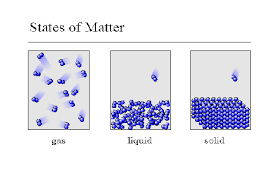
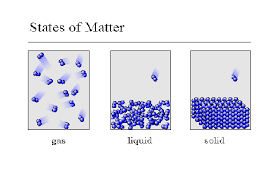
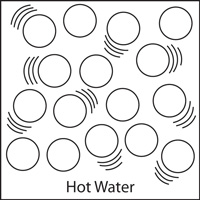
If a solid, liquid, and a gas are at the same temperature, which has the strongest attractions between its atoms?
Solid
Liquid
Gas
If the number of push ups I can do decreases as my age increases, the relationship between these variables is...
direct
inverse
exponential
linear
What creates gas pressure?
collisions of gas with eachother
reactions between particles
collisions of gas with the walls of the container
reactions between the intermolecular forces
A barometer is used to measure what?
temperature
distance
volume
pressure
If two particles have the same kinetic energy, their temperature is...
different
the same
higher in the second particle
higher in the first particle
solid to gas?
condensation
sublimation
deposition
vaporization
gas to solid?
condensation
sublimation
deposition
vaporization
Which statements are true accordingly to the kinetic molecular theory of matter? Please choose all that apply.
All matter is made of small particles
particles in matter are in constant, random motion
Particles in matter collide with each other and other objects
Only solids have particles
According to Boyle's Law, what would happen if the volume of a gas increased?
the pressure would decrease
the pressure would increase
Which law would best help to explain why a bag of chips would expand (increase in volume) at the top of a mountain with less atmospheric pressure?
Boyle's Law
Charles' Law
According to Charles' Law, would would happen if the temperature of a gas increased?
the volume of the gas would decrease
the volume of the gas would also increase
Which phase changes require the addition of heat?
sublimation
evaporation
deposition
melting
freezing
Which phase changes require the the particles move away from each other?
sublimation
evaporation
deposition
melting
freezing
Which phase changes require the the particles slow down?
sublimation
condensation
deposition
melting
freezing
What happens at absolute zero?
All Motions cease
everything turns to a solid
everything dies
who knows?

This graph represents which gas law ?
Grahams law
Avogadros law
Boyles Law
Charles Law

Which of the following graphs represents pressure versus volume (V) for a real gas at a constant temperature
A
B
C
D


What type of reaction is this?
4 Fe + 3 O2 --> 2 Fe2O3
Synthesis
Combustion
Single Replacement
Decomposition
Which of the following could be an indication that a chemical reaction has occurred?
SELECT ALL THAT APPLY!!!
Bubbles
Precipitate Formation
Change in Mass
Change in Shape
Change in Temperature
Which law states that Matter cannot be created or destroyed?
Law of Conservation of Matter
Law of Gravity
Law of Equivalent Exchange
Law of Matter ad Infinitum
What coefficient should be placed in front of Oxygen (O2) to balance this equation?
Al + O2 --> Al2O3
3
2
6
1

What type of reaction is this?
Pb(NO3)2 + 2KI --> 2KNO3 + PbI2
Double Replacement
Single Replacement
Synthesis
Decomposition

What type of reaction is this?
CH4 + 2O2 --> 2H2O + CO2
Combustion
Synthesis
Double Replacement
Single Replacement
Which coefficient should be placed in front of O2 to balance this equation?
C2H6 + O2 --> H2O + CO2
3.5
7
9
14
Which coefficient should be placed in front of Lithium to balance this equation?
AlCl3 + Li --> LiCl + Al
1
2
3
0.00000000000001
Which coefficient should be placed in front of NH3 to balance this equation?
NH3 + H2SO4 --> (NH4)2SO4
1
2
3
1,000,000,000
What does the symbol Δ represent?
Change in heat
Change in shape
Change in color
Change in attitude
What does the symbol (aq) stand for?
Aquatic
Aqueous
Aqua
Aquarium

What type of reaction is this?
2Na + 2H2O --> 2NaOH + H2
Single Replacement
Double Replacement
Synthesis
Decomposition

What type of reaction is this?
2NaHCO3 --> Na2CO3 + H2O + CO2
Single Replacement
Combustion
Decomposition
Synthesis

Which of the following describes the basic structure of single replacement reactions?
A + B --> C
A + B --> AB
A + BC --> AC + B
AB + CD --> AD + CB
Which of the following is an example of a PHYSICAL change?
Neutralizing vinegar with baking soda
Breaking your iPad with a rock due to school stress
Creating a precipitate by mixing Lead Nitrate and Sodium Iodide
Burning popcorn in the microwave
Which of the following is an example of a CHEMICAL change?
Shattering a window with a baseball
Ripping paper into 1,000,000,000 tiny pieces
Rusting an iron bar on a humid day
Melting a block of copper metal

