wayground logo

Free Printable Worksheets

Font size

S
M
L
XL
Worksheets

Unit 2 Review

Total questions: 86

Worksheet time: 1hrs 25mins
Name
Class
Date
1.
Why does ice float?
a)
Liquid water is less dense than solid water.
b)
Solid water is less dense than liquid water.
c)
Gaseous water is less dense than solid water.
d)
Liquid water is less dense than gaseous water.
2.
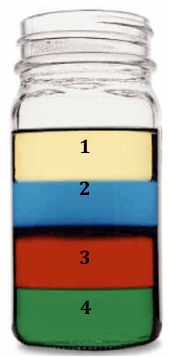
Put the liquids in order from most dense to least dense?
a)
4, 3, 2, 1
b)
1, 2, 3, 4
c)
3, 4, 2, 1, 
d)
4, 3, 1, 2
3.
What is the formula for density?
a)
density = mass x volume
b)
density = mass / volume
c)
density = mass + volume
d)
density = mass - volume
4.
Frank has an eraser. It has a mass of 4g, and a volume of 2cm3. What is its density?
a)
8 g/cm3
b)
2 g/cm3
c)
1/2 g/cm3
d)
24 g/cm3
5.
Jack has a rock. The rock has a mass of 14g and a volume of 2cm3. What is the density of the rock?
a)
7 mL
b)
7 g/cm3
c)
28 g/cm3
d)
1/7 g/cm3
6.
Why do some substances float on water?
a)
they are warmer than water
b)
they are cooler than water
c)
they are more dense than water
d)
they are less dense than water
7.
Helium balloons rise on earth because
a)
helium is less dense than air
b)
helium is more dense than air
c)
helium is cooler than air
d)
helium is warmer than air
8.
What is the measuring unit for mass?
a)
centimeter 
b)
millimeter 
c)
grams 
d)
pounds
9.
Which units of measurement are used for volume?
a)
grams
b)
centimeters
c)
grams/milliliter
d)
milliliter
10.
What units are used to measure Density?
a)
cm3/g
b)
g
c)
g/cm3
d)
cm3
11.
A crayon has a mass of 10g and volume of 5 mL. What is the density?
a)
30 g/mL
b)
15 g/mL
c)
1 g/mL
d)
2 g/mL
12.
What is this tool to get volume?
a)
triple beam balance
b)
ruler
c)
thermometer
d)
graduate cylinder
13.
What is this tool to get mass?
a)
triple beam balance
b)
ruler
c)
thermometer
d)
graduate cylinder
14.
Frank has an eraser. It has a mass of 4 g, and a volume of 2 cm3. What is its density?
a)
8 g/cm3
b)
2 g/cm3
c)
1/2 g/cm3
d)
24 g/cm3
15.
An object with which of the following densities will float on water?
a)
0.7 g/cm3
b)
1.2 g/cm3
c)
3.5 g/cm3
d)
11.4 g/cm3
16.
Which state of matter has a definite shape?
a)
solid
b)
liquid 
c)
gas
d)
plasma
17.
Which state of matter take up ALL the space inside a container? 
a)
solid
b)
liquid
c)
gas
d)
all of the above
18.
The drops of water that appear on the outside of a glass of cold juice on a warm day are an example of?
a)
Sublimation: A solid turning into a gas.
b)
Condensation: A gas changing to a liquid.
c)
Evaporation: A liquid changing to a gas.
d)
Deposition: A gas changing to a solid.
19.
Freezing point and melting point are the same temperature.
a)
True
b)
False
c)
It depends on the substance
20.
A substance that has a definite shape and volume.
a)
evaporation
b)
gas
c)
liquid
d)
solid
21.
What happens to particles when they are heated?
a)
They speed up and spread out
b)
They slow down and compress
c)
They stop moving
d)
They move closer together and speed up
22.
All changes in the state of matter of a substance requires a change in
a)
vibration
b)
water
c)
permission
d)
energy
23.
At higher temperatures
a)
particles in an object have less energy
b)
particles in an object move faster
c)
a gas contracts
24.
Boiling is the term we use to describe which phase change?
a)
Solid to a liquid
b)
Solid to a gas
c)
Gas to a liquid
d)
Liquid to a gas
25.
Change from gas to liquid...
a)
condensation
b)
evaporation
c)
expansion
d)
movement
26.
Change from Liquid to Solid is called......
a)
fusion
b)
Freezing
c)
sublimation
d)
evaporation
27.
Change from liquid to gas is called....
a)
expansion
b)
vaporization
c)
condensation
d)
sublimation
28.
All phase changes in the state of matter of a substance requires a change in
a)
vibration
b)
water
c)
permission
d)
energy
29.
When a substance changes from a gas to a liquid it is called
a)
Evaporation
b)
Condensation
c)
Freezing
d)
Melting
30.
The main difference between amorphous and crystalline solids is:
a)
One has definite shape, the other has definite volume.
b)
One has a pattern, the other does not.
c)
A crystalline solid example is glass.
d)
An amorphous solid example is sugar.
31.
When you freeze water, it turns to ice.  What kind of change is this?
a)
 Physical
b)
Chemical
32.
After you mix two substances together, a new substance forms.  This is an example of:
 
a)
 Physical Change
b)
 Chemical Change
33.
Particles move quickest
a)
solid
b)
liquid
c)
gas
d)
solid, liquid and gas
34.
Particles slide past each other
a)
solid
b)
liquid
c)
gas
d)
solid, liquid and gas
35.
Definite shape and definite volume
a)
solid
b)
liquid
c)
gas
d)
solid, liquid and gas
36.
What does this picture represent? 
a)
solid
b)
liquid
c)
gas
d)
plasma
37.
What does this picture represent? 
a)
solid
b)
liquid 
c)
gas
d)
plasma
38.
Which of the following is not true about gases?
a)
They spread out to fill their containers
b)
They have a low density. 
c)
The particles move very slowly. 
d)
The volume changes with whatever shape the room is. 
39.
Which state of matter do the particles in this picture represent?
a)
solid
b)
liquid
c)
gas
d)
plasma
40.
Which of the phases have particles that have a fixed volume but not a fixed shape? 
a)
solid
b)
liquid
c)
gas
d)
plasma
41.
a skin-like surface on a drop of water
a)
Dome
b)
Conserve
c)
Surface Tension
d)
Gas
42.
when water is cold, but not frozen, it will move closer together
a)
Expand
b)
Contract
c)
Liquid
d)
Absorb
43.
What is a change in the state of matter. For example, a solid goes to a liquid or gas, liquid to a gas or solid, or gas to a solid or liquid.
a)
phase change
b)
physical properties
c)
state of matter
d)
mixture
44.
Which type of vaporization happens from the surface?
a)
Vaporization
b)
Boiling
c)
Evaporation
d)
Sublimation
45.
Condensation is the change of state from _______ to ______ as a result of losing heat energy.
a)
Solid, Liquid
b)
Solid, Gas
c)
Liquid, Gas
d)
Gas, Liquid
46.
What is the change from a Solid to a Gas due to the gaining of energy?
a)
Condensation
b)
Vaporization
c)
Sublimation
d)
Deposition
47.
When objects absorb heat, the particles...
a)
gain energy and vibrate at fixed position.
b)
gain energy and increase in size.
c)
gain energy and move slower.
d)
gain energy and move faster.
48.
What is viscosity?
a)
A liquid's resistance to flow.
b)
a liquids flow.
c)
a liquid
d)
gas to solid.
49.

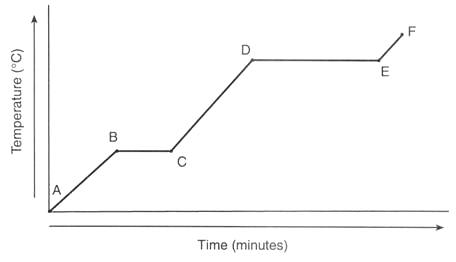
What line segment represents only the solid state? (Diagram F)

a)

A-B

b)

B-C

c)

C-D

d)

D-E

50.

Between which points is the temperature of the substance remaining constant? (Diagram F)

a)

A-B only.

b)

A-B, C-D, E-F

c)

B-C only.

d)

B-C, D-E

51.

A substance's heating curve is shown in the graph. What is its boiling point? (Diagram B)

a)

100 C

b)

60 C

c)

80 C

d)

20 C

52.

Is the substance gaining or losing energy? (Diagram D)

a)

Gaining

b)

Losing

53.

What phase change is occurring at line segment B-C if the graph is exothermic? (Diagram E)

a)

melting

b)

freezing

c)

boiling

d)

condensation

54.

Which line segment demonstrates vaporization occurring? (Diagram E)

a)

B-C

b)

C-D

c)

D-E

d)

E-F

55.
What happens when thermal energy is taken away from particles?
a)
They move faster and farther apart
b)
They move slower and closer together
56.
During a phase change, the temperature
a)
increases
b)
decreases
c)
fluctuates
d)
stays the same
57.

An ice cube feels cold when we hold it. Which of the following best explains why?

a)

Heat moves from our hands into the ice cube.

b)

Cold moves from our hands into the ice cube.

c)

Heat moves from the ice cube into our hands.

d)

Cold moves from the ice cube into our hands.

58.
Which process does the diagram show?
a)
freezing
b)
boiling
c)
evaporation
d)
melting
59.

Hot things have ____________ thermal energy than cold things

a)

more

b)

less

c)

same

d)

potato

60.

Cold things often have a _________ kinetic energy because_______

a)

lower; particles are moving around less

b)

lower; particles are moving around more

c)

higher; particles are moving around the same

d)

higher; particles do not move

61.

As temperature increases, molecules _____________

a)

move slower

b)

move the same

c)

move faster

d)

stop moving

62.

What happens to the particles of a substance as it changes from a solid to a liquid?

a)

They move closer together

b)

They move farther apart

c)

Their mass increases

d)

Their mass decreases

63.

Explain why gases are compressible while solids and liquids are not.

a)

Gases have high density

b)

Gases have weak intermolecular forces

c)

Gases have strong intermolecular forces

d)

Gases have low kinetic energy

64.
Which of the following below is a chemical property? 
a)
Color
b)
Density
c)
Boiling Point
d)
Reactivity with Acid
65.
Which of the following situations is evidence of chemical change? 
a)
Boiling water produces steam
b)
Adding vinegar to baking soda makes foaming bubbles
c)
Sharpening a pencil
d)
Cutting paper
66.
The fact that sugar can be white is a 
a)
Chemical Property 
b)
Physical Property 
c)
Both A and B
d)
None of the above 
67.
Flammability is a 
a)
Chemical Property 
b)
Physical Property 
c)
Both A and B
d)
None of the above 
68.
Iron's ability to rust when exposed to air is a 
a)
Chemical Property 
b)
Physical Property 
c)
Both A and B
d)
None of the above 
69.
Density is a 
a)
Chemical Property 
b)
Physical Property 
c)
Both A and B
d)
None of the above
70.
Which one of the following is NOT a physical property of paper? 
a)
It is solid
b)
It is white
c)
It is flammable
d)
It is smooth
71.
An antacids (TUMS) ability to change pH in your stomach is an example of a 
a)
Chemical Property 
b)
Physical Property 
c)
Both A and B 
d)
None of the above 
72.
After blowing out the flame on the candle, James noticed the wick changed from white to black, this is a
a)
Physical Property
b)
Physical Change
c)
Chemical Property 
d)
Chemical Change 
73.
The candle has a texture that is soft enough to scrape with a fingernail, this is a 
a)
Physical Property 
b)
Physical Change
c)
Chemical Property 
d)
Chemical Change 
74.
The mass of the candle is 2.12 grams, this is a 
a)
Physical Property 
b)
Physical Change
c)
Chemical Property 
d)
Chemical Change 
75.
The candle wick started to smoke after it was lit, this is a 
a)
Physical Property 
b)
Physical Change
c)
Chemical Property 
d)
Chemical Change 
76.
Which example represents a chemical change occurring? 
a)
A blue bike is painted pink
b)
Sand paper is used to smooth wood
c)
When the two chemicals inside an ice pack are mixed it becomes cold 
d)
Paper is ripped into smaller pieces 
77.
In a chemical change
a)
Bonds are not broken
b)
A new substance is formed and bonds are rearranged 
c)
No new substances are formed 
d)
None of the above 
78.
Sodium is a soft, white metal that reacts violently with water. Chlorine is a poisonous yellow-green gas. During the chemical reaction between sodium and chlorine, table salt is produced. Which of the following statements correctly compares and contrasts the reactants with the resulting products? 
a)
The reactants are dangerous and the product can be eaten 
b)
The reactants and the products are identical 
c)
The reactants are a solid and a gas and the product is a gas
d)
The reactants and the products are the same color 
79.
During a chemical reaction the chemical properties of the new substance 
a)
Are the same as the chemical properties of the original substance 
b)
Are different from the chemical properties of the original substance 
c)
All of the above
d)
None of the above 
80.
While burning, sugar changed from a white solid substance to a brown liquid substance. What occurred? 
a)
No new reactants were formed
b)
The products combined to form a new reactant
c)
The bonds of the reactants were broken and rearranged into a new product 
d)
The reactants were the same as the product 
81.
Which of the following would be the BEST scientific question to ask after the teacher burned the sugar? 
a)
What time is class over?
b)
Can we do this experiment again? 
c)
Did a chemical change occur? 
d)
Is sugar an element? 
82.
Which of the following is a physical property of vinegar (acetic acid)? 
a)
The liquid is dark and cloudy
b)
The powder is blue
c)
The white powder can rust 
d)
The liquid is clear and has a strong odor
83.
Which of the following is a chemical property of vinegar? 
a)
Vinegar is flammable
b)
Vinegar has the ability to rust 
c)
Vinegar is white
d)
Vinegar has a low pH and can react with a base 
84.

What is the process called when a liquid turns into a solid?

a)

Freezing

b)

Melting

c)

Condensation

d)

Evaporation

85.

Which state of matter has particles that are tightly packed and only vibrate in place?

a)

Liquid

b)

Plasma

c)

Solid

d)

Gas

86.

What happens to the particles of a substance when it is heated?

a)

They lose energy and move slower.

b)

They lose energy and vibrate in place.

c)

They gain energy and move faster.

d)

They gain energy and move closer together.