
Font size
 Worksheets
Biology Practice 2024
Total questions: 60
Worksheet time: 1hrs 5mins


What would happen to a cell placed in a hypertonic solution
The cell would shrink
The cell would expand and possibly burst
The cell would remain the same
The cell would dance and do the Nay Nay!
Fill in the blank:
Osmosis is the movement of ________ across a cell membrane from high to low.
Carbon dioxide
Starch
Water
Oxygen
In an isotonic solution which way will the water flow
it will not flow at all
it will flow into the cell
it will flow both ways at equal rates
out of the cell
A solution outside of a cell that contains a higher water concentration than the cytoplasm of a cell is called:
solution
hypertonic
hypotonic
isotonic
Which of the following is an example of osmosis?
Water moving from a less concentrated solution to a more concentrated solution through a cell membrane
Water moving from a less concentrated solution to a more concentrated solution through diffusion
Water moving from a less concentrated solution to a more concentrated solution through active transport
Water moving from a more concentrated solution to a less concentrated solution through a cell membrane
What happens to a red blood cell when placed in a hypertonic solution?
It expands and undergoes lysis.
It remains unchanged.
It shrinks and undergoes crenation.
It becomes more rigid and loses its flexibility.

The solution surrounding the cell in Diagram B, would be defined as:
hypertonic
hypotonic
isotonic

Movement of SOLUTE through the cell membrane from high to low concentration is called.....
diffusion
active transport
facilitated diffusion
osmosis
Movement toward a stimulus
hydrotropism
positive tropism
dormancy
stimulus
Movement away from a stimulus
geotropism
hydrotropism
stimulus
negative tropism
A plant's response to any stimulus
dormancy
tropism
hibernation
pollination
A plant's response to touch
thigmotropism
geotropism
hydrotropism
dormancy
Water, light, ,earth, and touch are examples of
dormancy
tropisms
stimulus
hibernation
The movement of roots toward the ground or the movement of stems away from the ground
hydrotropism
geotropism
thigmotropism
phototropism

The diagram shows a plant growing while lying on its side. How is the plant reacting positively and negatively to gravity?
the root are reacting negatively by growing downward while the stem and leaves are reacting positively by growing upward
the root are reacting positively by growing downward while the stem and leaves are reacting negatively by growing upward
only the roots are reacting by growing downward
only the leaves and stem are reacting by growing upward
Which change would most likely cause a plant to enter dormancy?
increasing temperature
decreasing temperature
increasing the amount of ight
tipping the plant over onto its side

The diagram shows a plant growing near a window. How can the plant's reaction best be described?
as condensation
as transpiration
as dormancy
as tropism
(a) is the chemical process plants, some algae, and bacteria go through to produce Glucose and Oxygen
A plants response to gravitational force is -
Geotropsim
Thigmotropsim
Hydrotropism
Phototropism
What is tropism?
A plant's response to a stimulus
A plant reproducing
An animal's response to a stimulus
A prokaryote's response to a stimulus
What is gravitropism/geotropism?
The movement of a plant in response to gravity
The movement of a plant in response to earthquakes
The movement of bacteria in response to changes in temperature
The movement of plants towards water
What is phototropism?
The movement of plants towards light
The movement of plants away from light
The movement of plants in response to infrared light
The movement of plants towards water


This plant was tipped on its side, it's roots continue to grow downward, and its stem up. This response to gravity is known as (a) .

This plant is showing the turning or bending of a plant or other organism in response to a touch stimulus. It is known as _________________.
phototropism
thigmotropism
gravitropism
hydrotropism

This plant closes when it feels an insect land on it. This could be considered ____________.
thigmotropism
hydrotropism
gravitropism
phototropism
What is a stimulus?
A response to water
The movement of plants towards or away a stimulus
An event that causes a response or reaction
Choose the TWO other resources that plants need in order to do photosynthesis besides the radiant energy absorbed from the sun.
Carbon Dioxide and Glucose
Glucose and Water
Water and Carbon Dioxide
Sunlight and Oxygen
What is tropism?
A plant's response to a stimulus
A plant reproducing
An animal's response to a stimulus
A prokaryote's response to a stimulus
What is thigmotropism?
The movement of plants in response to touch
The movement of plants toward the sun
A prokaryote's movement inside the bloodstream
The movement of plants in response to gravity

The roots in this plant are exhibiting (showing)
Hydrotropism & Geotropism
Photoropism
Only geotropism
Thigmotropism & Phototropism
What does Negative Tropism mean?
Not growing at all
Growth toward the stimulus
Growth away from the stimulus

Where do plants get the energy for photosynthesis to take place?
nutrients in the soil
the sun
chlorophyll
bee pollination
What two things are the product (end result) of photosynthesis?
Oxygen
Glucose
Chloroplasts
Carbon Dioxide
Where do the stem and leaves get their green color from?
glucose
carbon dioxide
oxygen
Chlorophyll
Carries water and inorganic ions from root upward
Xylem
Phloem
Cortex
Epidermis
Carries photosynthetic products either upward or downward in the plant
Xylem
Phloem
Cortex
Epidermis
Continuous layer on the outside of the plant
Xylem
Phloem
Cortex
Epidermis
Found in leaves and allows for entry of carbon dioxide
Cuticle
Stomata
Spongy mesophyll
Palisade mesophyll
__________is the flow of water into a root hair cell, up the xylem vessels and evaporation out of the leaves.
Transpiration
Osmosis
Active transport
Respiration
Plants exchange oxygen and carbon dioxide through pores in the leaves called ______.
chloroplast
phloem
stomata
xylem
Plants release oxygen into the atmosphere during ______.
cell respiration
photosynthesis
both of these
neither of these
Plants take in ________ through the leaves in order to undergo photosynthesis.
carbon dioxide
oxygen
glucose
water
Plants transport oxygen and carbon dioxide through the process of _________.
active transport
diffusion
facilitated diffusion
osmosis
The process of osmosis is best illustrated by the movement of _______.
water into root hair cells
oxygen into red blood cells
carbon dioxide through stomata
glucose through phloem
The concentration of water is higher in the soil than in the plant cells. Water moves into the root cells of a plant by ______.
Active Transport
Diffusion
Osmosis

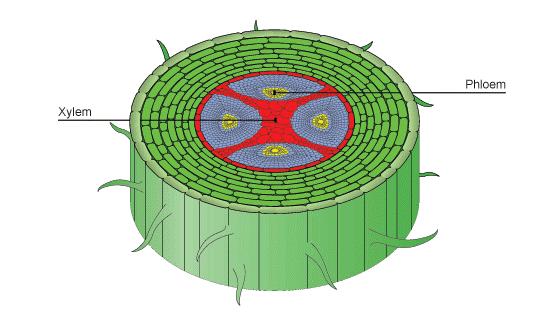
Xylem and Phloem are both __.
Transpiration
Absorption
Photosynthesis
Vascular tissue

Which tissue type is phloem?
A
B
C
D

