
 Worksheets
Review 1 - Physics Finals
Total questions: 50
Worksheet time: 2hrs 43mins
When a book rests on a table, consider one force to be the gravitational pull of the earth on the book. What is the 3rd Law pair to this force?
The normal force exerted by the table on the book
The gravitational pull of the book on the earth
The weight of the book
None of these
A 50-kg object is sliding on a frictionless surface at 6.0 m/s. What is the magnitude of the net force required to stop the object in 10 seconds?
3.0 N
6.0 N
30 N
50 N
A 10 kg object is moving with a velocity of 5 m/s. What is its kinetic energy?
50 J
125 J
250 J
25 J
Two resistors, 4 ohms and 6 ohms, are connected in series. What is the total resistance of the circuit?
24 ohms
10 ohms
5 ohms
2.4 ohms
A car accelerates uniformly from rest to a speed of 20 m/s in 5 seconds. What is the acceleration of the car?
5 m/s²
4 m/s²
10 m/s²
2 m/s²
A 5 kg object is moving with a velocity of 10 m/s. What is its momentum?
50 kg·m/s
5 kg·m/s
10 kg·m/s
100 kg·m/s
A 10 kg object is initially at rest on a frictionless surface. A constant force of 20 N is applied to the object. What is the velocity of the object after 4 seconds?
8 m/s
2 m/s
12 m/s
4 m/s
A 5 kg ball is dropped from a height of 10 meters. Assuming no air resistance, what is the speed of the ball just before it hits the ground?
10 m/s
14 m/s
20 m/s
28 m/s
A 5 kg object is moving in a circular path with a radius of 2 meters at a constant speed of 3 m/s. What is the centripetal force acting on the object?
22.5 N
30 N
15 N
45 N
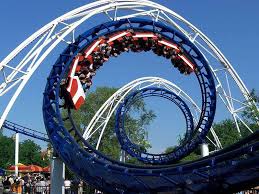
A roller coasters accelerates from an initial velocity of 6.0 m/s to a final velocity of 70 m/s over 4 seconds. What's the acceleration?
24 m/s2
18 m/s2
16 m/s2
16 m/s

Calculate the distance travelled in section B.
(a)

What is the force of friction of an object that has a normal force acting on it of 50N and a coefficient of friction between the object and the surface of 0.1?
5 N
10 N
50 N
500 N

Which is NOT a way to increase force between two charged objects?
Increase the charge of one of the objects
Bring the objects closer together
Make one of the objects bigger
Increase the charge of both the objects

A proton and electron are 1 x 10-13 m apart. What is the force of attraction between them?
-2.57 x 1026 N
-0.0231 N
-2.31 x 10⁻¹⁵ N
-231 N

Since the electric field lines are pointing away from the charged particle it must be...
positive
negative
neutral
none of the above
Which of the following diagrams should have the strongest electric field surrounding the charged particle?


none of the above
What happens to the gravitational force between two objects if the mass of one object is doubled?
The gravitational force between the two objects will decrease by a factor of 4.
The gravitational force between the two objects will double.
The gravitational force between the two objects will remain the same.
The gravitational force between the two objects will halve.
What is the gravitational force between two identical 50,000 kg asteroids whose centers of mass are separated by 1000 m?
2500 N
1.67 x 10⁻⁴ N
1.67 x 10⁻⁴ N
1.67 x 10⁻⁷ N
A 25.0 m object is placed 30.0 m from a convex lens, which has a focal length of 5.0 m. What is the distance of the image?
6 m
7 m
8 m
9 m

Light waves bending through a prism is an example of:
Reflection
Refraction
Absorption
Which of the following has the greatest momentum?
A .003 kg snail falling off a leaf at 10 m/s
A 1500 kg car moving at 0 m/s
A 5 kg baby crawling at the speed 0.71 m/s
a 0.006 kg pencil rolling off a table at 5 m/s
To break an egg it must receive 25 N of force, what is the minimum time interval needed to stop the egg if the egg weighs 0.08 kg and is moving at 5 m/s as it hits the ground?
1.0 s
0.016
0.05 s
0.15 s
What is the impulse that a 5kg cat feels after it falls from the height of 36 meters to rest?
175 N*s
133 N*s
122 N*s
146 N*s
The ability to do work is called
energy
force
power
machine
You pick up a 3.8 kg can of paint from the ground and lift it to a height of 1.4 m. You hold the can stationary for half a minute, waiting for a friend on a ladder to take it. How much work do you do during this time (when the can of paint was stationary)?
52 J
30 J
0 J
25 J
Two objects, one of mass m and the other of mass 2m, are dropped from the top of a building. If there is no air resistance, when they hit the ground _______.
the heavier one will have half the kinetic energy of the lighter one
the heavier one will have twice the kinetic energy of the lighter one
the heavier one will have one-fourth the kinetic energy of the lighter one
the heavier one will have four times the kinetic energy of the lighter one
A marble falls to the earth without air resistance. In a graph of the value of its acceleration (y) as a function of its time (x) the graph would look most like:


The graph represents the motion of a car during a 6-second time interval. What is the acceleration of the car at t = 5.0 seconds?
0.0 m/s2
2.0 m/s2
2.5 m/s2
10 m/s2

The graph shows the relationship between the speed and elapsed time for an object falling freely from rest near the surface of a planet. What is the total distance the object falls during the first 3 seconds?
12 m
24 m
44 m
72 m

The graph shows the relationship between speed and elapsed time for a car moving in a straight line. Determine the magnitude of the acceleration of the car.
15 m/s2
1.25 m/s2
1.33 m/s2
90 m/s2

A particle accelerates from rest at a uniform rate of 55 m/s2 for a distance of 3 meters. How fast is the particle going at the 3 meter mark?
34.64 m/s
11.55 m/s
18.17 m/s
0.33 m/s
330 m/s
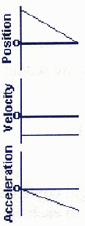
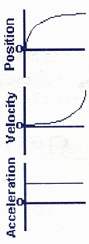
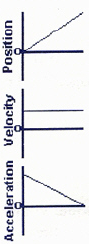
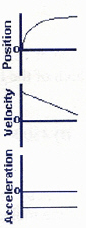
Which of the following sets of graphs might be the corresponding graphs of Position, Velocity, and Acceleration vs. Time for a moving particle?
An object is moving in a circle with constant speed. Which of the following is/are true?
I. The object has constant velocity
II. The object has nonzero acceleration
III. After one revolution, the magnitude of the displacement is a positive value.
I only
II only
III only
I and II only
II and III only

Given the FBD, which of the following must be true?
The frictional force must be accelerating the system to the left.
The box must be accelerating to the right.
The box must be moving to the right.
The FBD is incorrectly drawn. This situation isn't possible
Which statement illustrates Newton's First Law?
A stone will not move unless something pushes or pulls it.
A ball rolling across the floor eventually slows down.
As a car comes to a stop, the passengers continue to move forward.
All of the above
Calculate the gravitational force between two objects when they are 0.750m apart. Each object has a mass of 5.00kg.
2.96x10⁻⁷N
3.00x10⁻⁹N
2.22x10⁻⁹N
2.23x10⁻⁸N
What would the force between them be if the distance between them were doubled?


What is the net power needed to change the speed of a 1600 kg sport utility vehicle from 15.0 m/s to 40.0 m/s in 4.00 seconds?
300,000 W
275,000 W
125,000 W
140,000 W
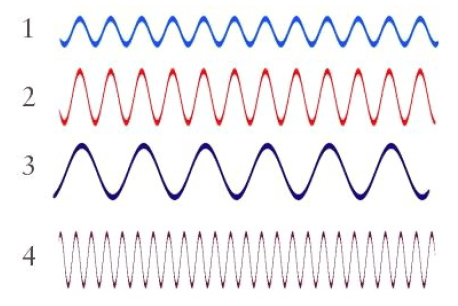

If the angle of incidence in the diagram is 80°, the angle of reflection will be:
10°
100°
90°
80°

