
 Worksheets
S7L1ab - Classification and Six Kingdoms
Total questions: 125
Worksheet time: 3hrs 41mins
Abigail and Arjun are curious about the smallest taxonomic group where organisms share many characteristics. Can you help them figure it out?
domain
kingdom
species
class
Anika and Aiden are curious about how scientists organize all the amazing living things on Earth. What is the science called that helps them describe, classify, and name these living things?
Geology
Biology
Taxonomy
Chemistry
Benjamin and Anika are curious about how scientists name living things. Can you help them out? The scientific name for an organism is made from the:
class and family name
genus and species name
domain and kingdom name
kingdom and phylum name
Samuel, Aiden, and Avery are playing a science quiz. They want to know: Which of the following is an example of a unicellular organism?
monkey
bacteria
spider
human

Avery, Benjamin, and Oliver are on a science adventure! They discover tiny, unicellular, prokaryotic organisms living in boiling hot springs and super salty lakes. What kingdom do these extreme-loving organisms belong to?
Animal
Archae
Bacteria
Plant

Ethan, Lily, and Arjun are on a science adventure! They discover a tiny creature that is prokaryotic and found everywhere—even in the most unexpected places. Can you help them figure out which kingdom this mysterious organism belongs to?
Bacteria
Archae
Fungi
Protista

Maya and Arjun found a mysterious organism growing on an old slice of bread. It's multicellular, a heterotroph, and has a cell wall made of chitin. Can you help them figure out which kingdom this organism belongs to?
fungi
plantae
animalia
bacteria
During a lively classroom debate, Daniel, Charlotte, and Luna are trying to figure out who first came up with the idea of binomial nomenclature to classify organisms. Can you help them solve this scientific mystery?
Carolus Linnaeus
Aristotle
Charles Darwin
Louis Pasteur
Olivia and Henry are learning about how scientists name living things. Binomial nomenclature is the ____________ system for naming organisms. Can you help them choose the right answer?
Numerical
Symbolical
two word
alphabetical
William, Aria, and Noah are exploring a forest using a dichotomous key. They notice that each question in the key offers four choices. Is this TRUE or FALSE?
TRUE
FALSE
Lily and Jackson are having a science debate! Which term means "True Nucleus" or refers to cells that have a nucleus?
Eukaryotes
Prokaryotes
Multi-cellular
Anika and David are exploring a magical forest and stumble upon some mysterious mushrooms. Can you help them figure out which Kingdom these mushrooms belong to?
Animalia
Protista
Archea
Fungi
Evelyn and Noah are sorting their toy collection. What is the word for arranging things into groups based on similarities?
Classify
Family
Kingdon
Orginize
Mason, Arjun, and Evelyn are exploring the world of biology! They want to know: What is the largest division used to classify living things?
Class
Domain
Genus
Species
Emma and Ethan are curious about scientific names! Emma thinks that an organism's scientific name tells you the family it belongs to, while Ethan disagrees. Who do you think is correct?
A
True or False: An organism's scientific name tells you the family in which the organism belongs.
True
False
Harper and Ava are exploring the world of science! They discover that an organism's scientific name reveals two important clues: the ________ and the ________ to which the organism belongs. Can you help them fill in the blanks?
genus, species
order, genus
family, species
class, order
Mason, Aiden, and Elijah are on a quest to organize the animal kingdom! Can you help them by choosing the correct order of the eight levels of classification?
domain, kingdom, class, phylum, family, order, genus, species
kingdom, domain, phylum, order, class, family, genus, species
domain, kingdom, phylum, class, order, family, genus, species
kingdom, domain, phylum, class, order, family, genus, species
Mason, Lily, and Nora are curious explorers in science class! They want to know: Humans belong to which domain?
Mammailia
Hominidae
Animalia
Eukarya
Zoe, Ava, and David are exploring the animal kingdom! They come across the scientific name Canis lupus. Can you help them figure out which word is the genus name?
Canis
lupus
Olivia, Grace, and William are curious about how biologists organize all the amazing living things on Earth. Can you help them figure out what biologists use to group living things?
Habitat
Size
Colors
Shared Characteristics
Evelyn and Elijah are working on their science project and want to write the scientific name of a plant correctly. Which of the following should they remember to do?
Genus Capitalized
Species Lowercase
Underline or Italics
All of the above
Henry and Olivia are on a nature adventure and come across a mysterious plant. They decide to use a dichotomous key to solve the mystery! What is the main purpose of a dichotomous key?
to find a common ancestor
to show the evolution of organisms
to show relationships between organisms
to identify organisms
Samuel, Isla, and Aria are on a nature adventure using a dichotomous key to identify mysterious creatures they find. What should they focus on to figure out what each organism is?
physical features
weather patterns
environment
diet
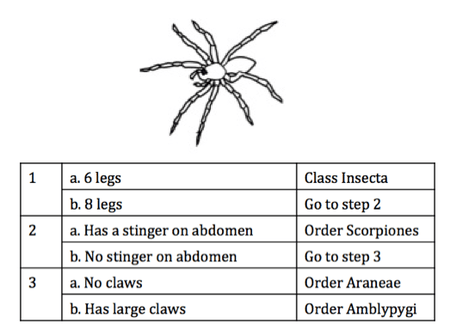
James, Henry, and Olivia are on a nature adventure and discover the mysterious creature shown in the illustration! Using the dichotomous key, help them figure out the correct classification for this organism. What do you think it is?
Class Insecta
Order Amblygygi
Order Araneae
Order Scorpiones

Emma, Henry, and Kai are hiking through the forest with a dichotomous key in hand. Suddenly, they spot a mysterious tree with large brown cones and single sharp needles. Can you help them figure out which species of tree they've discovered?
Juniper
Pine
Spruce
Fir

While exploring the school garden, Luna and Avery stumble upon a mysterious arachnid with a segmented abdomen, no tail, and covered in spines! Using the dichotomous key below, can you help them figure out which arachnid they've discovered?
Mite
Wind Scorpion
Daddy long legs
Scorpion
While exploring the school garden, Maya and Evelyn spot a mysterious arachnid with long legs and an unsegmented abdomen. Excited to solve the mystery, they grab the dichotomous key below to figure out what creature they've found. Which arachnid did Maya and Evelyn discover?
Mite
Wind Scorpion
Daddy long legs
Scorpion

Aria and James are exploring the world of insects using a dichotomous key. They discover an insect with two pairs of scaly wings! Can you help them figure out which order this fascinating insect belongs to?
Coleoptera
Heteroptera
Diptera
Lepidoptera
Avery and Isla are on a science adventure! They discover a kingdom that is made up of tiny, unicellular, prokaryotic organisms. Which kingdom did they find?
Bacteria
Protista
Fungi
Animalia
William, Elijah, and Liam are on a wild adventure! They spot tigers, jellyfish, gorillas, and sponges during their journey. All these creatures belong to which kingdom?
Animalia
Plantae
Fungi
Bacteria
Mia and Henry are exploring the school garden and spot daisies and oak trees. Which kingdom do these beautiful plants belong to?
Fungi
Plantae
Protista
Animalia
Avery and Liam are exploring the forest and spot some mushrooms and yeast. Can you help them figure out which group these belong to?
Fungi
Protista
Protista
Plantae
Animalia
Harper and William are exploring the jungle and spot different organisms. Which of these organisms feed on or consume other organisms? (Select all that apply)
autotroph
heterotroph
consumer
decomposer
Ava and Rohan are exploring a forest and notice some organisms breaking down dead leaves and logs. Which of the following types of organisms are they most likely observing? (Select all that apply)
autotroph
heterotroph
consumer
decomposer
Elijah and Michael are on a science adventure! They want to know which terms describe an organism that can whip up its own food (select all that apply).
autotroph
heterotroph
consumer
producer
James, Emma, and Aria are on a quest to organize the animal kingdom! Can you help them by choosing the correct order of the Linnaean Taxonomy Levels from the broadest to the most specific?
Kingdom, Phylum, Class, Order, Family, Genus, Species
Species, Genus, Family, Order, Class, Phylum, Kingdom
Phylum, Kingdom, Class, Order, Family, Genus, Species
Kingdom, Class, Phylum, Order, Family, Genus, Species
Sophia and James are exploring a magical garden filled with different living things. Which kingdom do the multicellular organisms that can perform photosynthesis belong to?
Animalia
Plantae
Fungi
Protista
Elijah, Evelyn, and Charlotte are curious about the world of living things! Why do you think biologists use a classification system to organize all the different organisms?
It helps in identifying and naming organisms.
It allows scientists to communicate more effectively about different species.
It helps in understanding the evolutionary relationships between organisms.
All of the above
Maya and Kai are on a nature walk and spot some mushrooms breaking down a fallen log. They wonder: Which of the following kingdoms is famous for having organisms that are primarily decomposers?
Plantae
Animalia
Fungi
Protista
Benjamin, Abigail, and Ethan are learning about the Linnaean classification system in science class. Which of the following is NOT a characteristic that scientists use in this system?
Physical characteristics
Genetic similarities
Behavioral traits
Habitat preferences
Oliver, Aria, and Isla are curious about how the invention of the microscope changed the way scientists classify living things. Can you help them figure out how microscopes influenced the classification of organisms?
It allowed scientists to see and classify microorganisms.
It led to the discovery of new kingdoms such as Protista and Fungi.
It provided more detailed information about the structure of cells.
All of the above
Michael, Aiden, and Ethan are exploring the world of taxonomy in their science class. They stumble upon Carl Linnaeus, a famous scientist. Why is Linnaeus considered a superstar in the field of taxonomy?
He developed the binomial nomenclature system.
He classified organisms based on their physical characteristics.
His system laid the foundation for modern biological classification.
All of the above
Oliver, Abigail, and Arjun are exploring the wonders of life on Earth! How has the six-kingdom system made their adventure even more exciting and helped them understand the amazing diversity of living things?
It has allowed for more precise classification of organisms.
It has helped in understanding evolutionary relationships.
It has provided a framework for identifying new species.
All of the above
Anika, Ava, and David are discussing the history of taxonomy in science class. Who do they discover created the most commonly used system of taxonomy?
Niels Bohr
Watson and Crick
Charles Darwin
Carl Linnaeus
Noah and Anika spotted a rat in their backyard and started wondering: What KINGDOM do rats belong to?
Protista
Fungi
Plantae
Animalia
Harper, Grace, and Daniel are learning about the characteristics of living things in science class. Which one of these is NOT a characteristic of living things?
All living things drink water.
All living things are composed of one or more cells.
All living things grow, develop, and have life spans.
All living things reproduce.
Avery and Kai are watching their pet cactus on the windowsill. They notice it slowly turning its spiky arms toward the sunlight streaming in. What characteristic of living things are they observing?
Responds to stimuli
Grow and develop
Evolution
Take in and use energy
Hannah and Ava are watching Elijah's dog play outside on a hot day. They notice the dog starts panting and leaves little wet paw prints on the sidewalk. What important characteristic of living things is the dog showing to keep cool?
Reproduce
Made of cells
Share similar chemicals
Homeostasis
Charlotte is playing with her baby sister, Nora. Whenever Nora hears Charlotte’s voice, she smiles brightly! In this situation, Charlotte’s voice is considered
stimulus
response
adaptation
resource
Oliver and Charlotte are curious about why their legs and arms get longer and stronger as they grow older. Which of the following characteristics of living things best explains this amazing change?
living things respond to their environment
living things maintain internal balance
living things are made of cells
living things grow and develop
Which of the following is not a characteristic of Archae?
single-cell
eukaryotic
extreme environments
cell walls, usually without peptidoglycans
Which is not a characteristic of fungi?
chitin in cells walls
all are heterotrophic
unicellular
may reproduce sexually or asexually
Which is not a characteristic of Kingdom Bacteria?
cell walls, usually without peptidoglycans
reproduce thru binary fission or conjugation
unicellular and prokaryotic
may photosynthesize or may be heterotrophic
Which is not a characteristic of Kingdom Plantae?
all are eukaryotes
all are multicellular
all have cell wall walls made of chitin
all are photoautotrophic
Which is not a characteristic of Kingdom Animalia?
may be unicellular or multicellular
all are eukaryotes
all are heterotrophs
most reproduce sexually, but not all
Which is not a characteristic of Kingdom Protista?
may or may not have cell walls
may photosynthesize or may be heterotrophic
unicellular or multicellular
reproduce asexually
Evaluate this statement: ALL protists are eukaryotes.
True
False
Evaluate this statement: Bacteria live ONLY in extreme environments.
True
False
Evaluate this statement: Kingdom Plantae organisms may reproduce sexually or asexually.
True
False
What would you rather do than take this exam?
Sleep
Eat chocolate ice cream
Go to DisneyWorld
No ... I'd rather take this exam.
True of False: The six-kingdom classification structure may change in the future.
True
False
What are the main type(s) of cells?
Prokaryotic Cells
Eukaryotic Cells
Prokaryotic and Eukaryotic Cells
Neither
Prokaryotes have NO...
Nucleus
Membrane Bound Organelles
They have both
They have neither
Eukaryotes DO have...
Nucleus
Membrane Bound Organelles
They have both
They have neither
Eukaryotic cells are more complex than prokaryotic cells.
True
False
Can not be determined

This is a...
Prokaryotic Cell
Eukaryotic Cell
Neither

A mushroom (a fungi) is an example of a...
Prokaryote
Eukaryote
Both
Neither

In what organelle is the genetic material found inside?
Endoplasmic Reticulum
Golgi Complex
Nucleolus
Nucleus

What organelle is called the "powerhouse" of a cell?
Endoplasmic Reticulum
Nucleus
Mitochondria
Nucleolus

Where does photosynthesis occur?
mitochondria
stomata
xylem
chloroplast
This organelle controls what goes in and out of plant and animal cells.
Cell Wall
Cell Membrane
Chloroplasts
Cytoplasm
Which statement is part of the cell theory?
All cells come from existing cells
All cells are prokaryotic or eukaryotic
All cells can make a tissue
All cells grow and develop
Which statement is part of the cell theory?
All cells can reproduce
All organisms are either unicellular or multicellular
All organisms are made of 1 or more cells
All cells grow and develop
Which statement is part of the cell theory?
All cells react to stimulus
The cell is the basic unit of all organisms
The cell can be large or small
The cell is either prokaryotic or eukaryotic
In what kingdom would you find trees and flowers?
Plantae (Plant)
Fungi
Eubacteria
Animalia

Archea...


What kingdoms have organisms that are prokaryotic? (hint: 2 correct answers)
Animal
Fungi
Bacteria
Archea

A pine tree is a member of the kingdom
Animalia
Protista (Protists)
Fungi
Plantae (Plant)

What kingdom has organisms that feed off dead or decaying organisms?
Plantae (Plant)
Fungi
Protista (Protist)
Archaebacteria
Which kingdom is known as the "odds and ends" kingdom?
Animalia
Plantae (Plant)
Protista (Protist)
Fungi
How many cells are found in Archae?
How do animals reproduce?
Sexually
Asexually
Both - Mostly Sexually but a few reproduce Asesually
Which kingdoms are in domain Eukarya?
Archaea and Bacteria
Plant and Animal
Protist and Fungi
Plant, Animal, Protist and Fungi

What kingdom am I? I am multi-cellular, eukaryotic and a heterotroph. Most members of my kingdom also move.
Plant
Fungi
Protist
Animal
following observations of the plant’s characteristics would be useful in determining its identity with a dichotomous key?
Which of the following characteristics will most likely be helpful in identifying a butterfly using a dichotomous key?
It migrates north in the summer
It has long tail
It likes only certain plants
Its wings beat very fast in hot weather
Which of the following characteristics would be useful in determining the identify of a tree in a dichotomous key?
It provides shade
It has a nest
It has several birds in it
Its leaves are long and narrow

What is insect B?
Bee
Ladybug
Firefly
Dragonfly

What type of characteristics are used to make a dichotomous key?
Characteristics that make an organism different from any other organism. (type of beaks, claws, root systems)
Characteristics like age of an organism
Where the organism lives
How many organisms live in the environment
How many options should every branch in a dichotomous key have?
1
2
3
4
The first part of the Scientific name (Genus) is always
lower case
capitaized
Which domain of prokaryotes is known to live in extreme environments and is distinguished by differences in genetics and cell wall makeup?
Bacteria
Genus
Archaea
Species
What is the term for the level of classification that contains similar species?
Domain
Genus
Taxonomy
Dichotomous Key
Which kingdom consists of complex, multicellular organisms that are usually green, have cell walls made of cellulose, and use the sun's energy to make sugar by photosynthesis?
Animalia
Plantae
Fungi
Protista
Which kingdom is mostly made up of one-celled eukaryotic organisms that are different from plants, animals, archaea, bacteria, and fungi?
Animalia
Plantae
Protista
Fungi
Which kingdom is made up of complex multicellular organisms that lack cell walls, can usually move around, and quickly respond to their environment?
Plantae
Protista
Fungi
Animalia
In a modern taxonomic system, which domain is made up of all eukaryotes?
Prokaryote
Eukarya
Protista
Animalia
What is a single-celled organism that does not have a nucleus or membrane-bound organelles called?
Eukaryote
Protista
Prokaryote
Fungi
Which kingdom includes organisms that have cell walls made of cellulose?
Animalia
Plantae
Fungi
Protista
Which kingdom includes organisms that reproduce by using spores?
Plantae
Animalia
Fungi
Protista
Sort the following statements based on if the statement is talking about prokaryotes or eukaryotes
A table comparing the characteristics of four samples is shown. Click on the sample name that is most likely a prokaryote.
Identify the type of cell each column represents.
Label correctly.
Prokaryote
Eukaryote
Select all the Eukaryotic Cells.

A model of a cell is shown. The cell is (a) because it (b) .
Choose the images that represent a Prokaryotic cell:

