
 Worksheets
General Chemistry Reviewer
Total questions: 115
Worksheet time: 2hrs 57mins
Which scientist discovered the electrons?
Dalton
Thomson
Atristotle
Bohr
Bohr discovered that electrons are located in
the nucleus
inside protons
electron cloud
circular orbits around the nucleus
The smallest particle of an element that still represents that element.
Nucleus
electron
proton
atom
What is a particle with one positive charge called?
proton
electron
neutron
quark
What is the center of an atom called?
nucleus
electron cloud
proton center
photon center
All matter is made of
energy
atoms
electrons
compounds
Who was the Greek philosopher who called the smallest particle of matter an "atom"?
Democritus
Aristotle
J.J Thompson
Einstein



The majority of an atom's mass exists where?
In the nucleus
In the electron cloud
In the space between the nucleus and the electrons
In the neutrons
In a combustion reaction one of the products is
a hydrocarbon
carbon dioxide
oxygen
nitrogen
How many single bonds will carbon look to make when it bonds covalently?
2
3
4
5
Which of the following elements does NOT form an ion with a charge of 2+?
Beryllium
Strontium
Magnesium
fluorine
When Alkali metals (Group 1) form ions, they ____.
lose 1 proton
gain 1 proton
lose 1 electron
gain 1 electron
Which of the following pairs of elements is most likely to form an ionic compound?
magnesium and fluorine
manganese and iron
oxygen and chlorine
sodium and aluminum
Which of the following shows correctly an ion pair and the ionic compound the two ions form?
Sn4+ and N3- form Sn4N3
Cu2+ and O2- form Cu2O2
Cr3+ and I- form CrI
Cr2+ and I- form CrI2
How many valence electrons are transferred from the sodium atom to fluoride in the formation of the compound sodium fluoride?
0
1
2
3
What is the chemical formula of sodium nitride?
NaN
Na2N
Na3N
NaN3
What is the balanced chemical formula of iron (II) oxide?
FeO
FeO2
Fe2O2
Fe2O
Select the correct formula for boron trichloride.
B2Cl
B3Cl
BCl3
BCl2
AlCl3 + Na(OH) → Al(OH)3 + NaCl
In the chemical equation above, NaCl is a ______.
Catalyst
Solvent
Product
Reactant
MgCl2 + Na ---> NaCl + Mg
What type of reaction is shown by the equation?
Combination/Synthesis
Decomposition
Single Replacement
Double Replacement
___Fe + ___O2 ---> ___Fe2O3
Which set of coefficients will correctly balance the equation?
Already Balanced (no coefficients needed)
2, 3, 4
4, 3, 2
3, 2, 2
How many chlorine (Cl) atoms are in 3MgCl2?
2
3
5
6
What type of reaction is electrolysis if its formula is:
2H2O → 2H2 + O2
Synthesis (Combination)
Decomposition
Single Replacement
Combustion
Branch of chemistry that deals with the quantitative measurements that can be determined using balanced chemical equations.
Physics
Inorganic Chemistry
Organic Chemistry
Stoichiometry
Stoichion means?
Element
Compound
Mixture
Solution
A unit of measurement for the quantity of a substance.
Mass
Density
Pressure
Mole
6.02 x 10²³
Mole Day
Avogadro's Number
Avodagro's Number
Mol Day
The sum of the atomic masses of all the atoms represented in the chemical formula of a substance.
Formula Mass
Percent Composition
Theoretical Yield
Percent Yield
Formula mass can also be called:
Molar Mass
Atomic Mass
Molarity
Atomic Weight
Can tell how abundant the element is in the compound.
Formula Mass
Percent Composition
Theoretical Yield
Percent Yield
Refers to the reactant that limits the yield of the product. It is also the reactant that runs out first and produced the LEAST amount of product.
Limiting Reagents or Limiting Reactant
Excess Reagent or Excess Reactant
The reactant that is left over and produced the GREATEST amount of product.
Limiting Reagents or Limiting Reactant
Excess Reagent or Excess Reactant
The amount that the limiting reactant produces.
Formula Mass
Percent Composition
Percent Yield
Theoretical Yield
The reaction 2ICl(s) ⇌ I2 (s) + Cl2 (g) is at equilibrium. Which change will increase the yield of Cl2
removing some of the I2 (s)
adding more ICl(s)
removing the Cl2 as it is formed
decreasing the volume of the container
Consider the equilibrium: 2 NO2 (g) ⇌ N2O4 (g) + energy. The equilibrium will shift to the left as a result of
adding a catalyst
increasing the volume
removing some N2O4
decreasing the temperature
The reaction CO(g) + 2 H2 (g) ⇌ CH3OH (g) + energy produces methanol. What will maximize the equilibrium yield of CH3OH ?
low temperature and low pressure
high temperature and low pressure
low temperature and high pressure
high temperature and high pressure
Consider the equilibrium: PCl5 (g) ⇌ PCl3 (g) + Cl2 (g). A 1 L flask contains 0,02 mol PCl5 , 0,05 mol PCl3 and 0,05 mol Cl2 at equilibrium. The value of Kc is …
0,125
2,50
5,00
8,00

Consider the equilibrium:
CH3COOH (aq) + H2O (l) ⇌ CH3COO− (aq) + H3O+ (aq) + heat
A stress was applied at time t1 and the data was plotted …
The stress is the result of …
the addition of HCl
decreasing the temperature
the addition of NaCH3OO
increasing the volume of the container
Consider the equilibrium: C(s) + 2 H2 (g) ⇌ CH4 (g). The addition of H2 will cause the equilibrium to shift to the …
left and [CH4] will increase
left and [CH4] will decrease
right and [CH4] will increase
right and [CH4] will decrease
Of the following equilibria, only __ will shift to the left in response to a decrease in volume …
4Fe(s) + 3 O2 (g) ⇌ 2 Fe2O3 (s)
H2 (g) + Cl2 (g) ⇌ 2HCl(g)
2 SO3 (g) ⇌ 2 SO2 (g) + O2 (g)
2HI(g) ⇌ H2 (g) + I2 (g)
The reaction is exothermic: 2 SO2 (g) + O2 (g) ⇌ 2 SO3 (g). Le Chatelier predicts that ____ will result in an increase in the number of moles of SO3 (g) in the reaction container.
increasing the pressure
increasing the temperature
removing some oxygen
increasing the volume of the container
3.45 liters of oxygen gas at STP?
2KClO3 (s) --> 2KCl (s) + 3O2 (g)
3.0 L. What is the new volume if the pressure increases to 303.9 kPa?
When CH3OH is dissolved in water, how many moles of particles does it put into solution?
1
3
4
5
6
At the same concentration, which of the following will depress (lower) freezing point the most?
C2H4O2
C12H22O11
LiBr
CaF2
What happens to the boiling point of water as a solute is added to it?
it increases (elevates)
it decreases (depresses)
it stays the same (constant)
At the same concentration, which of the following will elevate (increase) boiling point the most?
CH3OH
C6H12O6
KNO3
SrCl2
Rank the following solutes from least to greatest effect on freezing point:
KI, CH3OH, Li3PO4, CaCl2
KI, CH3OH, Li3PO4, CaCl2
Li3PO4, CaCl2, KI, CH3OH
Li3PO4, CH3OH, CaCl2, KI
CH3OH, KI, CaCl2, Li3PO4

Examine the models below. Assuming the same concentration, which would affect colligative properties more?
beaker A
beaker B
What happens to vapor pressure when you add a solute to a solution?
It lowers the vapor pressure.
It has no effect.
It raises the vapor pressure.
It causes the reaction to reach equilibrium.
Which of the following is an incorrect implication of the first law of thermodynamics?
The change in energy of a system is equal to the heat absorbed by the system and the work done on it.
It follows the law of conservation of energy.
Net change in energy can either be positive or negative.
Net change in energy is always negative.
Which of the following professions make great use of the study of the thermochemistry of food and the biochemical processes to establish the food intake and energy requirement of an individual?
Nutritionists and dieticians
Physical and occupational therapists
Physicians and Psychologists
Astronomers and Astrologers
Based on the formula q=mcΔT, what unit would specific heat have?
g/J°C
J/g°C
kJ/g
°C/gJ
For a group of particles enclosed in space, what would be the effect if more heat is supplied to the system?
They would slow down.
They would speed up.
They would stop moving.
There would be no effect.
In which way does heat flow?
Cooler to warmer
Warmer to warmer
Cooler to cooler
Warmer to cooler
The transfer of thermal energy between objects of different temperatures is called…
Heat
Temperature
Internal energy
Internal pressure
A chemical reaction that absorbs heat from the surroundings is said to be _____, and has a ______ ΔH at constant pressure.
Endothermic; positive
Exothermic; negative
Endothermic; negative
Exothermic; positive
The temperature of a glass of cold water will eventually…
Never change temperature.
Become warmer than the surrounding environment.
Always be colder than the surrounding environment.
Match the temperature of the surrounding environment.
Enthalpy is the energy absorbed or released during a chemical reaction as ___.
Light
Heat
Temperature
Sound
During an endothermic reaction in a beaker if we are part of the surroundings and touched the beaker, it would feel _______.
Warm
Moist
Cold
Slippery
4 PCl5 + 3438 kJ --> P4 + 10 Cl2
How much energy is required to produce each mole of chlorine?
687.6kJ
343.8kJ
859.5kJ
245.8kJ
As someone is running on the track, they begin to perspire. If the runner is our system, are they endothermic or exothermic?
Endothermic
Exothermic
H2 + 2C + N2 + 270.3 kJ --> 2 HCN
Is this reaction endothermic or exothermic?
Exothermic
Endothermic
Electrons always flow from
cathode to anode
anode to cathode
Oxidation occurs at the
anode
cathode
Electrons are gained at the
anode
cathode

Given their standard reduction potentials, which of the species is going to be oxidized?
Cu2+/Cu = 0.34V
Zn2+/Zn = -0.76V
Cu
Zn
CuSO4
ZnSO4
What occurs to the mass of copper electrode in the following reaction?
Zn/Zn2+ // Cu2+/Cu
increases
decreases
remains the same
Which metal is the negative electrode?
Zn/Zn2+ // Cu2+/Cu
zinc
copper
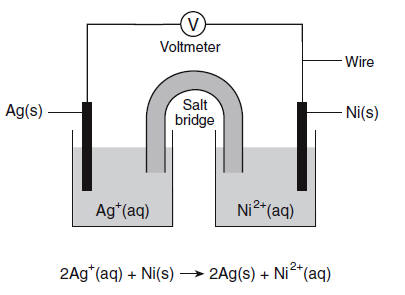
What reaction occurs at the anode?
Ag+/Ag = 0.80V
Ni2+/Ni = -0.25V
Ag+ + e- →Ag
Ag → Ag+ + e-
Ni2+ + 2e- → Ni
Ni → Ni2+ + 2e-
What would be the theoretical cell potential of the previous electrochemical cell?
Ag+/Ag = 0.80V
Ni2+/Ni = -0.25V
1.05V
-1.05V
0.55V
-0.55V

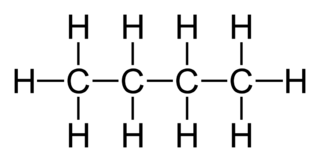
C3H8
Hydrocarbons burning is an example of what type of chemical reaction ?
neutralisation
endothermic
addition
exothermic

