
 Worksheets
Periodic Trends Review
Total questions: 75
Worksheet time: 41mins
Identify the following elements based on their electron configurations: a. 1s² 2s² 2p²
Carbon
Nitrogen
Oxygen
Identify the following elements based on their electron configurations: b. 1s² 2s² 2p⁴
Carbon
Nitrogen
Oxygen
As you go down a group on the periodic table, atomic radius __________.
Increases
Decreases
Which has a larger atomic radius? Li or Rb?
Li
Going left to right across a period, what happens to atomic radius?
It increases as protons are added to the nucleus
It decreases as protons are added to the nucleus
Atomic radius stays consistant across a period
Which has a larger atomic radius? Na or Ar?
Ar
Positive ions (cations) are _____________(larger or smaller) than the original parent ion.
Larger because they gained electrons
Smaller because they gained electrons
Smaller because they lost electrons
Negative ions (anions) are _____________(larger or smaller) than the original parent ion.
Larger, they have lost electrons
Larger, they have gained electrons
Smaller, they have lost electrons
Smaller they have gained electrons
Ionization energy is the energy needed to ________________ (add/remove) an electron from an atom.
Remove
Add
Across a period, ionization energy ________________ (increases/decreases) because the number of protons in the nucleus ________________ (increases/decreases) and pulls ________________ (more/less) on electrons in the electron cloud.
increases, increases, more
decreases, increases, less
decreases, increases, more
decreases, decreases, more
Down a group, ionization energy ________________ (increases/decreases) because there are ________________ (more/less) energy levels and the electrons are ________________ (closer to/further away from) the nucleus.
increases, less, further away from
decreases, more, further away from
increases, more, closer to
increases, less, closer to
Electron affinity is how much an atom “wants” to ________________ (gain/lose) an electron.
Across a period, electron affinity ________________ (increases/decreases).
Down a group, metals become ____________ (more/less) reactive because they can more easily ____________ (gain/lose) electrons.
more, gain
less, gain
more, lose
less, lose
Across a period, metals become ____________ (more/less) reactive because there are ____________ (more/fewer)protons pulling on their electrons.
more, fewer
less, more
more, more
less, fewer
Across a period, nonmetals become ____________ (more/less) reactive because they can more easily ____________ (gain/lose) electrons.
more, gain
less, gain
more, lose
less, lose
Which group are the halogens? Group # _______
7
1
none of these
Which group are the Alkali metals? Group # _______
10
2
17
1
Which group(s) are the transition metals? Groups _______ - ______________
1
13-18
1-2
Emma is studying the periodic table and wants to know how many valence electrons are in an atom of Ba. Can you help her?
2
8
4
1
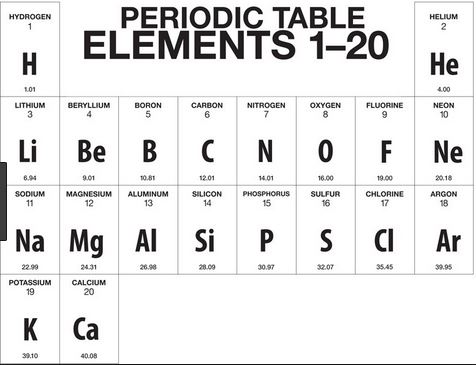
How many valence electrons does Oxygen Have?
4 Valence electrons
5 Valence electrons
6 Valence electron
7 Valence electrons
8 Valence electrons
Which one of the following has 4 electrons in its valence shell?
C
S
P
F
How many valence electrons does Na have?
11
2
1
7
Oxygen will ___________ electrons when forming an ion,
Gain
Lose
Potassium will ___________ electrons when forming an ion,
Gain
Lose
Bromine will ________ electrons when forming at ion.
Lose
Gain
Metal or nonmetal? F
Metal
Nonmetal
Metal or nonmetal? Rb
Metal
Nonmetal
Metal or nonmetal? Ba
Metal
Nonmetal
Metal or nonmetal? Ca
Metal
Nonmetal
Metal or nonmetal? Pd
Metal
Nonmetal
Metal or nonmetal? Ar
Metal
Nonmetal
Metal or nonmetal? Se
Metal
Nonmetal
Metal or nonmetal? S
Metal
Nonmetal
Metal or nonmetal? I
Metal
Nonmetal
Metal or nonmetal? N
Metal
Nonmetal
Metal or nonmetal? B
Metal
Nonmetal
Metal or nonmetal? Mo
Metal
Nonmetal
Which is more reactive? Br or Cl?
Br
Cl
Which is more reactive? Na or Cs?
Na
Cs
Which is more reactive? O or F?
O
F
Which is more reactive? Ca or Be?
Ca
Be
Which is more reactive? S or P
S
P
Which is more reactive? Zn or K
Zn
K
Which has a higher ionization energy? Br or F?
Br
F
Which has a higher ionization energy? N or O?
N
O
Which has a higher ionization energy? Li or Br?
Li
Br
Which has a higher electron affinity? F or Li?
F
Li
Which has a higher electron affinity? Rb or Na?
Rb
Na
Which has a higher electron affinity? P or Cl?
P
Cl
Which of the following shows the elements listed in order of increasing atomic size?
S, Cl, Al, Na
Na, Cl, Al, S
Cl, S, Al, Na
S, Al, Na, Cl
Which of the following lists the elements in order from biggest to smallest?
C, Ge, Si Pb
Pb, Si, C, Ge
Pb, Ge, Si, C
Which of the following elements is the largest? B, Pb, Cs, Ba
Ba
Pb
Cs
B
Which of the following has the highest ionization energy?
Be
Sr
Mg
Which of the following shows the elements in order of increasing ionization energy?
Bi, Ba, Cs
Cs, Ba, Bi
Ba, Bi Cs
Which of the following shows the correct order for the following elements for decreasing ionization energy?
S, Al, Na
Na, Al, S
Al, Na, S
Which has a higher electron affinity?
Cl
F
Which has a higher electron affinity?
C
N
Which has a higher electron affinity?
Mg
N
Which group are the halogens?
6
1
17
7
Which group are the Alkaline Earth Metals ?
4
2
12
17
What are valence electrons?
Electron configurations
Inner electrons
Outer shell electrons
Across a period, what happens to the number of valence electrons?
They increase
They decrease
What is atomic radius?
The size of an atom
The number of valence electrons
Left to right across a period, what happens to atomic radius?
It increases
It decreases
Down a group, what happens to atomic radius?
It increases
It decreases
What is ionization energy?
The energy it takes to gain/add an electron
The energy it takes to lose/remove an electron
Left to right across a period, what happens to ionization energy?
It increases
It decreases


The trend for ionization energy shows that
Carbon has a lower IE than Boron
Arsenic has a higher IE than Phosphorus
Silicon has a higher IE than Aluminum
Sodium has a higher IE than Chlorine

Potassium
Rubidium
Francium
Cesium

