
Font size
 Worksheets
Sun, Earth, and Moon Unit Review
Total questions: 53
Worksheet time: 57mins
What causes us to only see the same side of the Moon?
The Moon's tilt
The Moon's gravity
The Moon's rotation and revolution are at the same pace
None of the above


The event pictured at number 4, in the northern hemisphere, is the
summer solstice
winter solstice
autumnal equinox
vernal equinox

The events labeled 1 and 3 are called
solstices
equinoxes
How can it be summer & winter at the same time on the same planet?
one hemisphere is closer to the sun
one hemisphere is receiving the direct rays of the sun while the other is receiving indirect rays
one hemisphere has a path of warm winds from the north
the southern hemisphere balances out the temperatures for earth
What is the main cause of the seasons?
earth's tilted axis
earth's distance from the sun
earth's elliptical orbit
earth's rotation on its axis
What is the difference between rotation and revolution?
Rotation is the spin of the Earth. Revolution is the orbit of the Earth around the sun.
Revolution is the spin of the Earth. Rotation is the orbit of the Earth around the sun.
Rotation is the spin of the Earth. Revolution is how Earth orvits around other planets.

What season is it in Position A in the Northern Hemisphere?
Spring
Summer
Fall
Winter


If it's spring in the northern hemisphere at V, what season will the northern hemisphere be in at X?
winter
spring
summer
fall

In what position would the northern hemisphere need to be at to be in winter?
D
V
W
X

What season will come next in the norther hemisphere?
Summer
Winter
Spring
Fall

Which of the following best describes the tilt of the earth during the spring and fall equinoxes?
The earth is tilted away from the sun (Northern hemisphere)
The earth is tilted neither toward or away from the sun (tilt is side to side)
The earth is tilted toward the sun (Northern hemisphere)
The earth is not tilted during spring and fall
Which diagram best represents the tilt of Earth's axis that causes the Northern Hemisphere seasons shown? (Diagrams are not drawn to scale.)


Which of the following statements is true in the given photo?
only the southern hemisphere is experiencing day
part of the northern hemisphere is experiencing day and part is experiencing night
The northern hemisphere is experiencing day and the southern hemisphere is experiencing night
The northern hemisphere is experiencing night and the southern hemisphere is experiencing day
Which BEST describes the side of Earth that faces the sun?
The side of Earth facing the Sun is having Summer.
The side of Earth facing the Sun is having Winter.
The side of Earth facing the Sun is having day.
The side of Earth facing the Sun is having night.
When do spring tides occur?
During a new moon and full moon
During a first quarter moon and third quarter moon
When the Moon's gravity pulls on the Earth's ocean water
When the Moon is at right angles to the Sun and Earth
What is the difference between high tide and low tide during spring tides?
The high tide is higher than normal and the low tide is lower than normal
The high tide is lower than normal and the low tide is higher than normal
The high tide and low tide are at the same level
There is no difference between high tide and low tide during spring tides
When do neap tides occur?
During a new moon and full moon
During a first quarter moon and third quarter moon
When the Moon's gravity pulls on the Earth's ocean water
When the Moon is at right angles to the Sun and Earth
What is the difference between high tide and low tide during neap tides?
The high tide is higher than normal and the low tide is lower than normal
The high tide is lower than normal and the low tide is higher than normal
The high tide and low tide are at the same level
There is no difference between high tide and low tide during neap tides


When sea levels are higher than average what type of tide is occurring?
High Tide
Low Tide
Moon Tide
1st Quarter Tide

You visited the beach at 12 pm (lunchtime) and it is low tide. If you return 6 hours later, what tide will you see?
high
low
none
spring
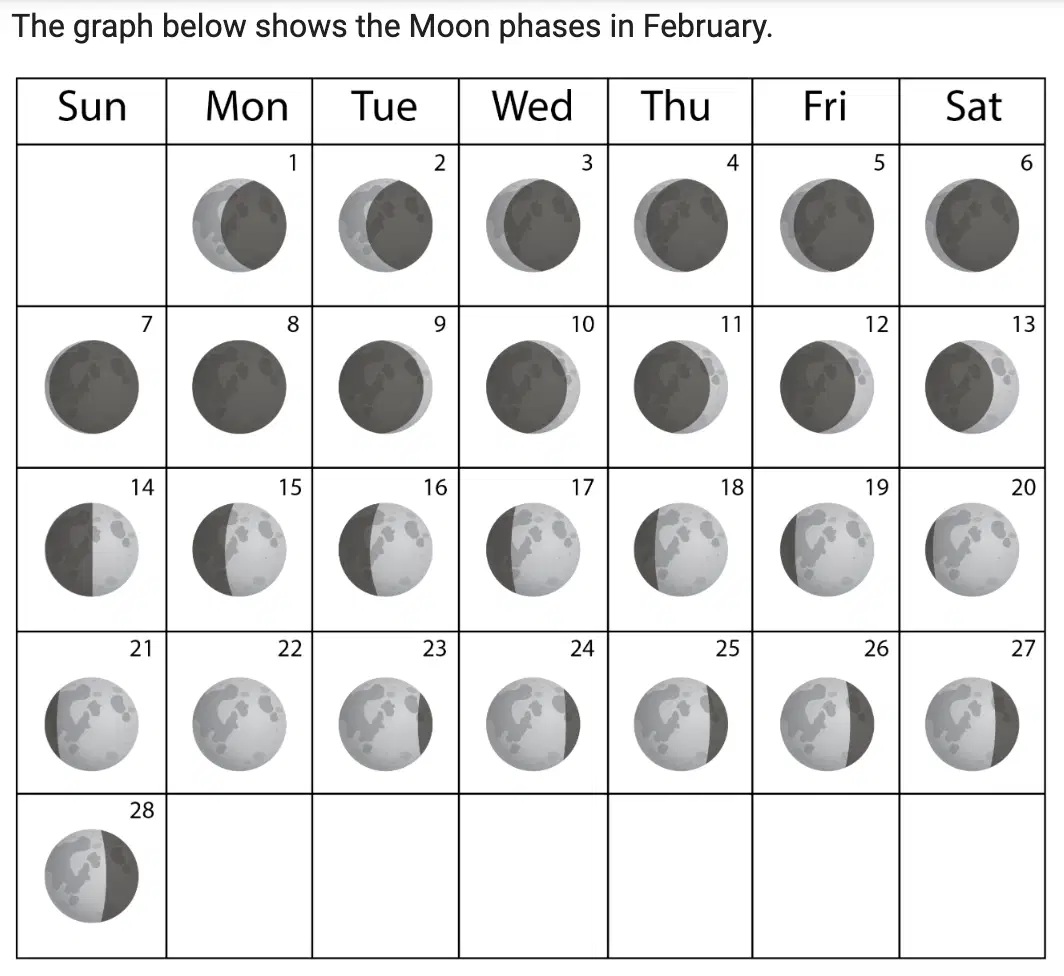
On February 14 you will experience a neap tide because...
neap tides happen in the middle of the month.
neap tides occur on full moons.
neap tides occur on new moons.
neap tides occur on quarter moons.

Using the lunar cycle diagram, at which two points will the oceans on earth experience spring tides?
Points A and E
Points B and H
Points C and G
Points D and F

What moon phase is shown in the picture?
first quarter
new moon
last quarter
full moon
Less than average tide occurring 1st and 3rd quarters of the moon
Neap Tides
Spring Tides
Seasons
Moon Phases

The diagram shows the alignment of the Sun, the Moon, and Earth during one of the Moon's phases.
Choose the correct phrase for each blank to correctly analyze the gravitational pull of the phase shown in the diagram and its effect on tides.
During the phase shown in the diagram, since the gravitational pull of the Moon and the Sun acts (a) to each other, it would result in (b) .

3.1 Consuela lives on the east coast of Florida where she notices a neap tide that occurs twice a month. Which two of the four Moon positions shown above will cause neap tides?
A. positions 1 and 2
B. positions 1 and 3
C. positions 2 and 4
D. positions 3 and 4

