Wayground logo

Free Printable Worksheets

Font size

S
M
L
XL
Worksheets

REG Chemistry Midterm Review

Total questions: 80

Worksheet time: 2hrs 44mins

Name
Class
Date
1.

Subatomic particles with a negative charge

a)

Electrons

b)

Neutrons

c)

Protons

d)

Quarks

2.
Subatomic particles with a positive charge
a)
neutrons
b)
atomic mass
c)
protons
d)
isotopes
3.
Subatomic particles that are neutral in charge
a)
Neutrons
b)
Protons
c)
Nucleus 
d)
Electrons
4.

Look at this picture of Argon off the periodic table. Which of the following is true for this element?

a)

18 protons

b)

40 protons

c)

22 protons

d)

21.9 protons

5.

Which part of an atom is used to identify it?

a)

number of protons

b)

number of neutrons

c)

number of electrons

6.

The atomic mass of an atom is equal to

a)

number of protons plus number of neutrons

b)

number of protons plus number of electrons

c)

number of electrons plus the number of neutrons

7.
The nucleus of an atom is made of
a)
electrons and protons
b)
electrons and neutrons
c)
protons and neutrons
d)
empty space
8.
Outside the nucleus of an atom are these
a)
protons
b)
neutrons
c)
quarks
d)
electrons
9.
The mass of this particle is so small that it is not counted.
a)
proton
b)
electron
c)
neutron
d)
quark
10.
The charge of the nucleus of all atoms or ions
a)
positive
b)
negative
c)
neutral
d)
sometimes positive and sometimes negative
11.
All atoms of a particular element have the same number of these
a)
electrons
b)
neutrons
c)
protons
12.
Which of these phrases best describes an atom?
a)
a positive nucleus surrounded by a hard negative shell
b)
a positive nucleus surrounded by a cloud of negative charges
c)
a hard sphere with postive and negative charges on the outside
d)
a negative nucleus surrounded by protons and neutrons
13.
What is true about an atom?
a)
Most of the space in an atom is taken up by the nucleus
b)
Atoms are mostly empty space
c)
Atoms have no mass
d)
Electrons have much more mass that protons or neutrons.
14.
The term "neutral" means
a)
having only a little bit of charge
b)
having a positive charge
c)
having a negative charge
d)
having no charge at all
15.

The smallest particle of an element.

a)

Element

b)

Molecule

c)

Atom

16.

The electronic configuration of an element QQ is: ...3s23p63d104s24p3. This means that the element QQ is...

a)

a d-block element

b)

a Group 13 element

c)

a Group 5 element

d)

a Group 15 element

17.

When a copper compound is heated strongly in a Bunsen flame, it emits a greenish-blue flame because...

a)

the copper atoms form copper ions

b)

the copper metal forms copper vapour

c)

energy is emitted by the electrons in the copper atoms

d)

energy is absorbed by the electrons in the copper atoms

18.

Which type of nuclear radiation is this?

a)

alpha emission

b)

beta emission

c)

gamma emission

d)

electron capture

19.
What particle completes this reaction?
a)
alpha particle
b)
beta particle
c)
gamma particle
d)
neutron
20.
What makes something radioactive?
a)
elements with an atomic number above 81
b)
an unstable nucleus
c)
contaminated sewage
d)
It decays over time
21.

Which particle has zero charge and mass?

a)

alpha particle

b)

beta particle

c)

gamma particle

d)

electron

22.
Which type of radiation has the greatest penetrating power?
a)
Alpha
b)
Beta
c)
Gamma 
d)
Microwaves
23.
The technetium-99 isotope has a half-life of 6.0 hours. If 100.0 mg were injected into a patient how much remains after 18 hours?
a)
33.0 mg
b)
12.5 mg
c)
.33 mg
d)
15.8 mg
24.

How close a measurement is to the true value is called..

a)

Accuracy

b)

Precision

c)

Significant

d)

Estimate

25.
When a measurement is repeatable and consistent it is said to have...
a)
High precision
b)
Low precision
c)
High accuracy
d)
Low accuracy
26.
How many sig. fig. are in the number below:
350.540
a)
4
b)
5
c)
6
d)
7
27.
How many sig. fig. are in the number below:
0.0005
a)
1
b)
2
c)
3
d)
4
28.
Round 1047.78 to three sig figs
a)
104
b)
105
c)
1050
d)
1050.00
29.
How many Significant Figures in the number below?
4.56 x 10³
a)
5
b)
4
c)
6
d)
3
30.
Convert 30 cm to m:
a)
300
b)
3
c)
0.03
d)
0.3 m
31.
6,000 milliliters = ______ liters
a)
60
b)
600
c)
6
d)
6,000
32.
What atom matches this electron configuration?
1s22s22p63s23p64s23d10
a)
Zinc
b)
Copper
c)
Nickel
d)
Germanium
33.
Which electron configuration belongs to Chlorine (Cl)?
a)
1s2 2s2 2p6 3s2 3p5
b)
1s2 2s2 2p6 3s2 3p6
c)
1s2 2s2 2p6 3s2 3p7
34.
How many electrons can the d sublevel hold?
a)
14
b)
10
c)
2
d)
6
35.
How many electrons can the s sublevel hold?
a)
14
b)
10
c)
2
d)
6
36.

Choose the correct shortcut configuration for iodine.

a)

[Ar]4s24d104p5

b)

[Kr]5s24d105p5

c)

[Xe]5s25d105p5

d)

none of the above

37.

Each row on the periodic table represents:

a)

an energy level

b)

a sublevel

c)

an electron

d)

an orbital

38.

Which area on the periodic table represents the electrons in the "d" sublevel?

a)

representative elements

b)

columns 3-8

c)

rare earth elements

d)

transition elements

39.

Energy levels are denoted by:

a)

letters

b)

numbers

c)

a combination of letters and numbers

d)

subscripts

40.
This orbital diagram represents:  
a)
C
b)
B
c)
N
d)
O
41.
Which element is pictured?
a)
neon
b)
fluorine
c)
magnesium
d)
argon
42.

Valence electrons are located...

a)

inside the nucleus

b)

in outer space

c)

on the outermost orbit of an atom

43.
24.1% of all the isotopes of a an element have a mass of 75.23 amu, 48.7% have a mass of 74.61 amu, and 27.2% have a mass of 75.20 amu.
What is the average mass of this element?
a)
74.92 amu
b)
24.97 amu
c)
75.01 amu
d)
74.51 amu
44.
4.35% of all X atoms have a mass of 39.946 amu. 83.79% have a mass of 41.941 amu, 9.50% have a mass of 42.941 amu, and 2.36% have a mass of 43.939 amu. What is the average atomic mass of atom X?
a)
41.97 amu
b)
42.19 amu
c)
10.43 amu
d)
40.04 amu
45.

The frequency of violet light is 7.5x10¹⁴ Hz. What is its wavelength?

a)

4.0x10⁻⁷ m

b)

4.0x10⁷ m

c)

2.25x10²³m

d)

2.25x10²³ Hz

46.

Red light has a wavelength of 675 x 10-9 m. What is its frequency?

a)

2.03x10¹¹ m

b)

4.44x10¹⁴ Hz

c)

4.44x10¹⁴ nm

d)

2.03x10¹¹ Hz

47.

What is the speed of light?

a)

3.0x10⁸ ms

b)

3.0x10⁸ m/s

c)

6.626x10⁻³⁴ Js

d)

6.626x10⁻³⁴ J/s

48.

Ground state means that an electron is...

a)

at its lowest possible potential energy

b)

in the first shell of an atom

c)

laying low for the weekend

d)

removed from an atom

49.

In order to go from ground state to an excited state, an electron must

a)

emit energy

b)

absorb energy

c)

rotate

d)

wiggle

50.

When an electron returns to ground state from an excited state, the atom will

a)

emit energy

b)

absorb energy

c)

rotate

d)

wiggle

51.

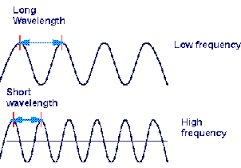
Wavelength and Frequency are related in that...

a)

they are always the same

b)

when one increases, the other decreases (inversely proportional)

c)

there is no correlation

d)

they both vary in an irregular pattern

52.

Which of the following electromagnetic waves has the lowest frequency?

a)

gamma ray

b)

infrared wave

c)

visible light wave

d)

microwave

53.
As you move down a group, atomic radius increases because - 
a)
you add more and more neutrons
b)
you add more and more protons
c)
you add more and more shells (energy levels)
d)
you add more atomic mass
54.
As you move across the periodic table from left to right, the atomic radius decreases.  This is because - 
a)
the number of protons increases, so attraction to electrons increases
b)
the number of energy levels increases
c)
the number of electrons increases
d)
the atomic mass increases
55.
The atom with the largest atomic radius in Period 4 (row 4) is - 
a)
K
b)
Kr
c)
Fe
d)
Fe
56.
Francium (Fr) has the lowest ionization energy in Group 1 because - 
a)
it has the smallest number of valence electrons
b)
it has the greatest atomic mass
c)
it has the greatest number of protons, so it attracts its electrons the strongest
d)
its 1 valence electron is very far from the nucleus, so little energy is needed to remove it
57.
What is the name of family I
a)
Alkaline Earth Metals
b)
Boron Family
c)
Alkali Metals
d)
Halogen Family
58.
Families all have similar 
a)
Names
b)
atomic numbers
c)
atomic masses
d)
properties
59.
Noble gases are characterized by...
a)
High reactivity
b)
Being solid at room temperature
c)
Low ionization energy
d)
Full valence shell of electrons
60.

Of the halogens, which has the smallest radius?

a)

F

b)

Br

c)

He

d)

At

61.
Ionization energy is...
a)
the energy required to add an electron to a specific atom
b)
how much energy it takes to remove an electron from an atom
c)
the energy required to shield the outer electrons from the nucleus
d)
a measure of the ability of an atom to attract electrons
62.

The tendency of an atom to attract a shared pair of electrons

a)

Atomic Radii

b)

Ionization Energy

c)

Electronegativity

d)

Electron Afinity

e)

Oxidation Number

63.

Valence electrons are involved in the formation of a chemical bond

a)

True

b)

False

64.

When 2 atoms share electrons

a)

Ionic bond

b)

covalent bond

c)

metallic bond

65.

Chemical bond formed from the electrostatic attraction between positive and negative ions

a)

covalent bond

b)

ionic bond

c)

metallic bond

66.

Which of the following is NOT an example of a molecular formula?

a)

H2O

b)

B

c)

NH3

d)

O2

67.
Which is the correct name for CaBr2?
a)
Calcium Bromine
b)
Bromine Calcium
c)
Calcium Bromide
68.
The chemical formula of carbon tetrachloride is
a)
CCl
b)
C₄Cl
c)
CCl₄
d)
C(IV)Cl
69.
The chemical formula of dinitrogen textroxide is
a)
Ni₂O₄
b)
NiO
c)
N₂O₄
d)
NiO₂
70.
This picture shows a...
a)
Ionic Bond
b)
Covalent Bond
c)
Both bonds
d)
Neither bond
71.
This picture shows a...
a)
Ionic Bond
b)
Covalent Bond
c)
Both bonds
d)
Neither bond
72.
What two types of measurements make up DENSITY? 
a)
Mass and Volume
b)
Temperature and Mass
c)
Grams and Centimeters
d)
Volume and Weight
73.

A bar of copper has a mass of 216g and a volume of 24 cm3. What is the density of copper?

a)

9g/cm3

b)

5184g/cm3

c)

.11g/cm3

d)

322mL

74.
Jack has a rock. The rock has a mass of 14g and a volume of 2cm3. What is the density of the rock?
a)
7 mL
b)
7 g/cm3
c)
28 g/cm3
d)
1/7 g/cm3
75.

What unit is used to measure mass?

a)

cm3/g

b)

g

c)

g/cm3

d)

cm3

76.
What units are used to measure Density?
a)
cm3/g
b)
g
c)
g/cm3
d)
cm3
77.

What units are used to measure Density?

a)

mL/g

b)

g

c)

g/mL

d)

mL

78.

What units is used to measure volume?

a)

mL/g

b)

g

c)

g/mL

d)

mL

79.

An irregularly shaped rock was lowered into a graduated cylinder holding a volume of water equal to 50 ml. The height of the water rose to 75 ml. If the mass of the stone was 250 g, what was its density?

a)

15 g/mL

b)

3.3 g/mL

c)

10 g/mL

d)

20 g/mL

80.
A mechanical pencil has the density of 3.000 g/cm3.  The volume of the pencil is 15.8 cubic centimeters.  What is the mass of the pencil?
a)
47.4 g
b)
50 g
c)
0.190  g
d)
5.27 g