
 Worksheets
Mid-Term Review
Total questions: 141
Worksheet time: 2hrs 38mins
Total distance an object travels with direction.
Displacement
Distance
Path
Velocity
What is the correct unit for distance?
m or km
d or kd
s
N
What is the correct unit for velocity?
m/s2
mi/hr
d/t
m/s
An airplane accelerates down a runway at 3.20 m/s2 for 8 s until it finally lifts off the ground.
Determine the velocity at take-off.


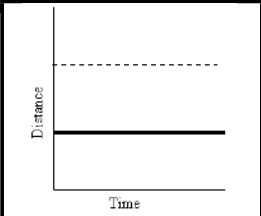
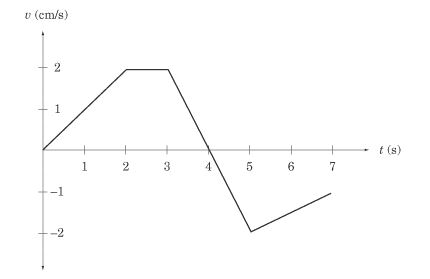
What is happening between 2 and 3 seconds?
The object is not moving.
The object is not accelerating.
The object is slowing down.
The object is speeding up.


What is the formula for speed?
speed = distance x time
speed=distance / time
speed = time / distance
speed = distance + time


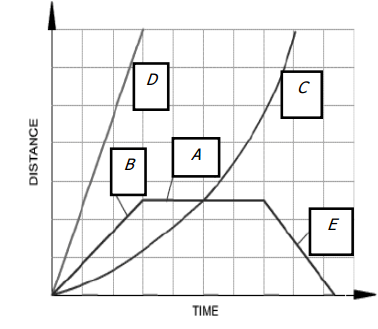
How would you walk to produce this graph?
walk away slow for 4 minutes, stand still for 4 minutes, walk away fast for 2 minutes
walk away slow for 2 minutes, stand still for 2 minutes, walk away fast for 6 minutes
walk toward slow for 4 minutes, stand still for 4 minutes, walk toward fast for 2 minutes
walk away at increasing speed for 4 minutes, stand still for 4 minutes, walk away with increasing speed for for 2 minutes

What is your velocity in segment B of the graph?
0 m/s
10 m/s
2 m/s
6 m/s

Which line segment show your speed is zero?
A
B
C
D

Which line segment shows increasing speed?
A
B
C
D
In science, __________________________ is defined as a change in position.
motion
potential energy
evaporation
sublimation
The SI unit for distance is the ______________________________.
millimeter
foot
meter
gram
_____________________________________is a measure of the change in velocity of a moving object
acceleration
speed
distance
displacement
The formula for calculating velocity is
velocity=timedistance
velocity =distancetime
velocity = timeacceleration
velocity =accelerationtime

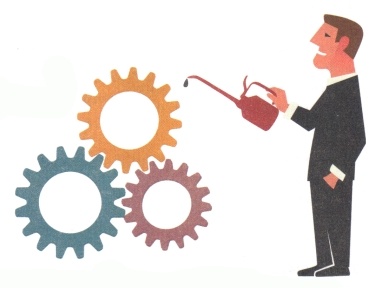
When looking at friction problems, if the net force in the x-direction on an object is zero, what can we say about its acceleration?
it is positive
it is negative
it is zero
not enough information is given

Which type of friction is shown in the picture?
fluid
static
rolling
sliding

Which type of friction is shown in the picture?
rolling
static
fluid
sliding

This photo represents...
Air resistance
water resistance
friction force between 2 solid bodies

Which boy A or B will slide down faster
A
B
A and B
A hard wood floor has more friction than a carpet.
true
false

Why is it important for basketball players to wear shoes with tread when playing?
to increase the speed of the player
to decrease the force between the player and the floor
to decrease the amount of force needed for the player to move
to increase friction between the floor and the player’s feet

Rough surfaces have _________ compared to smoother surfaces.
greater friction
less friction
the same level of friction
no friction
Match the following Types of Friction to their descriptions

Static Friction

Sliding Friction

Fluid Friction

Rolling Friction


The information you collect while doing your experiment is called
conclusions
data
hypotheses
procedures
What is the last step of scientific method?
hypothesis
observe
communicate
question
The information you collect while doing your experiment is called
conclusions
data
hypotheses
procedures
Which sentence is the claim?
Read each statement and match with the correct C-E-R method.
Plastic bottles should be completely banned.
Claim
Based on a study by USC, "every year billions of plastic bottles are landfilled, incinerated, or dumped in the ocean, where they leach pollutants into our water, air, soil, and food."
Evidence
This proves that plastic bottles should be completely banned because plastic bottles ruin our environment.
Reasoning
What does CER stand for?
Claim Evidence Reasoning
Chart Evidence Resource
Claim Events Resource
Claim Evidence Reject
What is the purpose of reasoning when writing a scientific argument?
To link the claim and the evidence.
To give more detail.
To learn how to write better.
To score high on a test.
Is this statement a Claim, Evidence, or Reasoning? "The Earth is round."
Claim
Evidence
Rasoning
Claim, Evidence, or Reasoning? "More accidents happen during full moons, because emergency rooms are full then."
Claim
Evidence
Reasoning
Which of the following is an example of quantitative evidence?
65 degrees Fahrenheit
Warm temperature
Cool temperature
A changing temperature.
Commonly conducted to test a hypothesis
variable
science
data
experiment
A summary of findings
variable
conclusion
experiment
data table
Most scientific investigations begin with this
variable
conclusion
question
science
Factor that is being tested
experiment
data
variable
controlled experiment
Any food we eat is a type of....
Thermal Energy
Chemical Energy
Mechanical Energy
Nuclear Energy
The moving of electrons is which type of energy?
Radiant
Nuclear
Electric
Thermal
Which of the following is not a form of radiant energy?
Microwaves
Gamma Rays
Visible light
Sound Waves
electrical energy
mechanical energy
thermal energy
nuclear energy
Kinetic Energy is the energy of _________
thermal
movement
potential
atoms
Which process is used by nuclear power plants to produce low cost, long lasting energy?
Nuclear fission
Neutron combination
Nuclear fusion
Nuclear detonation
Energy is the ability to do __________
bonds
work
atoms
molecules
What is potential energy?
moving energy
stored energy
renewable energy
non renewable energy
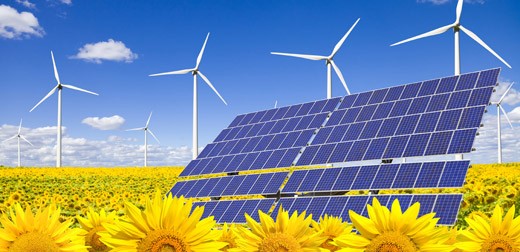
This alternate energy generates electricity by turning on the turbine through falling water stored from a dam
solar energy
nuclear energy
geothermal energy
hydroelectric energy
What is the main component of a photovoltaic system that converts sunlight into electricity?
battery
solar panel
wind turbine
solar plate
Renewable energy resources produce less_____________ than fossil fuels.
pollution
energy
wind
light
What is a geothermal heat pump?
A machine that extracts heat from the air to provide heating
A system that uses water from a river to cool down a building
A device that uses the heat from the sun to warm up a building
A heating and/or cooling system that uses the constant temperature of the earth as the exchange medium.
"Geo" means? "Thermal" means?
Earth and Cold
Earth and Heat
Sun and Heat
Sun and Cold
Two Disadvantages of Solar Power are:
It is polluting
It is not always sunny out
It is inefficient (nor fully utilizing the Sun's energy)
It cannot be stored at all.
What are some concerns about building dams to create hydropower? Check all that apply.
Dams change the environment.
There are no concerns.
Dams change fish swimming patterns.
Dams store too much water.
Why are fossils fuels so widely used?
They are renewable so they won't run out.
They pollution they produce is less compared to renewable energy sources.
They are easy to obtain and process.
They don't disrupt the environment when mined from the earth.

Which of these problems could happen if we don't look after the resources we have?
Loss of animal homes
Climate change
Increase in pollution
All of the above

Which of the following is a renewable energy source?
Natural Gas
Coal
Oil
Geothermal

Energy from the sun is ___________________.
hydroelectric energy
geothermal energy
solar energy
wind energy
What charges do protons have?
Positive
Negative
None
Both
What charges do Neutrons have?
Positive
Negative
Both
None
What charges do Electrons have?
Positive
Negative
None
Both
What is Conductive?
Materials that are easy for Electrons to flow through
Materials that are hard for Electrons to flow through
What is Insulative?
Material that is hard for electrons to flow
Material that is easy for electrons to flow
All of these materials are considered Conductive. EXCEPT...
Silver
Metal
Paper
All of these materials are considered Insulative. EXCEPT...
Rubber
Glass
Copper
Charges added to a conductor quickly spread over the surface of the object.
True
False
Electric charge is neither created nor destroyed; it is conserved.
True
False
Electric charges exist within atoms.
True
False
A series circuit has more than one path for the electric current to follow.
True
False
Like charges attract, whereas opposite charges repel.
True
False
A(n) ___ is described as a flow of charged particles.
resistor
electric current
electric circuit
resistance
A circuit that has two or more separate branches for current is a ___.
parallel circuit
series circuit
circuit diagram
electron circuit
Transferring charge by touching or rubbing is called ____.
a. charging by contact
b. convection
c. insulation
d. none of these
Electric charge that has accumulated on an object is referred to as ____.
a. circuit electricity
b. current circuit
c. current electricity
d. static electricity
An area with excess electrons has a net ____ charge; an area with a deficit of electrons has a net ____ charge.
a. negative, positive
b. positive, negative
c. positive, neutral
d. negative, neutral
Resistance is measured in a unit called the ____.
a. ampere
b. watt
c. ohm
d. volt
Lightning is ____.
a buildup of neutrons
harmless
a buildup of protons
a large discharge of static electricity
Normally, atoms are electrically neutral because there are ____.
more protons than electrons
more electrons than protons
equal numbers of protons and neutrons
equal numbers of protons and electrons
Voltage difference is measured in ____.
volts
amps
ohms
watts
When no current flows through a circuit, it's called a(n) ____.
open circuit
series circuit
parallel circuit
bummer

Similar charges ___
attract
repel
create atoms
attract and repel
Different charges ___
attract
repel
create atoms
attract and repel

An unbalanced negative or positive electric charge on an object is called ___.
electric current
electricity
static charge
charged object

How many ohms are in this resistor?
1
12
13
10

ANSWER ONLY WITH NUMBERS and the prefix k or M (if necessary): A 4-band resistor colored green, blue, brown, gold has a value of...
(a)

ANSWER ONLY WITH NUMBERS and the prefix k or M (if necessary): A 4-band resistor colored orange, white, orange, gold has a value of...
(a)

ANSWER ONLY WITH NUMBERS and the prefix k or M (if necessary): A 4-band resistor colored brown, red, yellow, gold has a value of...
(a)
What are the first three bands of a
yellow, violet, brown
yellow, blue, orange
orange, violet, yellow
yellow, violet, orange
What are the first three bands of a
brown, brown, brown
brown, black, black
brown, black, brown
black, black, brown
What are the first three bands of a
red, yellow, red
red, violet, red
red, violet, orange
orange, blue, brown
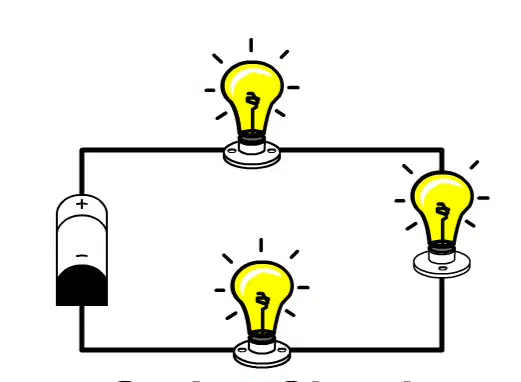
What type of circuit is shown in the example?
Series circuit
Parallel circuit
Mixed circuit
Open circuit
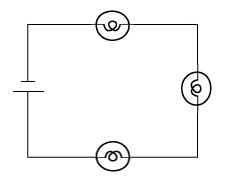


What is the purpose of a breadboard?
To protect LEDs
To connect wires in a circuit
To solder electronic components
To hold batteries
What happens if you connect the battery to the LED backwards?
The LED won't light up
The LED will be brighter
The LED will burn out
The LED will change color
What is the path made for an electric current called?
electric current
an insulator
a conductor
a circuit

How many light bulbs would be ON if the wire of this circuit was cut where the scissors are?
1
3
2
0

